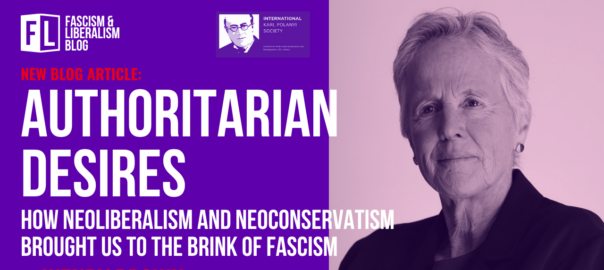

Authoritarian desires
How Neoliberalism and Neoconservatism Brought Us to the Brink of Fascism
by Wendy Brown
04.06.2026
How did authoritarianism become desirable for ordinary people in formerly liberal democracies? In this blog article, Wendy Brown traces two governing rationalities that have been central in shaping popular tolerance for Trump’s attacks on democracy: neoliberalism and neoconservatism. While neoliberalism eroded democratic values by naturalizing markets and traditional morality, neoconservatism promoted a strong state, including militarism at home and abroad, and normalized regime change. Moreover, neoconservatism forged a distinct identity for middle- and working-class adherents, displacing class and upward mobility with religion, family, and nation. According to Brown, understanding these political subject formations is key to addressing the anti-democratic turn and articulating emancipatory forms of belonging.
The following article is an adaption of Wendy Brown’s keynote address at the Historical Materialism Conference 2025. It was edited by Maie Klingenberg.
The Puzzling Desire for Authoritarianism
We know that authoritarian politicians today anoint wounds, mobilize fears and resentments among working– and middle-class populations, while enabling oligarchic control of the levers of government. But how do we explain the popular tolerance, and even enthusiasm, for dismantling democracy? How do we explain the support for soldiers and tanks in cities, and masked ICE agents invading schools, workplaces and homes, tackling old people and grabbing children? For state takeovers of cultural institutions and universities dictating what is doable and sayable? For trampling the Constitution while amplifying the power of capital, lining the pockets of the already rich, and cutting what remains of social benefits after decades of neoliberal slash-and-burn? Why are so many accepting this conduct?
In the following, I identify what I deem some of the most important forces behind the rapid consolidation of authoritarianism in the US. My analysis concentrates on two different governing rationalities de-democratizing the state and the citizenry: neoliberalism and neoconservatism.
Far from identical or even commensurate, these two forms of reason together tilled the popular ground for an authoritarian state and yielded Project 2025, the playbook for much of what the Trump regime is doing. From dismantling the Department of Education to voter suppression, from mass firings of federal workers to undoing the basic institutions of liberal democracy via both nuanced legal maneuvers and bold power grabs – as well as renewed imperial domination in all parts of the globe.
At 600 pages, Project 2025 is the most thorough plan for state-animated transformation of the political, cultural, social, and economic life that any liberal democracy has so far known – and neoliberalism and neoconservatism are at its heart. This claim will seem curious to many at first blush: neoliberalism is frequently declared to have suffered near-death blows from right-wing retorts to globalization – from ethnonationalism to tariff wars – and also from left-liberal efforts to revive the big state. At the same time, neoconservatism is conventionally regarded as history, left behind by the discredited Middle East wars, the rise of the Tea Party, and MAGA. Yet, the American present is profoundly shaped by the bastard legacies of both.
Neoliberalism: Markets and Morality as a Natural Order
At the level of economic policy, neoliberalism meant deregulation, privatization, regressive taxation, financialization, assaults on unions, and offshoring of jobs. Together, these exacerbated wealth inequality, stymied upward mobility, and throttled middle- and working-class existence, producing an economic populism that the entire right spotted and mobilized well before the center left did. At the level of political rationality, neoliberalism did something equally profound: it undermined the very idea of democracy – attacking its principles, its jurisprudence, and the idea of a social compact – even legislated justice.
Neoliberal reason naturalizes both markets and traditional morality, casting them as neither born from human minds or intentions nor as planned or engineered. Although markets may require state support, they are seen as emerging naturally and spontaneously. By contrast, democratic legislation is cast as emanating from an idea of “the good” imposed from above and thus intervening in these natural and spontaneous orders. Neoliberalism thus opposes active democratic practices, especially legislated ones, as it makes support for markets and traditional morality, along with national defense, the only legitimate domestic state practice.
With its privileging of capital accumulation, its dismemberment of society into individual units, its disintegration of the social compact, and its economization of politics, neoliberalism is an inherently anti-democratic force. By advancing the “equal right to inequality” and reducing freedom to the ability to buy, sell, and plunder, it has profoundly shaped the popular receptivity to authoritarian statism we see today.
Neoconservatism: Fighting the Redistributive, Anemic State
As neoconservatism is the lesser known of the two rationalities, I will explore it in more depth. Neoconservatism emerged in the 1970s, influenced by intellectuals such as Irving Kristol and Leo Strauss. Soon supported by secular cold warriors, Jewish and Christian religionists, and family moralists of all types, it had become mainstream in the Republican party by the 1990s. Neoconservatism is conventionally thought to have peaked in the early 2000s and then to have crashed after the second Bush administration, discredited by the quagmires in Afghanistan and Iraq for which its leading figures such as Paul Wolfowitz and Dick Cheney were responsible. Additionally, it was challenged by the Tea Party movement, with its principles of small government, fiscal austerity, and anti-regulatory libertarianism. However, we are not living with Tea Party politics today; MAGA is a descendent of neoconservatism even if MAGA leaders deny this. So we need to understand: how did neoconservative principles soak into the fabric of American political culture and life in general, and the Republican Party in particular?
Neoconservatism responded to the upheavals of the 1960s and 1970s with the diagnosis that capitalism – for all its glories and achievements – has a downside: It frays the moral and cultural fabric of a people and discredits authority, producing individual licentiousness and indulgence, cultural decadence, liberation movements, and fractured families. Moreover, according to the neoconservatives, capitalism pushes the state in the wrong direction, promoting states that are redistributive and internally and externally passive and anemic.
So neoconservatism offers a political balancing practice. It endorsed strong states that would put this strength to use both at home and abroad, that would align with and empower corporations and replace “decadent” popular culture with a culture rooted in traditional values: religion, heteronormative families, and manliness. It further advocated transforming education, especially at the university level, and fostering – in schools and civic life more broadly – the values of patriotism, militarism and support for wars of regime change.
At the heart of the neoconservative project was the aim of linking state power and morality for both domestic and international purposes. This moral-political project not only departed significantly from the neoliberal rationality taking shape in the same period, but also from classic conservatism and its belief in limits, moderation, and the aristocratic virtues of rectitude, civility, education, and discipline.
Neoconservatism: The Making of a Post-Class Identity
In abandoning these values, neoconservatism accomplished two ends. Firstly, whereas the Republican party had long been regarded as the home of the educated and wealthy, it now became incredibly attractive to working class men, especially amidst globalization and disinvestment in education. Secondly, neoconservatism was ready to battle with “its gloves off”, that is, without regard for liberal democratic norms or processes. Breaking with the old conservative attachment to a modest and small state, neoconservatives affirmed the values of authority and hierarchy, avowing the use of state power to shape the nation and the globe. It took the Republican Party in a direction that was not conservative, but right-wing and authoritarian, blasting past the party’s classic commitment to constitutional democracy, fiscal responsibility, unrestricted liberty, and isolationism in relation to foreign affairs.
In its place, neoconservatism installed the precept of a big powerful state, including an anti-democratic judiciary, with current Supreme Court justices such as Antonin Scalia and Clarence Thomas shaped by neoconservatism’s philosopher-king Leo Strauss. Moreover, it aimed at repressing “decadent culture”, seeking to influence school curriculums, regulate hip hop, and outlaw porn. Neoconservatism also installed the principle of robust foreign policy – one that would reassert American empire, including devotion to Israel and active efforts at regime change to “spread American values around the world”.
In addition to legitimating authoritarian statism and imperialism, this project politicized family, religion, and education by tightly fusing them with Americanness and patriotism. Those who held traditional values were interpolated as true American patriots, tacitly and later explicitly demonizing the rest as un-American. Vilifying ordinary liberal democrats as radicals, terrorists, and dangers to the republic became a common strategy for right-wing leaders.
Crucially, neoconservatives bound together family, religion, nation, and patriotism in a way that made economic precarity fall out of the picture. As unions were being destroyed, jobs outsourced, public education privatized, and upward mobility and access to cosmopolitanism removed, neoconservatism produced a distinctive identity for the working and middle class – an identity that was devoid of the concept of class. The promise of jobs and upward mobility – once a central part of post-war American capitalism – was now being replaced by God, family and country. Increasingly this bound working- and middle-class populations – those who brought Trump to power – to the authority and hierarchy of church, traditional family, and the neoconservative version of the state.
Neoconservatism: The Normalization of Regime Change
While few call themselves neoconservative anymore, we live with the legacy of three neoconservative decades. Three decades during which the neoconservative vision – a powerful state, traditional values at the heart of the nation, militarism abroad, and intensified policing in American cities – became normalized as mainstream conservative politics. Above all, neoconservatism legitimated regime change, which – while briefly discredited by Iraq and Afghanistan – was bound to come home, and is now being applied to the American republic.
Regime change for the United States is what the 900 pages of Project 2025 map and detail. That document specifies exactly what to do and how to do it, just as the Bremer orders – the 100 governing principles for Iraq after Saddam Hussein was toppled – provided details of regime change and the making of a new state, culture, and political economy for that country. In the case of Iraq, the design was for a relentlessly neoliberal order with a finesse of liberal constitutionalism. In the case of Project 2025, it is for a right-wing authoritarian order that transforms the liberal democratic state and its institutions, political economy, and culture.
At the Brink of Fascism: Possibilities of Turning Back
To conclude, over the past decades, with neoliberalism’s naturalization of markets and traditional morality, its economization of the principles of democracy, its tarring of democratic legislation as totalitarian social engineering, combined with neoconservatism’s affirmation of strong state power, hierarchy, authority, and binding of traditional values to patriotism, the ground was tilled for turning a population against its own class interests and in favor of an authoritarian state.
It is important to pay attention to political subject formations like these if we are to get our analysis and organizing right. Those who voted for Donald Trump and continue to support him are more than dethroned white workers manipulated by autocrats or bewitched by right wing media. We need to understand what these historical political formations legitimated and normalized, what they delegitimate, hystericize, and marginalize, and what desires, communities, and attachments they produce.
Zohran Mamdani showed us how to address and begin to transform this formation by treating affordability and the right to the city as a non-radical value, even, we might say, a traditional one. To quote Zohran, “the people who work and raise families in New York City need to be able to live here.” Day after day during his campaign, he repeated his mission to make New York City a collective object of love and belonging – one that belongs to the people, not the billionaires. Mamdani revived patria in its original Latin sense: not as loyalty to an abstract nation defined by flags or militarism, but as a lived attachment to the city – something collectively built, cared for, and protected. He is especially brilliant at linking principles across the local to the global: New Yorker’s right to live in New York is no greater and no lesser than Palestinians right to live in Palestine. After several decades of driving toward fascism, his campaign showed us a way back from the brink.

Wendy Brown is a political theorist and Professor Emerita of Political Science at the University of California, Berkeley. Brown holds an endowed professorship at the Institute for Advanced Study in Princeton.
Further Readings
Brown, Wendy (2023): Nihilistic Times: Thinking with Max Weber. Harvard University Press.
Brown, Wendy (2019): In the Ruins of Neoliberalism: The Rise of Antidemocratic Politics in the West. Columbia University Press.
Brown, Wendy (2015): Undoing the Demos: Neoliberalism’s Stealth Revolution. Zone Books.
Photo Credit
Nando Ochando