Tag Archives: Trump

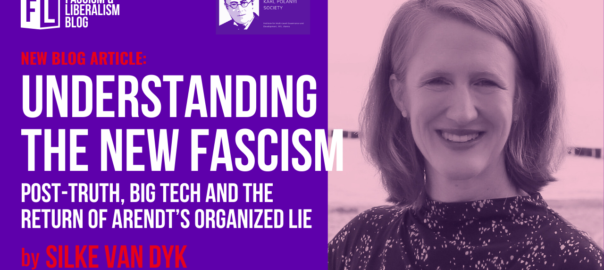
title page for the F&L blog post "Understanding the new fascism" by Silky van Dyk

F&L Blog – Understanding the New Fascism

Understanding the New Fascism: Post-Truth, Big Tech and the Return of Arendt’s Organized Lie

by Silke van Dyk

12.03.2026

Trump II is far more than just a radical version of the first administration. Rather, we are confronting a deeper transformation of the political itself, writes Silke van Dyk. The flooding of public discourse with right-wing populist falsehoods that defined Trump’s first term has given way to a more far-reaching manipulation of public opinion. This is further reinforced by the rise of digital capitalism and its neo-feudal concentration of power and resources. As such, van Dyk argues we are seeing a return of Hannah Arendt’s “organized lie” – the ongoing and deliberate manipulation of opinion and knowledge – a defining feature of totalitarian regimes. But countering this new fascism will require more than fighting fake news. It means liberal democracies must also address their own inconsistencies

With the first and second election of Donald Trump, the Brexit referendum, the rise of right-wing parties across numerous countries, the influence of conspiracy narratives during the COVID-19 pandemic, and the momentum of climate change denial, a new political era has taken shape – one in which the right is increasingly challenging liberal hegemony. Alongside the resurgence of racist, nationalist, and chauvinist politics, public discourse itself has undergone a marked transformation. We are witnessing a proliferation of falsehoods, conspiracy theories, and half-truths, often coupled with hostility toward science and intellectuals. Political deception, of course, is nothing new. What is new, however, is its sheer volume, the speed of its dissemination, and the striking fact that exposure no longer appears to damage its authors. Whereas Richard Nixon was forced to resign in 1974 following the revelation of his lies in the Watergate scandal, Trump returned to the White House for a second term despite his countless false statements. 

Traditional versus Organized Lies

The classic definition of the lie is that of an intentional act in which the perpetrator is quite capable of distinguishing between the true and the untrue and deliberately makes a false statement. The publication of the Pentagon Papers[i] prompted Hannah Arendt to re-evaluate this traditional lie, and to contrast it with what she termed the “organized lie”. According to Arendt, “the difference between the traditional lie and the modern (organized) lie will more often than not amount to the difference between hiding and destroying.”[ii] While the traditional lie revealed itself because the yardstick of truth remained intact, this no longer applies to the organzied lie, since it changes the overall context in such a way that the lie becomes a substitute for reality.

According to Arendt the organized lie destroys, our “sense by which we take our bearings in the real world”[iii]The organized lie is a demanding practice: it requires the power to eliminate or refashion all contrary evidence – documents, testimonies, witnesses, even history books – so that reality itself is consigned to a form of orchestrated oblivion. Unsurprisingly, such practices are most characteristic of authoritarian and totalitarian regimes. As a central example, Hannah Arendt points to the Stalinist effort to erase all traces of Leon Trotsky from everyday life, education, and cultural memory.  

If, according to Arendt, actors lack the power needed for the organized lie, with its inherent shift away from reality, they increasingly fall back on the mode of opinion, claiming the right to freedom of expression: “The blurring of the dividing line between factual truth and opinion belongs among the many forms that lying can assume.”[iv] To take just one example: it is one thing to conclude from the Fukushima nuclear disaster that Germany’s energy policy did not require revision – this would constitute a legitimate political opinion. It is quite another thing to deny the disaster itself in order to preserve nuclear energy – and to justify that denial in the name of free speech. The latter amounts to erasing the boundary between fact and opinion. To avoid any misunderstanding: Hannah Arendt consistently defended the value of opinion and warned that truth turns despotic when it supplants politics. At the same time, she made unequivocally clear that democratic contestation presupposes a shared sense of reality, which forms the indispensable basis of political struggle. Without it, public debate deteriorates into cynical relativism – a danger against which Hannah Arendt forcefully warned. 

Trump I: The Populist Play With Truth

Arendt reminds us: "The ideal subject of totalitarian rule is not the convinced Nazi or the dedicated Communist, but people for whom the distinction between fact and fiction (i.e. the reality of experience) and the distinction between true and false (i.e. the standards of thought) no longer exist.”

Echoing Friedrich Nietzsche’s dictum that truth is “the obligation to lie according to a fixed convention”[v], Trump & Co lied in open defiance of convention.[vi] The falsehoods were so frequent, so blatant, and so inconsistent that their inaccuracy were most often immediately apparent. Many of these statements were situational and contradictory, loosely connected rather than embedded in a coherent worldview. In Trump‘s first term, the surrounding context remained largely intact; indeed, the point was to flaunt the possibility of dismissing that context as the ‘deceptive reality’ constructed by allegedly left-liberal elites. In this configuration, being accused of lying poses no threat to the liar. On the contrary, it serves as proof of the critic’s elite status. 

Deliberate fabrications or organized lies were less a threat to empirical realities than the elevation of mere opinion. When Trump once speculated that U.S. unemployment might be as high as 42% he did not challenge the official rate of 5.3% by criticizing statistical methods or narrow definitions of unemployment. Instead, he countered a verified figure with an opinion, citing unnamed sources and invoking the right to free speech. In its first phase, the Trump system thus sought to circumvent the established procedures of truth verification in liberal democracies. Yet the countless falsehoods of Trump I had another effect as well: they generated lasting confusion, thereby paving the way for authoritarianism. As Hannah Arendt observed: “The ideal subject of totalitarian rule is not the convinced Nazi or the dedicated Communist, but people for whom the distinction between fact and fiction (i.e. the reality of experience) and the distinction between true and false (i.e. the standards of thought) no longer exist.”[vii]

Trump II: The Fascist Return of the Organized Lie

From the outset of his second term, Trump and his circle made utterly clear that they would not simply replicate the first. Immediately after the inauguration on January 20, 2025, the new president signed numerous executive orders, including pardons for convicted Capitol rioters, withdrawal from the World Health Organization (WHO), and the elimination of birthright citizenship for U.S.–born children of non-citizen parents. Although the January 2025 inaugural address carried unmistakable populist overtones – Trump accused “a radical and corrupt establishment” of having “robbed our citizens of power and wealth” for years – the speech, and even more so the administration’s first-year policies, revealed distinctly fascist-like features.  

"The manipulation of knowledge production and dissemination [...] all testify to a new form of control over education, culture, and science. [...] this represents a renewed deployment of the organized lie with its characteristic power to derealize"

This has resulted in the further radicalization of the extreme nationalist MAGA (Make America Great Again) project, paired with the construction of Trump as a Führer-like figure divinely chosen to end the “terrible betrayal” of international forces against the American people. Glorification of violence appears in the widespread imagery of deportations of alleged gang members, the repeated calls to expand the death penalty, and the brutal conduct of U.S. Immigration and Customs Enforcement (ICE), with its increasingly paramilitary characteristics. Migrant communities, queer people, and scientists are cast as enemies from whom the American people must be “saved.” 

Concrete measures quickly followed: deportations, emergency legislation at the Mexican border, the elimination of the third-gender option on official documents, cuts to diversity programs, and sweeping restrictions on academic freedom. The manipulation of knowledge production and dissemination, the suppression of unwelcome research in climate, health, and diversity, and political interference in the governance and direction of cultural institutions all testify to a new form of control over education, culture, and science. School curricula, museums, and public libraries are seeing the increasing removal of references to the crimes of slavery and the history of racism. Government agencies are currently deleting photographs and documents that record the service of women and people of color in the military or critically examine U.S. military actions. In the terms of Hannah Arendt, this represents a renewed deployment of the organized lie with its characteristic power to derealize: inconvenient facts, evidence, and scientific knowledge are no longer merely challenged with opinion – they are actively manipulated, and the records themselves, destroyed. 

Big Tech as Agents of Fascist Derealization

The newfound alliance between Silicon Valley tech giants and Trump & Co. has accelerated this trend, visible in every inauguration photograph, with the heads of Meta, Google, X, and Amazon seated in the front row. It proved highly convenient for the Trump administration that the fact-checking measures temporarily introduced on Facebook and Instagram to curb fake news and conspiracy theories vanished immediately after the inauguration. Likewise, Google promptly – and illegally – implemented Trump’s order to rename the Gulf of Mexico the “Gulf of America”, at least within the U.S. The fragmentation of the public sphere in the digital economy corresponds to the concentration of power in the hands of a handful of ultra-wealthy private entrepreneurs, who, as enablers of fascistleaning governments, have become key agents of derealization. Artificial intelligence is increasingly deployed to reshape the state in anti-democratic ways: deepfakes can be used to discredit political opponents, while evidence of corruption and illegal government actions are likewise dismissed as false, fabricated by the liberal elite. The fascistlike return of the organized lie thus brings derealization into reality – something that even Hannah Arendt and George Orwell could hardly have imagined: a neofeudal, privately controlled capacity, enabled by new technologies, to artificially remake the very representation of the world. 

The Liberal System Must Confront Its Own Inconsistencies

"the liberal 'postpolitics' of inevitability bears at least partial responsibility for the rise of rightwing forces that manipulate reality and advance their own anti-elite narratives"

One obvious response to these developments would be to bring communication and information infrastructures under public ownership and democratic control – rather than subject to the priorities and profit motives of a handful of multi-billionaires. Yet to do so requires understanding why the “offer” of rightwing and fascist politicians appeal to so many. This means examining the functional deficits of liberal democracies. At a time when liberal elites often celebrate the primacy of truth, they frequently overlook their own problematic handling of facts. For decades, they have presented certain realities as immutable constraints, while promoting radical market and austerity policies as inevitable and beyond debate. 

Hannah Arendt emphasized that political thinking operates between two risks, “the danger of taking [facts] as the results of some necessary development which men could not prevent and about which they can therefore do nothing, and the danger of denying them, of trying to manipulate them out of the world”[viii]. To understand the complex picture we face today, it is crucial to connect these two dangers and recognize that the liberal “postpolitics” of inevitability bears at least partial responsibility for the rise of rightwing forces that manipulate reality and advance their own anti-elite narratives. It is true, in other words, that “those at the top lie” when they claim there is no alternative. It becomes particularly dangerous when the necessary vigilance against the right blinds us to the functional deficits of liberal democracy and economy – the unfulfilled promises, technocratic tendencies, and socioeconomic failures that have brought us to the present moment. Even more perilous is the call to end debates among democrats in the face of the rightwing threat. Yet democratic public life depends on political contestation, including vigorous debate over what an anti-fascist social and economic policy should look like – a question that now, more than ever, must concern all democrats. 


Silke van Dyk Headshot

Silke van Dyk is a professor of Political Sociology at Friedrich Schiller University Jena. Her main research areas are the sociology of social inequality, the sociology of social policy and the welfare state, the sociology of aging and demography, and perspectives of social critique.

References

  • i The Pentagon Papers are a formerly secret document produced by the US Department of Defense, whose serial publication by the New York Times in 1971 revealed the feeding of false information to the US public concerning the Vietnam War.
  • ii Hannah Arendt (1969) Truth and Politics. In: Hannah Arendt, Between Past and Future: Eight Exercises in Political Thought, New York, p. 227-264 (here: 253).
  • iii Ibid., p. 257.
  • iv Ibid., p. 250.
  • v Friedrich Nietzsche (1988) Kritische Studienausgabe, Vol. 1, Berlin/New York, p. 881 (own translation).
  • vi For a detailed analysis, see Silke van Dyk (2022): „Post-Truth, the Future of Democracy and the Public Sphere”, in: Theory, Culture & Society, 39 (4), pp. 37-50.
  • vii Hannah Arendt (1958) Origins of Totalitarianism, Cleveland/New York, S. 474.
  • viii Hannah Arendt (1969) Truth and Politics, p. 259.

Related Posts

title page for the F&L blog post "Property Damages" by Jacob Blumenfeld

F&L Blog – Property Damages

Property Damages

by Jacob Blumenfeld

13.02.2026

Does private property secure freedom, or train us for domination? In this article, philosopher Jacob Blumenfeld traces how liberal ownership rights shape social relations, trigger ecological conflict, and foment authoritarian desires. His claim is not that all forms of private ownership corrupt individuals. Rather, he argues that the specific legal form of liberal property rights – granting exclusive control over socially necessary resources – enables relations of power, resentment, and authority that prime authoritarian movements. In an age of climate crisis and deepening inequality, the future hinges on the question of how property relations are organized: for private ends – or for social needs.

In a speech on January 21st in Davos, Donald Trump asked, rhetorically, in relation to Greenland: “Who wants to defend something on a lease?” To defend something, he implied, one must first own it. The need for protection becomes the justification for possession. Trump’s remark expresses a familiar liberal conviction: authority appears legitimate when grounded in ownership, and ownership is only legitimate if you take on ‘responsibility’ and can defend it. Property rights, thus, do not only allocate resources, they allocate decision-making power. Whoever owns decides; others adapt. This article examines the ideological roots of such thinking and discusses the political consequences of that ordinary arrangement posing the question: does owning property make you more prone to fascism? Does acquiring a taste of sovereign authority over an external thing slowly translate into a desire to dominate people as well? If you treat the world fundamentally as property, characterized by the right to use and abuse things at will, then isn’t it only a matter of time before you overstep the boundary between thing and person?

Property is Power

If slavery is the origin of property rights, as David Graeber once argued, then being a property owner is an education in dominion, the authority to dispose over what is mine by commanding the wills of other people. The right to an external thing is a license to treat others in certain ways in relation to the thing at hand. My legally sanctioned authority over this land, these assets, and those machines gives me the legitimate power to determine how others may or may not use them, irrespective of the social consequences. Treating something as property flattens the salient normative distinctions between items of personal use, societal infrastructures, natural landscapes, and means of production, as if they could all be simply mine or yours, ours or theirs, without further thought. Property is power over people, masked as a relation of power over things. Whether a pair of shoes or a pair of companies, a piece of land or a piece of writing, I can develop or destroy what’s mine as I see fit. Whether the air is polluted, food wasted, tenants evicted, or ecosystems plundered, that is not my concern. Freedom trumps consequences.

Liberalism is founded on the right to private property, but private property is also what breaks liberalism. For what better way than owning property is there for learning how to be a dictator? If this is true, then the bedrock of liberal freedom is made from the same material as the authoritarian longings it is supposed to ward off. Or maybe we have it backwards. Does not owning property make you more prone to fascist tendencies? If you don’t have anything at all to call your own, does that make you jealous of those who do? Resentful, hateful, you see others as threats or competitors, as rivals scrambling for scarce jobs, limited resources, and even romantic companions. Dependent on bosses, managers, and landlords, you despise those not above you—you want to be them—but those beside you and below you. They are the ones taking your job, raising costs, committing crimes. Squeezed between employers and unemployed, between owners and beggars, you seek an outlet for affirming your unrecognized status, for exercising the power of possession over property you don’t have. A class of vulnerable people—women, migrants, minorities—fills the void of property and upon them you exert your dominion. But resentment does not remain a private feeling—it seeks a public form. It looks for a figure who can promise to restore what should be yours, someone who can bring back greatness, who can give you a share of domination as compensation for a share of ownership.

The Liberal Paradox of Private Property Rights

Damaged subjects, damaged objects, damaged society—property leaves wreckage in its wake, whether you have it or you don’t. But what is property after all? And isn’t this about private property, not property as such? The term property can refer to a thing that is owned, to rules of ownership, or to the right to control the use of something. Ownership usually entails rights of exclusion: the authority to legitimately exclude others from determining the use of something, including the right to possess, to control, to sell, to destroy, and so on. Private property—as opposed to public, common, open access, social and other forms of ownership—grants the authority to decide on the use of something to a single person, although “person” here is not a human being, but a juridical category. This right to exclude others from having a say in determining the use of goods is the anti-democratic core of liberal democracy, and it is morally permitted due to the alleged gains that private property contributes to securing individual freedom and fostering economic efficiency.

"Property organizes our ethical relations, our ecological conditions, and our subjective identities. It habituates us to a grammar of command and deference"

But private property is not a simple one-way relation between owner and owned. Rather, the relation extends in multiple directions out from the self: from self to others, from self to world, and from self to self. Property, in other words, is a social relation, a world relation and a self-relation. It shapes how we relate to each other, how we treat nature, and how we treat ourselves. Property organizes our ethical relations, our ecological conditions, and our subjective identities. It habituates us to a grammar of command and deference. While owning personal possessions need not be problematic, at the societal level, private control over infrastructure, housing, or productive assets magnifies the dominating, sovereign power of private property over social life. That is why it’s so important to prevent social property relations from being structured in ways that are beyond democratic control. Letting private persons with ownership rights determine the fate of the natural environment, visual media, medical developments, or technological investments, to name a few, can cause immense damage not only to social institutions and complex ecosystems, but also to the psychological well-being of individuals themselves.

The paradox is that liberal property rights, in their very atomism, bind human beings together on a planetary scale through our forced inclusion in global markets. We are individually empowered to exclude each other, yet collectively unable to escape one another. Therein lies the dual power of property rights: separating us in ways that foster regression and binding us in ways that elicit material transformation.

Critical Property Theory

There has been a renaissance of critical property theory in recent years. Eva von Redecker has shown how authoritarian tendencies emerge as a kind of reflexive phantom possession over amputated rights to dominate others. Daniel Loick argues that property rights themselves deform the subjects who exercise them, and thus demands a non-appropriative relation to the world. Brenna Bhandar has traced the colonial violence embedded in legal techniques of property such as title by registration, while Robert Nichols has demonstrated how states create property through acts of dispossession. Across these approaches, a common theme emerges: property is not a neutral legal tool but a central site of social conflict, whether over housing, data, land, finance, and the environment, or wherever we have a stake in determining the boundaries of mine and yours.

"To treat nothing as property would block the will’s need to externalize itself. But to treat everything as property would be a scandal for ethical life, reducing all relations to the grammar of possession."

This insight has deep philosophical roots. Hegel described property as an “external sphere of freedom,” the domain in which the free will gives itself objective form in the world and can be recognized as such by others. For Hegel, property is a necessary but still one-sided realization of freedom. It must be taken up into richer ethical and political relations—family, civil society, and the state—if freedom is to acquire substance and direction. To treat nothing as property would block the will’s need to externalize itself. But to treat everything as property would be a scandal for ethical life, reducing all relations to the grammar of possession.

The political stakes of this ambiguity become stark in moments of crisis. In a 1934 essay on the relation between liberalism and fascism, Herbert Marcuse highlighted the property-centered definition of liberalism offered by Ludwig von Mises: liberalism, according to Mises, can be summed up in a single word—property, specifically private property in the means of production. From this premise follows both an unqualified defense of capitalism and a qualified tolerance for authoritarian rule, insofar as it is seen as a temporary bulwark against socialism. When property becomes the supreme value, the line between defending freedom and excusing domination grows perilously thin.

Max Horkheimer captured the view from below with brutal clarity: for those who live at the sharp end of economic power, liberal and authoritarian regimes often blur together. What changes is not the experience of hunger, police, or compulsion, but the language in which these realities are justified.

Liberal Property and Authoritarian Politics

A contemporary echo of this logic surfaced in Trump’s recent Davos speech, cited at the top. Ownership in Trump’s liberal-fascist rhetoric is bound explicitly to protection, and protection is bound to war—both legally and psychologically. What is not asked is what should be defended by whom in the first place. The fact that property must be defended is taken as retroactive justification for making it “mine.” Whether concerning oil, airspace, land, or minerals, the right to determine the use and abuse portions of the world as one’s property is the underlying premise of geopolitical struggle. Trump just made it explicit.

Also in Davos, Canadian prime minister Mark Carney defended what he calls the ‘liberal international order’ against Trump’s openly proprietarian language. Yet the contrast is less absolute than it appears: the liberal world order has long protected property claims through sovereignty, contracts, and international law, thereby limiting open territorial conflict while simultaneously enabling asymmetric control over resources, labor, and development across the global economy. Recognition and domination formed two sides of the same structure: internally pacified through rights, externally extended through markets, finance, and extraction.

"[...] conflicts increasingly appear in direct form as disputes over entitlement - who may dispose over shared conditions of life, and who must adapt."

Whether in Ukraine, Venezuela, or Gaza, it seems as if the recognition of formal property rights has suddenly ceased to play a role in geopolitics. But what is changing is not the respect for property as an international principle altogether, but the weakening of the discursive and juridical mediation around which property was previously organized. As the language of sovereignty loses its stabilizing force, conflicts increasingly appear in direct form as disputes over entitlement – who may dispose over shared conditions of life, and who must adapt. Those who have the power to take and defend property with force increasingly shape the future of the planet. Breaking the capacity of these claims to determine our collective fate for the gain of a few at the expense of the many is one of the defining political tasks of our time.

Under conditions of ecological crisis, these dynamics intensify further still. As material conditions deteriorate, struggles over access to energy, housing, water, and security sharpen. Claims of “mine” and “yours” harden, becoming less negotiable and more willing to enlist authoritarian means—which is what we are arguably witnessing in international politics already. Managing a declining economic order becomes a central political problem. If investment, infrastructure, and resource allocation remain governed primarily by markets and private rights, the burdens of transition will be distributed through mechanisms that amplify inequality, exclusion and violence. Demands for protection slide into demands for war.

Socialization or Regression

If authoritarian tendencies are rooted in the contradictions of liberal property rights, familiar liberal remedies, such as more rights, better juridical procedures and stronger institutions are unlikely to suffice. As long as the external sphere of freedom remains privately monopolized, the gap between formal equality and material power will continue to generate political and affective pressures that can be mobilized in illiberal directions. However, the alternative is not the abolition of property but its socialization, or rather, the abolition of one kind of property through its socialization: the democratization of the powers of use, control, and investment over the basic infrastructure of society so as to plan a better future together. Socialization means transforming property from a private claim backed by exclusive rights into a collective capacity oriented toward shared needs and democratic priorities. It asks who gets to decide what is built, extracted, funded, maintained, or allowed to decay. It seeks to expand the external sphere of freedom beyond the boundaries of private title – a necessary precondition for a more just and sustainable social order, particularly regarding the ownership of society’s central means of reproduction.

"When property relations fail to secure mutual recognition and the satisfaction of basic needs for large segments of society, they become politically damaging. The defense of private ownership transforms from a claim of freedom into a demand for domination."

In this sense, socialization is a struggle for recognition at the level of material life. It aims to make democracy effective not only during the election cycle but in the everyday organization of production, reproduction, and ecological repair. It is an attempt to align formal equality with real capacities to shape one’s conditions of existence. When property relations fail to secure mutual recognition and the satisfaction of basic needs for large segments of society, they become politically damaging. The defense of private ownership transforms from a claim of freedom into a demand for domination.

Property is not simply something individuals have. It is a social relation through which freedom, dependence, and mutual obligation are organized. How that relation is structured will shape not only patterns of inequality but the very forms of politics that appear plausible, legitimate, or necessary in moments of crisis. Property damages, and damage demands compensation. In a world of climate breakdown and deepening precarity, the stakes of property are nothing less than the kinds of futures we make possible—or foreclose.

Jacob Blumenfeld is a philosopher and postdoctoral fellow at the Centre for Social Critique in Berlin. His work spans critical property theory, the normative foundations of socialization, climate change and subjectivity, Fichte’s critical theory, and the moral philosophy of Günther Anders.

References

  • Angebauer, Niklas; Blumenfeld, Jacob; Wesche, Tilo (ed.) (2025): Umkämpftes Eigentum. Eine gesellschaftstheoretische Debatte. Suhrkamp.
  • Bhandar, Brenna. 2018. Colonial Lives of Property. Duke University Press.
  • Blumenfeld, Jacob. 2024. The Concept of Property in Kant, Fichte, and Hegel. Routledge.
  • Graeber, David. 2011. Debt: The First 5000 Years. Melville House.
  • Hegel, G.W.F. 1991 [1820]. Elements of the Philosophy of Right. Cambridge.
  • Horkheimer, Max. 1973 [1940] . “The Authoritarian State” in Telos 15: 3-20.
  • Loick, Daniel. 2023. The Abuse of Property. MIT Press
  • Marcuse, Herbert. 2009 [1934]. “The Struggle against Liberalism in the Totalitarian View of the State.” in: Negations: Essays in Critical Theory. Mayfly.
  • Mises, Ludwig von. 1985 [1927]. Liberalism. Liberty Fund/Cobden Press
  • Nichols, Robert. 2019. Theft is Property! Duke University Press.
  • Redecker, Eva von. 2020. “Ownership’s Shadow”. Critical Times 3 (1): 33–67.

Related Posts

F&L Blog – Untangling Donald Trump

Untangling Donald Trump: Between Liberalism and Fascism

Fred Block

13.08.2025

The relentless series of shocks in the first five months of Donald Trump’s second administration has left most observers stunned and confused. One horrendous set of policies has followed another. There is the destructive march of the Department of Government Efficiency (DOGE) team through government agencies, the abrupt ending of U.S. foreign aid programs, the on-again, off-again, on-again tariffs, the push for a major budget bill that will cut taxes for the rich while throwing millions off of medical coverage, the war against major institutions including the National Institutes of Health, the legacy news media, Ivy League Universities, the largest corporate law firms, and the disregard of the courts in sending noncitizen detainees to overseas Gulags. And now we have the U.S. Marines on the streets of Los Angeles in response to minor acts of violence. How can we make sense of these changes?

Trump’s initiatives are part of an authoritarian playbook. Trump is using every ounce of executive branch power to cow potential opponents into submission. Arresting pro-Palestinian campus activists and deporting people without due process is sending the signal that public dissent is dangerous. The attacks on big law firms, universities, and legacy media are intended to force these major pillars of civil society to acquiesce in whatever MAGA policies Trump chooses to pursue.  

During the first Trump Administration, Adam Serwer made the cogent observation that “the cruelty is the point.” That continues to be true in the second Trump Administration with the abrupt cessation of food aid overseas, the shipping of Venezuelan immigrants to concentration camps in El Salvador, and the huge cuts in social programs in the President’s “big beautiful” budget bill. 

For Trump, the actual consequences of the tariffs for the economy are largely irrelevant; he is not doing it to accomplish anything other than the exercise in dominance. To be sure, if the economic, political, and foreign policy consequences are too negative, he will “coward out” and move on to another display of dominance. He has the threatened conquest of Greenland, Canada, or the Panama Canal in reserve as future exercises in the unilateral exercise of irrational authority.

Trump’s commitment to irrationality is not unique. Richard Nixon and Henry Kissinger tried something similar back in the 1970’s with the “madman” strategy vis-à-vis their former communist adversaries. The idea was to convince North Vietnam, the Soviet Union, and China that Nixon was so crazy that he might further escalate the war against North Vietnam by using nuclear weapons or by deliberately bombing the dikes on the Red River to create catastrophic flooding. But this ploy ultimately proved ineffective.

In contrast, Trump’s version of the madman strategy has been effective at home. His threats that he will defy legality and take direct revenge against universities, corporate law firms, legacy media companies, and other businesses that refuse to bend the knee has produced a wave of subservient surrenders. He successfully intimidated Republicans in the House of Representatives to vote for a cartoonishly awful and electorally indefensible budget bill.  

The Neoliberal Agenda

It is also true that much of what Trump has been doing is completely consistent with a long-term right-wing Republican agenda that has considerable support from the business community. He has been faithfully delivering on the wish list compiled by the Heritage Foundation’s Project 2025 which is basically a more radical version of the neoliberal agenda pushed by Ronald Reagan and Margaret Thatcher four decades ago.

Trump’s Administration has crippled government regulation of business including measures for environmental protection, protections against financial fraud, and efforts to assure product safety. He has also dismantled the government infrastructure that protects racial groups, women, and others from discrimination.  Huge personnel cuts at the Internal Revenue Service undermine effective tax collection. Trump has further escalated the historic right-wing campaign against the regulation of business by firing the heads of independent regulatory agencies who previously could only be terminated for cause.  Thus far, the Supreme Court seems ready to rubber stamp this reversal of doctrine that had been in place since the 1930’s.

Trump with his DOGE allies has been shrinking the civilian side of the federal government by mass firings across a wide range of government agencies. While many of these firings are still being contested in the courts, tens of thousands accepted voluntary buyouts. At the same time, proposed cuts to Medicaid, Medicare, and SNAP (food stamps) benefits will shrink these key safety net programs.

Finally, there are the enormous proposed tax cuts benefiting the wealthy that the House passed even though hardly anybody still claims that they will produce future prosperity. The justification seems to be that the very rich, including the Trump family, deserve every penny that they have garnered, and trying to make them pay taxes is basically immoral.

While these Trump measures are in line with a long-term right-wing business agenda, this agenda does not unify the capitalist class. The group of people who make up the capitalist class—those who have amassed great wealth and those who run major business firms—have become deeply divided in their political outlook. While some are militant supporters of the rightward trajectory of the Republican coalition, others have allied themselves to the Democratic Party.

Most media attention has focused on the network of right-wing billionaires and multi-millionaires who have been fervent supporters of Donald Trump since he came down that famous escalator. This includes key actors in finance who have made fortunes in hedge funds, private equity and cryptocurrencies. They have been joined more recently by tech-based oligarchs including Elon Musk, Peter Thiel, and Marc Andreesen who have seen the second Trump Administration as an opportunity to fundamentally reshape the federal government.

However, Kamala Harris’ campaign and associated groups raised nearly $2 billion—much of which came from very rich people. Forbes reported in late October 2024 that they had identified 83 billionaires who were supporting Kamala Harris and only 52 who were backing Trump. Of course, Elon Musk’s $288 million contribution to the Trump campaign more than made up for this imbalance in billionaire support.

Some of the big money contributors to Harris did so in the hope that once elected she would abandon some of the less business-friendly policies of the Biden Administration. They wanted an end to Biden’s aggressive antitrust policies and greater restraint on deficit spending. However, many also supported her because of deep distrust of Trump for his corruption, his disregard for norms and laws, and his embrace of the radical right’s agenda.

In short, there is little substantive agreement in the U.S. capitalist class over the best policies needed to make the U.S. economy and society work effectively. There is an important and influential faction that wants to roll back not just the New Deal but most of the reforms of the Progressive Era as well.  But there is also a substantial group who look back at Bill Clinton’s Administration with considerable nostalgia. He pursued a balanced budget, ended welfare entitlements, and presided over an economic boom. Finally, there is even a group who has come to believe that the inequality in income distribution is now too extreme, and that steps must be made to improve the living standards of working class and poor people. A group called, Patriotic Millionaires, has been lobbying for higher taxes on themselves.

Whatever these divided preferences, Trump’s madman performance has effectively intimidated those members of the ruling class who run actual organizations. Whether they manage a legacy media outlet, a university, a law firm, a bank, or a medium-sized or giant corporation, the risks are great of offending a President obsessed with vengeance against his opponents. He can cancel federal contracts, impose negative regulatory actions, and pursue criminal or tax evasion charges. The safest strategy is to keep one’s head down and one’s mouth closed and avoid conflict. If he comes after you—as he has with law firms, universities, and media companies—make a quick deal and give him what he wants.

The key point is that Trump’s only means to pursue the neoliberal agenda of more tax cuts for the rich, reducing regulation, and shrinking social programs is through the exercise of his style of irrational authoritarianism. The neoliberal policies are now deeply unpopular, even with substantial segments of Trump’s electoral base who depend on programs like Medicaid and Medicare that are scheduled for massive cuts. Moreover, the agenda is also opposed by critical parts of the capitalist class, even as many of them are too fearful to express that opposition in public. In short, Trump has to rely on intimidation to force Republicans in Congress to rubber stamp his efforts.

The irony is that Trump’s various irrational initiatives end up further eroding his political support. The crazy tariffs, the catastrophic gutting of foreign aid programs, the assault on green energy spending, and the systematic assault on federally funded scientific research are disliked by much of the business community and by large majorities of the public. Even the mass deportation program is upsetting to many employers and much of the public.    

This provides some grounds for hope in a terrifying political environment. Precisely because Trump’s policies have attacked so many different constituencies simultaneously, the possibility exists for political protests on a scale not seen in the U.S. since the Great Depression.  Trump and his minions will probably respond to such protests with military force, as they have started doing already in Los Angeles. But the repressive capacity of his regime is limited because in contrast to Mussolini and Hitler, Trump lacks disciplined paramilitary units eager to assault or kill their political opponents.   

How this all ends remains highly uncertain. What we do know, however, is that decades of neoliberalism have culminated in Trump’s frontal assault on democratic governance.

Fred L. Block is Professor of Sociology at UC Davis. He is widely regarded as one of the world’s leading sociologists and followers of Karl Polanyi.

Further Reading

  • Block, Fred L. (2025). The Habitation Society: Creating Sustainable Prosperity. Agenda Publishing. https://cup.columbia.edu/book/the-habitation-society/9781788217507/
  • Block, Fred. L (2018). Capitalism: The Future of an Illusion. University of California Press. https://www.ucpress.edu/books/capitalism/paper
No post found