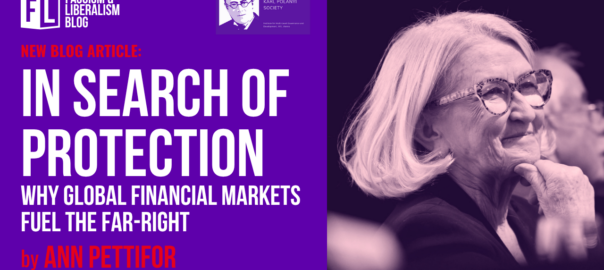
In Search of Protection
Why Global Financial Markets Fuel the Far-Right
by Ann Pettifor
09.07.2026
Why are so many people willing to trade democracy for authoritarian promises of protection? According to political economist Ann Pettifor, humans share a need for social, economic, and ecological security. This need, however, has been undermined by globalised markets in money, energy, food and housing as well as the US dollar standard. The consequent existential precarity is a primary reason why far-right leaders with their promises of protection and strength appeal to a growing number of people. Thus, Pettifor calls for a financial order that again subordinates global financial markets to public control.
Human Insecurity and the Need for Protection
Human beings have a fundamental need for security. In their book “Human Givens”, Joe Griffen and Ivan Tyrrell outline a radical new framework for the practice of psychiatry, psychotherapy and counselling based on the idea that humans, like all living organisms, share innate needs. These inbuilt patterns are nature’s genetic endowment. According to Griffen and Tyrell, we seek to fulfill these emotional needs not only for our well-being, but ultimately for our survival. Fortunately, our needs are only one half of the story, write Griffen and Tyrrell. Nature has also provided us with a wealth of resources to help us get those needs met.
According to the authors, one of our most important needs is security – or safe territory. An environment which enables us to lead our lives without experiencing undue fear and anxiety, and that ensures we develop fully. Our need to feel secure is closely connected, the authors explain, to our innate need for control and autonomy.
Griffin and Tyrell’s insights allow us to acknowledge that when economic, social and ecological life becomes increasingly precarious, people do not simply demand more freedom – they demand protection. However – just as “in the early thirties, with an awe-inspiring vehemence”[1] – the world has once again become profoundly insecure. Societies turn to authoritarian strongmen and women for protection from the globalised markets of our era – markets in money, energy, food, and housing that, while enriching the already wealthy, have stripped millions of incomes, secure work, the right to a decent home, and affordable food. These insecurities have led many societies to turn away from what passed as democratic politics and towards far-right leaders promising protection. Donald Trump, for example, appealed to workers in the American Rust Belt by promising to protect jobs and incomes through walls against Mexico and China.
Thus, I argue, global financial markets are one of the key reasons why authoritarian leaders have become attractive again across the world. It is not inequality alone that drives the far right, but the widespread experience of insecurity generated by an international financial order that has subordinated democratic politics to global markets.
The recent turn away from democracy and towards authoritarianism has been remarkably rapid in historical terms and has spread across an extraordinary range of countries—from the United States under Trump, to India under Modi, Russia under Putin, China under Xi Jinping and Brazil under Bolsonaro, with many more countries like Indonesia, Ethiopia and Vietnam following similar trajectories. As the ‘Tyranny Tracker’ illustrates, authoritarian rule is no longer confined to a handful of countries but has become a defining feature of today’s political landscape. Of all 179 countries covered by the tracker, only 74 are classified as democracies, 25 as hybrid authoritarian regimes, and 80 as fully authoritarian regimes.
Authoritarianism and Its International Roots: From the Gold Standard to the Dollar Standard
What explains the remarkably simultaneous rise of authoritarian politics across countries with very different political traditions? As Karl Polanyi argued of the 1930s, “only a cause external to them all could have had such an effect.” The external cause of this era’s rise in authoritarianism worldwide, I argue, is the insecurity generated by the globalised financial system and the US Dollar Standard – a system that in many respects mirrors the gold standard of the 1930s. Polanyi described the “fount and matrix” of that earlier international order as the self-regulating market, built around markets in the fictitious commodities of labour, land and money. Much the same can be said of today’s financial order.
To paraphrase Polanyi, since President Nixon dismantled the Bretton Woods international financial architecture in 1971, little has been allowed to impede the expansion of private global markets in money, labour, energy, food and housing [2]. Prices, supply and demand have increasingly been left to market forces, while governments have retreated from regulating markets in the public interest. Neither price, nor supply, nor demand were fixed or regulated: only such policies and measures were introduced which helped to ensure the self-regulation of the market. The result has been an international economic order in which global markets have become the only organizing power in the economic sphere.
Reflecting on the collapse of the Gold Standard and the rise of fascism, Polanyi concluded in a 1940 lecture that “neither liberal capitalism nor representative democracy could function satisfactorily under such conditions” [3]. His insight remains strikingly relevant today.
The willing surrender of the world’s parliaments and congresses to government by private, globalised markets in the neoliberal era, increasingly hollowed out political power and bred cynicism and disillusion with so-called democratic politics. The governance of globalised markets was not only deliberately detached from democratic, regulatory oversight, globalised markets increasingly disturbed and ruined our daily lives and livelihoods by way of financial, political and ecological volatility, leading periodically to catastrophic crises and causing growing insecurity.
The Neoliberal Age: Financial Crises and Wars
What ensued from these neoliberal market policies was a non-stopping wave of financial crises: The sovereign debt crises of low-income countries began at the fringes of the global economy in the 1970s, 80s and 90s. With the following dotcom crisis of the 2000s – which was caused by the widespread euphoria over the internet and new telecommunication technologies – financial crises shifted to the Western core.
Since the start of the twenty-first century, as awareness grew of the threat posed by ecological breakdown, societies have endured recurring global crises and growing precarity: The world lurched from the Great Financial Crisis (GFC) of 2007-09, to the 2009-10 European debt crisis, to the collapse of the repo market, i.e. shadow banking, on 17 September 2019 which led to massive central bank bailouts. The wave of crises continued from the COVID-induced stock market crash in February 2020, to the shadow banking crash in March 2020, to the 2021-2024 global cost-of-living crisis.
In reference to the 1930s, Karl Polanyi argued that the economic system has led to a social and economic “transformation of planetary range […] topped by wars of an entirely new type in which a score of states have crashed, and the contours of new empires are emerging out of a sea of blood”. [4] Today, similar dynamics can be seen in Russia’s long war against Ukraine, the ongoing devastation in Gaza following the Hamas attack on Israel, and the subsequent immiseration and deliberate genocide of tens of thousands of Palestinians in Gaza. The disastrous 2026 war against Iran, led by Israel and the United States led to the closure of the Strait of Hormuz, driving energy prices sharply upward and intensifying both the cost-of-living crisis and global ecological pressures.
Toward a Global Financial Order for Security
Taken together, these developments provide stark evidence that the contemporary US dollar-based financial order has become a destabilising force in global politics and material life. Looking at the multiple wars, rising costs and ensuing resource shortages there can be no clearer evidence that today’s US dollar standard of globalised financial markets threatens to physically destroy human society and to transform the ecosystem into a wilderness.
Yet this is not an inevitable condition. An international financial order that subordinated finance to democratic priorities has existed before. We did this as a world community, at Bretton Woods in 1944, when the world’s leading economists gathered to design an international financial system that rejected the globalisation of the 1930s, and built a system that subordinated global markets to the interests of states. These states worked inter-nationally to create what is known in all economic textbooks as ‘the golden age’. An age when governments exercised power over cross-border capital flows; used central bank powers to manage the creation of credit, and regulation to intervene in the conduct of markets in money, labour and land. It was an era in which humanity experienced relative peace, security and stability, thanks to the subordination of global markets to democratic regulation in the interests of society.
Society’s only hope today is to draw on nature’s wealth of resources to restore some sense of security and stability to both humanity and the ecosystem. The ability to mobilise those resources requires wise leadership, solidarity and community and the political power needed to, once again, subordinate global markets to the interests of society and the biosphere.In other words, we must once again draw on our own personal resources to build the international coordination and cooperation needed to restore humanity’s and the ecosystem’s profound need for stability, security and autonomy.

Ann Pettifor is a political economist, author, advisor and public speaker. Her work focuses on the global financial system, sovereign debt restructuring, international finance and sustainable development.
References
- Karl Polanyi, 1940. Lecture 1: The Passing of 19th Century Civilization
- Karl Polanyi, The Great Transformation, 1957, p.72
- Karl Polanyi, 1940. Lecture Four: Is America an Exception?
- Karl Polanyi, 1940. Lecture Four: Is America an Exception?, p. 4.
Further Reading
Pettifor A. (ed.) (2003) The Real World Economic Outlook: the legacy of globalization, debt and deflation. London: Routledge.
Pettifor, A. (2005) The Coming First World Debt Crisis. London: Palgrave.
Pettifor, A. (2017) The Production of Money. London: Verso.
Pettifor, A. (2019) The Case for the Green New Deal. London: Verso.
Pettifor, A. (2026) The Global Casino: How Wall St Gambles with People and the Planet. London: Verso.
Polanyi, K. (1940). Lecture 1: The passing of 19th-century civilization. The Present Age of Transformation.
Polanyi, K. (1940). Lecture 4: Is America an exception? The Present Age of Transformation.
Polanyi, K. (1957). The great transformation: The political and economic origins of our time. Beacon Press.