
Tag Archives: fascism

F&L Blog – A Fascist “Solution”?

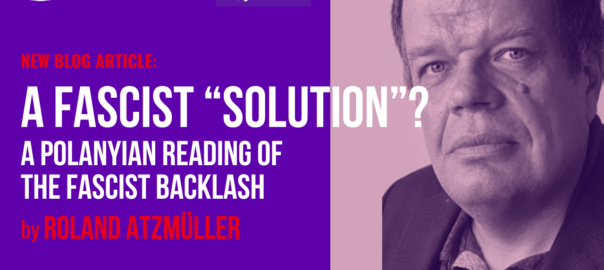
A fascist "solution"? A Polanyian Reading of the Fascist Backlash

by Roland Atzmüller

30.04.2026

As commentators struggle to make sense of the rise of the far right and its entanglements with the neoliberal project, Roland Atzmüller turns to Karl Polanyi’s analysis of fascism and liberalism a century ago. In Polanyi’s view, fascism was a reaction to emancipatory social struggles that challenged the unchecked expansion of capitalist market society and demanded greater democratic control, universal equality, and individual freedoms. Fascism, in turn, came to the rescue of capitalism, ending the social and political blockages by reinstating inequality — especially along racial lines — as a principle of governance. According to Atzmüller, Polanyi’s analysis sharpens our understanding of both neoliberalism as a project to suppress or absorb egalitarian movements in the name of economic recovery, and contemporary processes of fascisation as efforts to reverse an alleged Western decline by attacking “wokism,” reasserting white supremacy, and defending the capitalist development model.

(Mis-)interpretations of the Far Right

Since the beginning of the second Trump administration and its attempt to remodel U.S. society and democracy along authoritarian lines, public and scholarly debates concerning the appropriate interpretation of the far right’s recent electoral successes and governing projects have intensified. The debates centre on whether these phenomena should still be understood as right-wing populism, or if they are better described as processes of fascisation (Faschisierung, to use the German term) in the light of their radicalization – or even a new fascism. These debates build on earlier controversies about how the hegemonic neoliberal governing projects of recent decades in many countries are related to the growing successes of (increasingly radicalized) right-wing parties and movements. 

Although originally, many right-wing populist parties were combining anti-migration sentiments with (authoritarian) neoliberal economic and social policy ideas, they developed increasingly encompassing and distinct programs and narratives for fundamental social change, particularly in the last one or two decades – albeit with considerable national variation. The emerging programmatic extensions of far-right parties have been particularly notable in certain sociopolitical fields such as welfare policy. Of course, these extensions remained closely aligned with ideologies which had been central to the (post-war) far right from the beginning, particularly concerning the rejection of immigration and a racist and even “völkisch” conception of the nation. However, since these programmatic expansions usually entailed assigning the state an important role in economic and social policy, certain public and social-scientific debates (for references see Atzmüller and Decieux, 2019) advanced the view that these actors should no longer be classified as right-wing, as their positions appeared closer to those of centre-left parties in these policy fields. This argument was linked to the fact that, in some countries, far-right reform policies hardly – or did not – reduce expenditure levels in certain policy areas, such as welfare.

In the course of such debates, two things are often ignored. First, and this is particularly overlooked in journalistic contributions, the far right – beyond all social rhetoric – draws on long standing traditions of authoritarian statehood that do not have too much in common with the idea of a democratic, social, and inclusive state. Second, a perspective that mainly focuses on state expenditure levels – which is itself a sign of neoliberal hegemony in certain debates – tends to ignore the qualitative policy-changes implemented by far-right parties to foster authoritarian change.

Polanyi’s Interpretation of Fascism’s Rise

Karl Polanyi’s writings from the 1930s and 1940s on the role and consolidation of fascist regimes and their political and ideological “essence” offer considerations and insights that are of remarkable relevance for interpreting today’s rightward shift in many societies. Their significance stems from the fact that Polanyi engaged with these questions in particular during the period in which the democratic constitutional state was being displaced by a far-right movement and the establishment of a fascist regime. In his analyses from the 1930s onwards, Polanyi demonstrated how fascism sought to impose itself as an authoritarian and antidemocratic “solution” to social crisis dynamics and political deadlocks resulting from the contradictions and dynamics of the unbridled expansion of capitalist market society. Fascism, in Polanyi’s theoretical framework, constituted itself as the rescue of capitalism as a whole. Hence, Polanyi ascribed fascism a systemic role oriented towards society in its totality. For him, fascism was a reaction of certain social forces to progressive developments resulting from social struggles against the crisis-prone effects of unrestrained market expansion in the decades before.

Polanyi’s fundamental critique of fascist philosophers such as Othmar Spann or Ludwig Klages in the 1930s therefore does not simply constitute a scholastic refutal of their attempt to formulate a philosophical essence of fascism. Rather, their authoritarian and antidemocratic philosophical musings about concepts such as freedom or in/equality referred to a range of real social developments which became the target of fascist politics to rescue capitalism. These concerned first, the expansion of democratic structures; second, the extension of individual freedoms; and third, their grounding in ideas of universal equality.

"because the “liberal creed” was unwilling and unable to react to the outlined progressive countertendencies and to accept democratic control of the economy and society, a profound social crisis and political blockage emerged"

Thus, even if his formulations – particularly in The Great Transformation – were not entirely unambiguous, Polanyi did not simply conceptualize fascism as a “countermovement” similar to more progressive counterparts such as trade unions and working-class parties which aimed at securing the protection of society against the “liberal creed” and the consequences of market dynamics. Rather, because the “liberal creed” was unwilling and unable to react to the outlined progressive countertendencies and to accept democratic control of the economy and society, a profound social crisis and political blockage emerged. According to Polanyi, from a fascist viewpoint, the progressive countertendencies were responsible for the manifestations of crisis and political paralysis. The fascist “solution” was thus aimed at the abolition of democracy and individual freedom in order to subject individuals to violent re-education and, ultimately, to reimpose inequality – not least (but nationally varied) along ethnicized and racialized lines – as a mode of dominance. The attack on democracy and politics sought to absolutize the economy and to destroy all forms of democratic control and participation not only at the level of the state but also within the economy. In this way, as Polanyi wrote in 1933, economic dynamism was to be restored and society embodied in the economy.

Understanding the Neoliberal Project with Polanyi

"Polanyi’s approach can help to understand the political impetus of neoliberal governing projects which saw these developments as obstacles for economic recovery."

What, then, is today’s relevance of Polanyi’s reflections on fascism? In my view, the social countertendencies he identified as responses to the unrestrained imposition of market society resurfaced in the social struggles and movements of the post-war period – in particular in 1968 and the social reform projects of the 1970s. The expansion of individual freedoms sought to realize the “utopian promise” of social inclusion in the words of Jürgen Habermas, individual freedom, and recognition in the democratic welfare state. They became the basis of emancipatory aspirations “not only” of the (traditional) working class, but also of women, ethnic minorities and other “minority” or marginalized groups and extended to struggles around sexual self-determination and gender identities.

Polanyi’s approach can help to understand the political impetus of neoliberal governing projects which saw these developments as obstacles for economic recovery. From the outset, neoliberal projects curtailed codetermination rights and trade-union activities, targeted the dismantling of economic-democratic institutions and control mechanisms, and sought to remove the economy from political control as they regarded these developments as obstacles to overcoming economic crises. Furthermore, through welfare-state cutbacks and reorganization, neoliberal policies aimed at recommodifying labor power and intensifying social inequalities. In the name of individual freedom on global markets, the autonomy gains of subjects vis-à-vis market dynamics (as well as traditional family ties and other personal dependencies and subordinations) were to be rolled back.

"The alleged universalistic promise of economic individualism of so-called progressive neoliberalism ultimately collapsed – confronted with the reality of the market dynamics it promoted."

For neoliberal projects, allegedly focusing on individual freedom on markets, the expansion of minority rights could be legitimate only insofar as it proved its economic profitability. This points to the attempts of “progressive neoliberalism,” which since the 1990s sought to make market society more socially sustainable through inclusion and diversity and in particular equal opportunity to participate in markets. However, the alleged universalistic promise of economic individualism of so-called progressive neoliberalism ultimately collapsed – confronted with the reality of the market dynamics it promoted. Rather, these dynamics contributed to reproducing social inequalities and hierarchies along race, class, and gender, which deepened in numerous countries after the 2008 financial crisis. This reflects two fundamental conditions: first, that a democratic, diverse, and inclusive society cannot be achieved on unregulated, expanding markets; and second, that the basic structures of capitalist market societies were not challenged in neoliberal societies based on the Thatcherian claim that there is no alternative.

Contemporary Fascisation as “Solution” to Social Crises

In light of the failure of progressive neoliberalism, the new far right developed a comprehensive set of authoritarian “solutions” to social crises and political blockages, replacing market individualism through national and religious – i.e., Christian – homogeneity. As can be seen almost paradigmatically in the actions of the second Trump administration, this “new fascism” strives to gain extensive control over political structures in order to restrict political influence over economic domains and to reduce the significance of democratic processes or even destroy them. Social inequalities are deepened by cuts to social programs, the abolition of affirmative action, attacks on the public sector, and the like. The expansion of freedoms and opportunities for the inclusion and participation of all members of society – grounded in comprehensive concepts of equality and emancipation and the extension of anti-discrimination provisions won by social movements – has become a prime target of an increasingly authoritarian and fascistoid restructuring project that centres around the white, male-dominated, Christian nation.

The expansion of freedoms and opportunities for the inclusion and participation of all members of society [...] has become a prime target of an increasingly authoritarian and fascistoid restructuring project that centres around the white, male-dominated, Christian nation.

From this (Polanyian) perspective, the question arises whether the outlined policies also have a systemic dimension oriented towards the rescue of capitalism, as did their historic counterparts. Since fascist “solutions” never intended to save capitalism as such but rather a specific national social formation – and since crises are always also socially constructed – a systemic justification of imposing an authoritarian “solution” for western/northern capitalism is part of the self-understanding of the far right or the new fascism.

To begin with, there is the far-right claim – especially in the Global North – of a decline of western societies under the sway of so-called “woke” ideologies and an allegedly migration-induced “great replacement” attributed to certain global elites. This is said to undermine entrenched patriarchal, white, and class-specific “natural” hierarchies. In addition to these phantasmatic perspectives, the political positions of the contemporary far right or “new fascism” involve the preservation of the capitalist development model of permanent growth based on private enterprise and fossilism, combustion engines, and unrestrained meat consumption – against their projections of an allegedly looming ecological dictatorship. Amongst others, they aim to create the political and ideological conditions to secure access to (fossil) resources against global competitors such as China amid an escalating climate crisis – if necessary, by means of warfare. To implement these policies, they furthermore try to re-educate individuals by reasserting for example entrenched masculinist and racist hierarchies. Members of society are to acquire those subject dispositions that make them willing to accept – or even enact – the violent defense of borders against climate refugees, rather than merely “enduring some cruel images”, as Sebastian Kurz, former Austrian prime minister and now staffer to a representative of the fascistoid tech-oligarchy, once emphasized.

Only if – opposed to what Polanyi calls “freedom’s utter frustration” – the connections between individual freedom, universal notions of equality, and the extension of democracy can be restored in all their already attained complexity, can a new perspective on freedom in a global, complex society be opened.

Roland Atzmüller is Associate Professor at the Institute of Sociology at Johannes Kepler University in Linz, Austria, focusing on (critical) theories of capitalist societies, welfare states and social policies with an emphasis on labour market policies.

Further Readings

  • Atzmüller, Roland; Décieux, Fabienne (2019): “Freedom’s utter frustration…”: Neoliberal social-policy reforms and the shift to the far-right through Polanyi’s theory of fascism. In: Roland Atzmüller, Brigitte Aulenbacher, Ulrich Brand, Fabienne Décieux, Karin Fischer und Birgit Sauer (Hg.): Capitalism in transformation. Movements and countermovements in the 21st century. Cheltenham, UK u.a.: Edward Elgar Publishing, S. 135–151.

  • Dale, Gareth; Desan, Mathieu (2019): Fascism. In: Gareth Dale, Christopher Holmes und Maria Markantonatou (Hg.): Karl Polanyi’s political and economic thought. A critical guide, S. 151–170.

  • Polanyi, Karl (2018): The essence of fascism. In: Karl Polanyi (Hg.): Economy and society. Selected writings. Edited by Michele Cangiani and Claus Thomasberger. Cambridge/Medford: Polity, S. 81–107.

Related Posts

F&L Blog – No Nationalism Without Exclusion

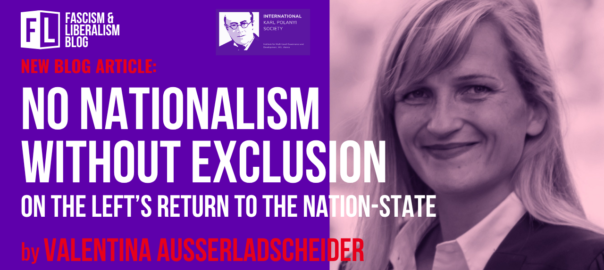
No Nationalism without Exclusion: On the Left’s Return to the Nation-State

by Valentina Ausserladscheider

09.04.2026

Does the nation-state offer democratic protection in an age of crisis – or does it reproduce the exclusions that helped generate those crises in the first place? In this article, economic sociologist Valentina Ausserladscheider examines why moments of economic and political dislocation repeatedly revive demands for national sovereignty – even on the left. While many contemporary left accounts portray the nation-state as the last viable site of social protection and democratic control, she argues that this move risks recoding rather than questioning the national form of the state itself. Drawing on debates in political theory, sociology, and critical political economy, the article argues that nationalism is never a neutral instrument: defining a political community always entails drawing boundaries of belonging and exclusion. At stake, then, is not only the resurgence of the far right, but a broader political convergence around nationalist frameworks of protection – but according to Ausserladscheider, there is also a democratic politics that can move beyond them.

Karl Polanyi’s The Great Transformation remains indispensable because it diagnosed how the collapse of liberal market society generated a widespread desire for protection. Historically, however, this demand did not produce an emancipatory response. Instead, the search for protection gave rise to nationalist spatial-political regimes. Most catastrophically through fascism and National Socialism, these regimes restored political control within bordered nation-state containers. The crucial lesson is that the crisis of liberal globalization did not simply produce “more state,” but a turn to national sovereignty through exclusion as the dominant horizon of response. That lesson matters today as the ascent of the far right openly couples social protection to chauvinism and nationalist exclusion. More surprisingly, even sections of the left increasingly flirt with the idea that democratic protection, welfare, and planning can only be recovered within nationally bounded forms. What this underestimates is that nationalism is never a neutral instrument. Once protection is framed nationally, exclusion is no longer a side effect but part and parcel of the political logic itself – an issue this blog post seeks to examine.

The Deceptive Appeal of the Nation-State

In the wake of recent developments such as increasing financial instability, ecological breakdown, geopolitical fragmentation, inflation, and the exhaustion of neoliberal globalization, a range of left and heterodox-economic accounts have renewed the case for the nation-state as the primary site of democratic agency, economic regulation, and social protection. These accounts locate both the crises and our inability to address them in the disembedding effects of globalized neoliberalism. Costas Lapavitsas, Professor of Economics at SOAS, for example, has made “the left case against the EU,” casting it as a neoliberal citadel from which nation-states must be defended through popular and national sovereignty. Another instance is Wolfgang Streeck, former Director of the Max Planck Institute for the Study of Societies, who – after his famous critiques of the EU´s austerity and neoliberal policy – moved toward controversial arguments about borders and immigration control as a last defense of the European welfare state. Streeck also became politically active in his support for Sahra Wagenknecht and her left-conservative, migration-critical party BSW. From this perspective, the sovereign nation-state has re-emerged as the last credible site from which market power might be restrained, political accountability restored, and planning capacities reconstituted.

This argument has real force. Transnational markets have escaped democratic control, while supranational institutions have insulated economic governance from popular contestation. The appeal of the nation-state lies not only in its familiarity, but in its concentration of fiscal, legal, territorial, and administrative power. The left return to the nation-state is therefore not simply nostalgic, but a response to a genuine institutional problem. In these accounts, the state is seen as the most capable institutions for constraining capital, organizing redistribution, and sustaining democratic solidarity – an argument that deserves serious engagement. Indeed, democratic institutions require a demos, which historically been organized within bounded political communities. Abstract cosmopolitanism, however, has thus far offered little concrete institutional approaches for redistribution, decarbonization, or decommodification.

"The nation-state is not a neutral scale of governance. It is a historically sedimented form of political belonging organized through the distinction between members and non-members."

The pitfall of this argument, however, is that it leaves the conventional understanding of the state as the nation-state intact, without adequate scrutiny. Since these approaches do not question the national framing of the state, the problem concerns not only institutional power but also the bounded and exclusionary community that such power is assumed to represent, a logic intrinsic to nationalism. Nationalism is not merely representative of a national political community; it is also a way of drawing boundaries around political membership. In that sense, there is no nationalism without exclusion. The nation-state is thus not a neutral scale of governance. It is a historically sedimented form of political belonging organized through the distinction between members and non-members. Even in its civic or universalist variants, nationalism presupposes a bounded community in whose name decisions are taken and distributive claims justified. Therefore, the nation-state remains exclusionary.

No Nationalism Without Exclusion

Among the many accounts demonstrating that nationalism is inherently exclusionary, Meghan Tinsley´s critique of patriotism is exemplary: while patriotism has been represented as a supposed counterweight to ethnocultural nationalism, Tinsley argues that patriotism itself hardens racialized distinctions between citizens and non-citizens. Thomas Jeffrey Miley likewise stresses that “nation” is bound to the legitimation of “states” – a nexus that has shown strong affinities with racism and fascism. Bhambra and Holmwood, in turn, show that the liberal welfare state cannot be understood apart from European colonial exploitation. These boundaries are not incidental; they are constitutive. To define a people is always also to define those who do not belong.

Exclusion, then, is not a deviation from nationalism but one of its basic operations. Its forms vary – juridical, racial, cultural, territorial, colonial, administrative – but it is always present. Nationalism establishes a principle of priority for those recognized as members of the nation, structuring the distribution of rights, protections, and vulnerabilities. The outsider – migrant, refugee, minority, internal stranger, geopolitical rival – is therefore central, not secondary, to national politics.

"Fascism does not emerge mechanically from nationalism, but nationalism supplies symbolic and institutional resources that fascist and reactionary movements can radicalize."

This is where the historical record matters. A critique of the left’s renewed attachment to the nation-state does not require the crude claim that all nationalism is fascist, or that every defense of sovereignty culminates in authoritarianism. The stronger claim is that nationalism has repeatedly furnished the grammar through which crises of liberal order are translated into projects of closure, hierarchy, and restoration. Fascism does not emerge mechanically from nationalism, but nationalism supplies symbolic and institutional resources that fascist and reactionary movements can radicalize.

Because of this, the left cannot assume that it can mobilize the desire for protection in national terms without reproducing the terrain on which the far right possesses decisive advantages. This may be the central error of left-national or sovereigntist currents: they treat nationalism as if it were a progressive idiom detachable from its exclusionary history. Indeed, Daphne Halikiopoulou and Tim Vlandas warn against the hype around supposedly “new” issues such as immigration and cultural grievance when these often eclipse enduring economic concerns; reclaiming the discussion on inequality would be a more promising strategy for the left than entering a contest over national belonging. 

Going Beyond the Dichotomy

"The problem with the left’s renewed attachment to nation-state sovereignty is not that state institutions are unimportant, but that state-centred strategies alone are inadequate to crises whose causes and dynamics exceed national borders."

None of this implies a defense of globalized neoliberalism, nor does it deny the importance of state institutions in any plausible project of transformation. The historical lesson is that nationalism is not an empty vessel waiting to be filled with progressive content. It is a mode of political belonging constituted through exclusion. The answer to current crises cannot be a left politics that re-legitimates the nation as the privileged horizon of protection. Solutions cannot be limited to either national or inter-, transnational. Global challenges such as climate change demand political solutions beyond this dichotomy – both within and beyond the state.

The problem with the left’s renewed attachment to nation-state sovereignty is not that state institutions are unimportant, but that state-centred strategies alone are inadequate to crises whose causes and dynamics exceed national borders. This does not mean we can ignore the familiar critiques of transnational governance – its democratic deficits, technocratic insulation, and subordination to market imperatives. The democratic failures of transnational governance are real as Robert Dahl so convincingly explained decades ago. But the answer to those failures cannot be a retreat into the nation-state as the final horizon of politics. The crises that define the present exceed that horizon and necessitates responses on all levels. With Jürgen Habermas’s death, we have also lost one of the most important thinkers who insisted that democracy need not end at the borders of the nation-state. The question, then, is not whether we can afford to think beyond the state, but whether we can afford not to.

Valentina Ausserladscheider is an Assistant Professor at the Department of Economic Sociology at the University of Vienna. Her research focuses, among other topics, on the relationship between neoliberalism and right-wing populism.

Further Readings

  • Ausserladscheider, Valentina. (2024). Far-right populism and the making of the exclusionary neoliberal state. London: Palgrave Macmillan.
  • Ausserladscheider, Valentina. (2024) Constructing a neoliberal exclusionary state: the role of far-right populism in economic policy change in post-war Austria. Comparative European Politics 22, 128–152.

Related Posts

F&L Blog – Beyond Net Zero

Beyond Net Zero: Towards a Climate Politics that Can Defeat the Far Right

by Christopher Shaw

26.03.2026

Christopher Shaw holds Research Associate roles at both the University of Sussex’s School of Global Studies and the Working Class Climate Alliance, and is a leading voice in climate communications in the UK. Below, he argues that the UK’s liberal, technocratic net zero climate politics has reached its limits. By ignoring both the political roots of the climate crisis, and the voices of the working class, net zero has allowed itself to be instrumentalized by the far-right. Drawing on recent political developments, Shaw outlines what a climate politics, rooted in social justice and grassroots democracy, could look like, in the fight not just for heat pumps or electric cars—but a world that feels like home.

The UK’s net zero policy: preserving liberalism versus preserving life

As the centrist waters recede back down the beach of history, climate policies are left stranded and exposed on the shore, flapping about like so many dying fish. Who will fight for net zero now? Not the European Union it seems, which is busy shredding many of its flagship climate policies, whilst the long standing net zero consensus in the UK is now coming apart. Even climate researchers supportive of net zero remain divided over the ability of net zero to deliver emission cuts quickly and fairly. To cap it all, campaigners have seen twenty years of efforts to get people to adopt the low carbon behaviours needed to deliver net zero come to naught. The rapid and ongoing collapse of the net zero policy architecture leaves climate campaigners with two choices. The first is to double down on net zero, turning increasingly to geo-engineering and technological innovation as the primary tools used to fix the climate. This limits the need to involve people or politics. The only choice the public needs to make is whether to install an air source or ground source heat pump. The second option is to recognise that the climate fight is, and always has been, political. Campaigners are choosing the first option, a strategy destined to fail further and faster than ever before. Rather than trying to lift climate policy out of the democratic sphere, we need narratives that present climate change as a product of the same politics that have delivered austerity, inequality and war. Fixing climate change means fixing the political conditions that are generating these crises. If this is not a fight the existing liberal climate movement wants to take on, we will need a new climate movement, one that does not prioritise the preservation of liberalism over the preservation of life.

The myth of the good liberal citizen

"Support for net zero has also come to stand as a marker of whether or not you are a good liberal citizen."

There is more anger, resentment and fear abroad today than liberal politics can assimilate – liberal politics and the current public mood are as oil and water. Liberal climate policy remains wedded to the hope that the evidence-based application of intellect and reason will dissipate both greenhouse gases and public anger. Through calculation and rational deliberation we can fashion a painless technocratic and reformist path to the net zero land beyond history. Liberals look to an eternal tomorrow of ‘self-regulating citizens conducting resource-efficient and sustainable lives’, enjoying outdoor yoga, cycling to the repair cafe. The mainstream climate movement is blind to the true function of net zero; it is an idea created by the allies of capital as an instrument of control, handed over to the middle class liberal climate movement to then sell to the working class as their only hope of a decent life. Support for net zero has also come to stand as a marker of whether or not you are a good liberal citizen. It doesn’t matter if you enabled the bombing of 2 million Gazans or got rich from an exploitative finance system. If you are on board with net zero then you are part of the liberal climate family. As a consequence, your voice is more deserving of attention and obedience than a poor person of poor means who is critical of net zero. If you want to identify as a progressive then you have to support net zero. If you don’t support net zero you are a fascist.

Towards a climate politics that can defeat the far right

"The UK Green Party recently overturned a huge Labour majority without once mentioning climate change in their leaflets"

There is much excellent theoretical and practical work to draw on when thinking about what sort of climate politics can defeat the far right. Efforts to articulate and promote a Green New Deal offer vital insights for how to combine climate policy with an anti-austerity, anti-imperialist agenda. Community engagement projects across Europe have identified important knowledge about barriers and opportunities for combining climate action with social justice campaigns. These ideas will remain on the margins all the while climate organizations continue drawing from the same privileged strata of society, or insist any subaltern actors must adopt middle class values and norms before being allowed into the circle. The political shift we are seeing as parties of the left and far right gain momentum is an opportunity for the climate movement to jump to the left and engage in the battle for humanity’s future.

The UK Green Party recently overturned a huge Labour majority without once mentioning climate change in their leaflets, focusing instead on poverty and the destruction of public services. This reflects a deep public rift with the liberal climate agenda. It points toward the path we need to take — further and faster, in the opposite direction to that mapped out by net zero narratives: away from global and towards the local, away from work and towards play, prioritise the human over the machine, democracy over technocracy, the substantive over the abstract, equality over difference, the social over the individual. It is only from these foundations that we can undermine the allure of far-right politics, whilst building a climate strategy from the bottom up.

For a world that feels like home

"Such technologies may be a part of living in a carbon-constrained world, but the first task is to recreate the social world, to make a world people feel at home in, feel rooted in, have control over."

The failure of the liberal climate movement is in part a failure to understand human nature. Liberalism, and the climate policies it has birthed, wrongly assume there is a space above and beyond the human heart. We cannot escape our own subjectivity. Right-wing politicians would rather see the world destroyed than compromise their political beliefs. This is also true for liberalism. This is also true for climate campaigners. This is also true for you and me. I joined the climate fight because it seemed to me the best reason for the ecosocialist future I already wanted. I am not going to fight for a decarbonised capitalist future of ground source heat pumps, a modernised electricity grid, or more EV charging points, even if I thought such things would preserve a liveable future for my children. Such technologies may be a part of living in a carbon-constrained world, but the first task is to recreate the social world, to make a world people feel at home in, feel rooted in, have control over. There seems nothing so thrilling as this prospect. Whilst liberalism makes a fetish of free will and individual autonomy, the vast majority can see that the decisions about our future have already been made for us by experts and leaders. Net zero promised to let the targets be humanity’s guide and leave the politics behind. But actually what we need is maximum politics in climate policy, a genuine grassroots democracy, a mechanism for embracing and channeling public anger towards a world that feels like home, not an innovation hub.

Christopher Shaw holds Research Associate roles at both the University of Sussex's School of Global Studies and the Working Class Climate Alliance, and is a leading voice in climate communications in the UK.

Further Readings

  • Bernstein, Steven. F. (2001). The compromise of liberal environmentalism. Columbia University Press.
  • Crary, Jonathan. (2022). Scorched earth: Beyond the digital age to a post-capitalist world. Verso books.
  • Moyn, Samuel. (2023). Liberalism against itself: Cold War intellectuals and the making of our times. Yale University Press.
  • Rose, Matthew. (2021). A world after liberalism: Philosophers of the radical right. Yale University Press.
  • Shaw, Christopher. (2023). Liberalism and the challenge of climate change. Routledge.

Related Posts

title page for the F&L blog post "Understanding the new fascism" by Silky van Dyk

F&L Blog – Understanding the New Fascism

Understanding the New Fascism: Post-Truth, Big Tech and the Return of Arendt’s Organized Lie

by Silke van Dyk

12.03.2026

Trump II is far more than just a radical version of the first administration. Rather, we are confronting a deeper transformation of the political itself, writes Silke van Dyk. The flooding of public discourse with right-wing populist falsehoods that defined Trump’s first term has given way to a more far-reaching manipulation of public opinion. This is further reinforced by the rise of digital capitalism and its neo-feudal concentration of power and resources. As such, van Dyk argues we are seeing a return of Hannah Arendt’s “organized lie” – the ongoing and deliberate manipulation of opinion and knowledge – a defining feature of totalitarian regimes. But countering this new fascism will require more than fighting fake news. It means liberal democracies must also address their own inconsistencies

With the first and second election of Donald Trump, the Brexit referendum, the rise of right-wing parties across numerous countries, the influence of conspiracy narratives during the COVID-19 pandemic, and the momentum of climate change denial, a new political era has taken shape – one in which the right is increasingly challenging liberal hegemony. Alongside the resurgence of racist, nationalist, and chauvinist politics, public discourse itself has undergone a marked transformation. We are witnessing a proliferation of falsehoods, conspiracy theories, and half-truths, often coupled with hostility toward science and intellectuals. Political deception, of course, is nothing new. What is new, however, is its sheer volume, the speed of its dissemination, and the striking fact that exposure no longer appears to damage its authors. Whereas Richard Nixon was forced to resign in 1974 following the revelation of his lies in the Watergate scandal, Trump returned to the White House for a second term despite his countless false statements. 

Traditional versus Organized Lies

The classic definition of the lie is that of an intentional act in which the perpetrator is quite capable of distinguishing between the true and the untrue and deliberately makes a false statement. The publication of the Pentagon Papers[i] prompted Hannah Arendt to re-evaluate this traditional lie, and to contrast it with what she termed the “organized lie”. According to Arendt, “the difference between the traditional lie and the modern (organized) lie will more often than not amount to the difference between hiding and destroying.”[ii] While the traditional lie revealed itself because the yardstick of truth remained intact, this no longer applies to the organzied lie, since it changes the overall context in such a way that the lie becomes a substitute for reality.

According to Arendt the organized lie destroys, our “sense by which we take our bearings in the real world”[iii]The organized lie is a demanding practice: it requires the power to eliminate or refashion all contrary evidence – documents, testimonies, witnesses, even history books – so that reality itself is consigned to a form of orchestrated oblivion. Unsurprisingly, such practices are most characteristic of authoritarian and totalitarian regimes. As a central example, Hannah Arendt points to the Stalinist effort to erase all traces of Leon Trotsky from everyday life, education, and cultural memory.  

If, according to Arendt, actors lack the power needed for the organized lie, with its inherent shift away from reality, they increasingly fall back on the mode of opinion, claiming the right to freedom of expression: “The blurring of the dividing line between factual truth and opinion belongs among the many forms that lying can assume.”[iv] To take just one example: it is one thing to conclude from the Fukushima nuclear disaster that Germany’s energy policy did not require revision – this would constitute a legitimate political opinion. It is quite another thing to deny the disaster itself in order to preserve nuclear energy – and to justify that denial in the name of free speech. The latter amounts to erasing the boundary between fact and opinion. To avoid any misunderstanding: Hannah Arendt consistently defended the value of opinion and warned that truth turns despotic when it supplants politics. At the same time, she made unequivocally clear that democratic contestation presupposes a shared sense of reality, which forms the indispensable basis of political struggle. Without it, public debate deteriorates into cynical relativism – a danger against which Hannah Arendt forcefully warned. 

Trump I: The Populist Play With Truth

Arendt reminds us: "The ideal subject of totalitarian rule is not the convinced Nazi or the dedicated Communist, but people for whom the distinction between fact and fiction (i.e. the reality of experience) and the distinction between true and false (i.e. the standards of thought) no longer exist.”

Echoing Friedrich Nietzsche’s dictum that truth is “the obligation to lie according to a fixed convention”[v], Trump & Co lied in open defiance of convention.[vi] The falsehoods were so frequent, so blatant, and so inconsistent that their inaccuracy were most often immediately apparent. Many of these statements were situational and contradictory, loosely connected rather than embedded in a coherent worldview. In Trump‘s first term, the surrounding context remained largely intact; indeed, the point was to flaunt the possibility of dismissing that context as the ‘deceptive reality’ constructed by allegedly left-liberal elites. In this configuration, being accused of lying poses no threat to the liar. On the contrary, it serves as proof of the critic’s elite status. 

Deliberate fabrications or organized lies were less a threat to empirical realities than the elevation of mere opinion. When Trump once speculated that U.S. unemployment might be as high as 42% he did not challenge the official rate of 5.3% by criticizing statistical methods or narrow definitions of unemployment. Instead, he countered a verified figure with an opinion, citing unnamed sources and invoking the right to free speech. In its first phase, the Trump system thus sought to circumvent the established procedures of truth verification in liberal democracies. Yet the countless falsehoods of Trump I had another effect as well: they generated lasting confusion, thereby paving the way for authoritarianism. As Hannah Arendt observed: “The ideal subject of totalitarian rule is not the convinced Nazi or the dedicated Communist, but people for whom the distinction between fact and fiction (i.e. the reality of experience) and the distinction between true and false (i.e. the standards of thought) no longer exist.”[vii]

Trump II: The Fascist Return of the Organized Lie

From the outset of his second term, Trump and his circle made utterly clear that they would not simply replicate the first. Immediately after the inauguration on January 20, 2025, the new president signed numerous executive orders, including pardons for convicted Capitol rioters, withdrawal from the World Health Organization (WHO), and the elimination of birthright citizenship for U.S.–born children of non-citizen parents. Although the January 2025 inaugural address carried unmistakable populist overtones – Trump accused “a radical and corrupt establishment” of having “robbed our citizens of power and wealth” for years – the speech, and even more so the administration’s first-year policies, revealed distinctly fascist-like features.  

"The manipulation of knowledge production and dissemination [...] all testify to a new form of control over education, culture, and science. [...] this represents a renewed deployment of the organized lie with its characteristic power to derealize"

This has resulted in the further radicalization of the extreme nationalist MAGA (Make America Great Again) project, paired with the construction of Trump as a Führer-like figure divinely chosen to end the “terrible betrayal” of international forces against the American people. Glorification of violence appears in the widespread imagery of deportations of alleged gang members, the repeated calls to expand the death penalty, and the brutal conduct of U.S. Immigration and Customs Enforcement (ICE), with its increasingly paramilitary characteristics. Migrant communities, queer people, and scientists are cast as enemies from whom the American people must be “saved.” 

Concrete measures quickly followed: deportations, emergency legislation at the Mexican border, the elimination of the third-gender option on official documents, cuts to diversity programs, and sweeping restrictions on academic freedom. The manipulation of knowledge production and dissemination, the suppression of unwelcome research in climate, health, and diversity, and political interference in the governance and direction of cultural institutions all testify to a new form of control over education, culture, and science. School curricula, museums, and public libraries are seeing the increasing removal of references to the crimes of slavery and the history of racism. Government agencies are currently deleting photographs and documents that record the service of women and people of color in the military or critically examine U.S. military actions. In the terms of Hannah Arendt, this represents a renewed deployment of the organized lie with its characteristic power to derealize: inconvenient facts, evidence, and scientific knowledge are no longer merely challenged with opinion – they are actively manipulated, and the records themselves, destroyed. 

Big Tech as Agents of Fascist Derealization

The newfound alliance between Silicon Valley tech giants and Trump & Co. has accelerated this trend, visible in every inauguration photograph, with the heads of Meta, Google, X, and Amazon seated in the front row. It proved highly convenient for the Trump administration that the fact-checking measures temporarily introduced on Facebook and Instagram to curb fake news and conspiracy theories vanished immediately after the inauguration. Likewise, Google promptly – and illegally – implemented Trump’s order to rename the Gulf of Mexico the “Gulf of America”, at least within the U.S. The fragmentation of the public sphere in the digital economy corresponds to the concentration of power in the hands of a handful of ultra-wealthy private entrepreneurs, who, as enablers of fascistleaning governments, have become key agents of derealization. Artificial intelligence is increasingly deployed to reshape the state in anti-democratic ways: deepfakes can be used to discredit political opponents, while evidence of corruption and illegal government actions are likewise dismissed as false, fabricated by the liberal elite. The fascistlike return of the organized lie thus brings derealization into reality – something that even Hannah Arendt and George Orwell could hardly have imagined: a neofeudal, privately controlled capacity, enabled by new technologies, to artificially remake the very representation of the world. 

The Liberal System Must Confront Its Own Inconsistencies

"the liberal 'postpolitics' of inevitability bears at least partial responsibility for the rise of rightwing forces that manipulate reality and advance their own anti-elite narratives"

One obvious response to these developments would be to bring communication and information infrastructures under public ownership and democratic control – rather than subject to the priorities and profit motives of a handful of multi-billionaires. Yet to do so requires understanding why the “offer” of rightwing and fascist politicians appeal to so many. This means examining the functional deficits of liberal democracies. At a time when liberal elites often celebrate the primacy of truth, they frequently overlook their own problematic handling of facts. For decades, they have presented certain realities as immutable constraints, while promoting radical market and austerity policies as inevitable and beyond debate. 

Hannah Arendt emphasized that political thinking operates between two risks, “the danger of taking [facts] as the results of some necessary development which men could not prevent and about which they can therefore do nothing, and the danger of denying them, of trying to manipulate them out of the world”[viii]. To understand the complex picture we face today, it is crucial to connect these two dangers and recognize that the liberal “postpolitics” of inevitability bears at least partial responsibility for the rise of rightwing forces that manipulate reality and advance their own anti-elite narratives. It is true, in other words, that “those at the top lie” when they claim there is no alternative. It becomes particularly dangerous when the necessary vigilance against the right blinds us to the functional deficits of liberal democracy and economy – the unfulfilled promises, technocratic tendencies, and socioeconomic failures that have brought us to the present moment. Even more perilous is the call to end debates among democrats in the face of the rightwing threat. Yet democratic public life depends on political contestation, including vigorous debate over what an anti-fascist social and economic policy should look like – a question that now, more than ever, must concern all democrats. 


Silke van Dyk Headshot

Silke van Dyk is a professor of Political Sociology at Friedrich Schiller University Jena. Her main research areas are the sociology of social inequality, the sociology of social policy and the welfare state, the sociology of aging and demography, and perspectives of social critique.

References

  • i The Pentagon Papers are a formerly secret document produced by the US Department of Defense, whose serial publication by the New York Times in 1971 revealed the feeding of false information to the US public concerning the Vietnam War.
  • ii Hannah Arendt (1969) Truth and Politics. In: Hannah Arendt, Between Past and Future: Eight Exercises in Political Thought, New York, p. 227-264 (here: 253).
  • iii Ibid., p. 257.
  • iv Ibid., p. 250.
  • v Friedrich Nietzsche (1988) Kritische Studienausgabe, Vol. 1, Berlin/New York, p. 881 (own translation).
  • vi For a detailed analysis, see Silke van Dyk (2022): „Post-Truth, the Future of Democracy and the Public Sphere”, in: Theory, Culture & Society, 39 (4), pp. 37-50.
  • vii Hannah Arendt (1958) Origins of Totalitarianism, Cleveland/New York, S. 474.
  • viii Hannah Arendt (1969) Truth and Politics, p. 259.

Related Posts

title page for the F&L blog post "Property Damages" by Jacob Blumenfeld

F&L Blog – Property Damages

Property Damages

by Jacob Blumenfeld

13.02.2026

Does private property secure freedom, or train us for domination? In this article, philosopher Jacob Blumenfeld traces how liberal ownership rights shape social relations, trigger ecological conflict, and foment authoritarian desires. His claim is not that all forms of private ownership corrupt individuals. Rather, he argues that the specific legal form of liberal property rights – granting exclusive control over socially necessary resources – enables relations of power, resentment, and authority that prime authoritarian movements. In an age of climate crisis and deepening inequality, the future hinges on the question of how property relations are organized: for private ends – or for social needs.

In a speech on January 21st in Davos, Donald Trump asked, rhetorically, in relation to Greenland: “Who wants to defend something on a lease?” To defend something, he implied, one must first own it. The need for protection becomes the justification for possession. Trump’s remark expresses a familiar liberal conviction: authority appears legitimate when grounded in ownership, and ownership is only legitimate if you take on ‘responsibility’ and can defend it. Property rights, thus, do not only allocate resources, they allocate decision-making power. Whoever owns decides; others adapt. This article examines the ideological roots of such thinking and discusses the political consequences of that ordinary arrangement posing the question: does owning property make you more prone to fascism? Does acquiring a taste of sovereign authority over an external thing slowly translate into a desire to dominate people as well? If you treat the world fundamentally as property, characterized by the right to use and abuse things at will, then isn’t it only a matter of time before you overstep the boundary between thing and person?

Property is Power

If slavery is the origin of property rights, as David Graeber once argued, then being a property owner is an education in dominion, the authority to dispose over what is mine by commanding the wills of other people. The right to an external thing is a license to treat others in certain ways in relation to the thing at hand. My legally sanctioned authority over this land, these assets, and those machines gives me the legitimate power to determine how others may or may not use them, irrespective of the social consequences. Treating something as property flattens the salient normative distinctions between items of personal use, societal infrastructures, natural landscapes, and means of production, as if they could all be simply mine or yours, ours or theirs, without further thought. Property is power over people, masked as a relation of power over things. Whether a pair of shoes or a pair of companies, a piece of land or a piece of writing, I can develop or destroy what’s mine as I see fit. Whether the air is polluted, food wasted, tenants evicted, or ecosystems plundered, that is not my concern. Freedom trumps consequences.

Liberalism is founded on the right to private property, but private property is also what breaks liberalism. For what better way than owning property is there for learning how to be a dictator? If this is true, then the bedrock of liberal freedom is made from the same material as the authoritarian longings it is supposed to ward off. Or maybe we have it backwards. Does not owning property make you more prone to fascist tendencies? If you don’t have anything at all to call your own, does that make you jealous of those who do? Resentful, hateful, you see others as threats or competitors, as rivals scrambling for scarce jobs, limited resources, and even romantic companions. Dependent on bosses, managers, and landlords, you despise those not above you—you want to be them—but those beside you and below you. They are the ones taking your job, raising costs, committing crimes. Squeezed between employers and unemployed, between owners and beggars, you seek an outlet for affirming your unrecognized status, for exercising the power of possession over property you don’t have. A class of vulnerable people—women, migrants, minorities—fills the void of property and upon them you exert your dominion. But resentment does not remain a private feeling—it seeks a public form. It looks for a figure who can promise to restore what should be yours, someone who can bring back greatness, who can give you a share of domination as compensation for a share of ownership.

The Liberal Paradox of Private Property Rights

Damaged subjects, damaged objects, damaged society—property leaves wreckage in its wake, whether you have it or you don’t. But what is property after all? And isn’t this about private property, not property as such? The term property can refer to a thing that is owned, to rules of ownership, or to the right to control the use of something. Ownership usually entails rights of exclusion: the authority to legitimately exclude others from determining the use of something, including the right to possess, to control, to sell, to destroy, and so on. Private property—as opposed to public, common, open access, social and other forms of ownership—grants the authority to decide on the use of something to a single person, although “person” here is not a human being, but a juridical category. This right to exclude others from having a say in determining the use of goods is the anti-democratic core of liberal democracy, and it is morally permitted due to the alleged gains that private property contributes to securing individual freedom and fostering economic efficiency.

"Property organizes our ethical relations, our ecological conditions, and our subjective identities. It habituates us to a grammar of command and deference"

But private property is not a simple one-way relation between owner and owned. Rather, the relation extends in multiple directions out from the self: from self to others, from self to world, and from self to self. Property, in other words, is a social relation, a world relation and a self-relation. It shapes how we relate to each other, how we treat nature, and how we treat ourselves. Property organizes our ethical relations, our ecological conditions, and our subjective identities. It habituates us to a grammar of command and deference. While owning personal possessions need not be problematic, at the societal level, private control over infrastructure, housing, or productive assets magnifies the dominating, sovereign power of private property over social life. That is why it’s so important to prevent social property relations from being structured in ways that are beyond democratic control. Letting private persons with ownership rights determine the fate of the natural environment, visual media, medical developments, or technological investments, to name a few, can cause immense damage not only to social institutions and complex ecosystems, but also to the psychological well-being of individuals themselves.

The paradox is that liberal property rights, in their very atomism, bind human beings together on a planetary scale through our forced inclusion in global markets. We are individually empowered to exclude each other, yet collectively unable to escape one another. Therein lies the dual power of property rights: separating us in ways that foster regression and binding us in ways that elicit material transformation.

Critical Property Theory

There has been a renaissance of critical property theory in recent years. Eva von Redecker has shown how authoritarian tendencies emerge as a kind of reflexive phantom possession over amputated rights to dominate others. Daniel Loick argues that property rights themselves deform the subjects who exercise them, and thus demands a non-appropriative relation to the world. Brenna Bhandar has traced the colonial violence embedded in legal techniques of property such as title by registration, while Robert Nichols has demonstrated how states create property through acts of dispossession. Across these approaches, a common theme emerges: property is not a neutral legal tool but a central site of social conflict, whether over housing, data, land, finance, and the environment, or wherever we have a stake in determining the boundaries of mine and yours.

"To treat nothing as property would block the will’s need to externalize itself. But to treat everything as property would be a scandal for ethical life, reducing all relations to the grammar of possession."

This insight has deep philosophical roots. Hegel described property as an “external sphere of freedom,” the domain in which the free will gives itself objective form in the world and can be recognized as such by others. For Hegel, property is a necessary but still one-sided realization of freedom. It must be taken up into richer ethical and political relations—family, civil society, and the state—if freedom is to acquire substance and direction. To treat nothing as property would block the will’s need to externalize itself. But to treat everything as property would be a scandal for ethical life, reducing all relations to the grammar of possession.

The political stakes of this ambiguity become stark in moments of crisis. In a 1934 essay on the relation between liberalism and fascism, Herbert Marcuse highlighted the property-centered definition of liberalism offered by Ludwig von Mises: liberalism, according to Mises, can be summed up in a single word—property, specifically private property in the means of production. From this premise follows both an unqualified defense of capitalism and a qualified tolerance for authoritarian rule, insofar as it is seen as a temporary bulwark against socialism. When property becomes the supreme value, the line between defending freedom and excusing domination grows perilously thin.

Max Horkheimer captured the view from below with brutal clarity: for those who live at the sharp end of economic power, liberal and authoritarian regimes often blur together. What changes is not the experience of hunger, police, or compulsion, but the language in which these realities are justified.

Liberal Property and Authoritarian Politics

A contemporary echo of this logic surfaced in Trump’s recent Davos speech, cited at the top. Ownership in Trump’s liberal-fascist rhetoric is bound explicitly to protection, and protection is bound to war—both legally and psychologically. What is not asked is what should be defended by whom in the first place. The fact that property must be defended is taken as retroactive justification for making it “mine.” Whether concerning oil, airspace, land, or minerals, the right to determine the use and abuse portions of the world as one’s property is the underlying premise of geopolitical struggle. Trump just made it explicit.

Also in Davos, Canadian prime minister Mark Carney defended what he calls the ‘liberal international order’ against Trump’s openly proprietarian language. Yet the contrast is less absolute than it appears: the liberal world order has long protected property claims through sovereignty, contracts, and international law, thereby limiting open territorial conflict while simultaneously enabling asymmetric control over resources, labor, and development across the global economy. Recognition and domination formed two sides of the same structure: internally pacified through rights, externally extended through markets, finance, and extraction.

"[...] conflicts increasingly appear in direct form as disputes over entitlement - who may dispose over shared conditions of life, and who must adapt."

Whether in Ukraine, Venezuela, or Gaza, it seems as if the recognition of formal property rights has suddenly ceased to play a role in geopolitics. But what is changing is not the respect for property as an international principle altogether, but the weakening of the discursive and juridical mediation around which property was previously organized. As the language of sovereignty loses its stabilizing force, conflicts increasingly appear in direct form as disputes over entitlement – who may dispose over shared conditions of life, and who must adapt. Those who have the power to take and defend property with force increasingly shape the future of the planet. Breaking the capacity of these claims to determine our collective fate for the gain of a few at the expense of the many is one of the defining political tasks of our time.

Under conditions of ecological crisis, these dynamics intensify further still. As material conditions deteriorate, struggles over access to energy, housing, water, and security sharpen. Claims of “mine” and “yours” harden, becoming less negotiable and more willing to enlist authoritarian means—which is what we are arguably witnessing in international politics already. Managing a declining economic order becomes a central political problem. If investment, infrastructure, and resource allocation remain governed primarily by markets and private rights, the burdens of transition will be distributed through mechanisms that amplify inequality, exclusion and violence. Demands for protection slide into demands for war.

Socialization or Regression

If authoritarian tendencies are rooted in the contradictions of liberal property rights, familiar liberal remedies, such as more rights, better juridical procedures and stronger institutions are unlikely to suffice. As long as the external sphere of freedom remains privately monopolized, the gap between formal equality and material power will continue to generate political and affective pressures that can be mobilized in illiberal directions. However, the alternative is not the abolition of property but its socialization, or rather, the abolition of one kind of property through its socialization: the democratization of the powers of use, control, and investment over the basic infrastructure of society so as to plan a better future together. Socialization means transforming property from a private claim backed by exclusive rights into a collective capacity oriented toward shared needs and democratic priorities. It asks who gets to decide what is built, extracted, funded, maintained, or allowed to decay. It seeks to expand the external sphere of freedom beyond the boundaries of private title – a necessary precondition for a more just and sustainable social order, particularly regarding the ownership of society’s central means of reproduction.

"When property relations fail to secure mutual recognition and the satisfaction of basic needs for large segments of society, they become politically damaging. The defense of private ownership transforms from a claim of freedom into a demand for domination."

In this sense, socialization is a struggle for recognition at the level of material life. It aims to make democracy effective not only during the election cycle but in the everyday organization of production, reproduction, and ecological repair. It is an attempt to align formal equality with real capacities to shape one’s conditions of existence. When property relations fail to secure mutual recognition and the satisfaction of basic needs for large segments of society, they become politically damaging. The defense of private ownership transforms from a claim of freedom into a demand for domination.

Property is not simply something individuals have. It is a social relation through which freedom, dependence, and mutual obligation are organized. How that relation is structured will shape not only patterns of inequality but the very forms of politics that appear plausible, legitimate, or necessary in moments of crisis. Property damages, and damage demands compensation. In a world of climate breakdown and deepening precarity, the stakes of property are nothing less than the kinds of futures we make possible—or foreclose.

Jacob Blumenfeld is a philosopher and postdoctoral fellow at the Centre for Social Critique in Berlin. His work spans critical property theory, the normative foundations of socialization, climate change and subjectivity, Fichte’s critical theory, and the moral philosophy of Günther Anders.

References

  • Angebauer, Niklas; Blumenfeld, Jacob; Wesche, Tilo (ed.) (2025): Umkämpftes Eigentum. Eine gesellschaftstheoretische Debatte. Suhrkamp.
  • Bhandar, Brenna. 2018. Colonial Lives of Property. Duke University Press.
  • Blumenfeld, Jacob. 2024. The Concept of Property in Kant, Fichte, and Hegel. Routledge.
  • Graeber, David. 2011. Debt: The First 5000 Years. Melville House.
  • Hegel, G.W.F. 1991 [1820]. Elements of the Philosophy of Right. Cambridge.
  • Horkheimer, Max. 1973 [1940] . “The Authoritarian State” in Telos 15: 3-20.
  • Loick, Daniel. 2023. The Abuse of Property. MIT Press
  • Marcuse, Herbert. 2009 [1934]. “The Struggle against Liberalism in the Totalitarian View of the State.” in: Negations: Essays in Critical Theory. Mayfly.
  • Mises, Ludwig von. 1985 [1927]. Liberalism. Liberty Fund/Cobden Press
  • Nichols, Robert. 2019. Theft is Property! Duke University Press.
  • Redecker, Eva von. 2020. “Ownership’s Shadow”. Critical Times 3 (1): 33–67.

Related Posts

F&L Blog – Silicon Valley Tech For Whom?

Silicon Valley Tech for Whom? From Flying Cars to AI-controlled Weapons Systems

by Claus Thomasberger

29.01.2026

What can the 1930s interwar period teach us about the growing power of Silicon Valley tech monopolies? Below, Claus Thomasberger contrasts two critical works on the role of technology: an article by the late anarchist anthropologist David Graeber, and a book by libertarian thinkers and Palantir executives Alexander Karp and Nicholas Zamiska. Combining these with Karl Polanyi’s observations of how corporate interests aided the rise of fascism and sidelining of democratic and civil liberties in the 1930s, he cautions against Karp and Zaminska’s vision of a merger of tech monopoly and state interests. Drawing parallels between Polanyi and Graeber, he then shares ideas for how we might instead develop technologies that work in the interest of all, not elites.

In 2015—one year before Donald Trump’s first election—the much-too-early-deceased anthropologist David Graeber, leading figure in the Occupy Wall Street movement and self-described anarchist, expanded on his widely acclaimed 2012 article Of Flying Cars and the Declining Rate of Profit.[1] In the extended version, he directed even stronger criticism towards the government bureaucracies and economies of Western countries for losing sight of the needs and desires of the majority of the population. Technological progress, he argued, was being directed in ways that served the class interests of capital while ignoring the actual needs of society. Technologies were being steered toward enforcing labor discipline and the surveillance of people in and beyond the workplace. In place of the promised democratic control of technological progress, had come complex bureaucratic apparatuses. Not only technology, but social development as a whole, had gone astray. At the same time, the gap between economic and political systems had widened, while society’s control over both shrank.

A decade later, only a few weeks after Trump’s second inauguration, billionaire Alexander Karp, co-founder and CEO of defence contractor Palantir Technologies Inc.—who earned his doctorate in social theory from Goethe University in Frankfurt—and Nicholas Zamiska, the firm’s legal counsel, published a book in which they drew on Graeber’s critique. The Technological Republic: Hard Power, Soft Belief, and the Future of the West [2], quickly rose to number one on the New York Times Bestseller List. Karp and Zamiska, too, criticized today’s political system—, its inflexibility and overgrown bureaucracy. The government, they complain, has become unwilling and unable to promote large-scale technological breakthroughs— a task that in the past had been essential for the rise of the U.S. On the other hand, they accused U.S. companies—especially the Silicon Valley giants—of treating the U.S. government as an impediment to innovation instead of as a logical partner. Some Silicon Valley monopolies focusing on trivial products such as photo-sharing apps and chat interfaces had actively avoided working for the government and abandoned any serious efforts to improve and uplift society. “The vital yet messy questions of what constitutes a good life, which collective endeavours society should pursue, and what a shared and national identity can make possible have been set aside as the anachronisms of another age,” they concluded. At first, Karp and Zamiska’s critique appears surprisingly similar to Graeber’s, however, as we will see, its underlying vision and implications differ significantly.

Polanyi’s Warning

In 1932, a few months before Hitler came to power, Karl Polanyi published an article for the weekly Der Österreichische Volkswirt that began with the following observation:

A chasm has opened between the economy and politics. These scant words give the diagnosis of the times. The economy and politics, two manifestations of the life of society, have declared their autonomy and wage unceasing war against each other. They have become slogans under which political parties and economic classes pursue their opposing interests… There is no contemporary problem more worthy of the attention of well-intentioned people than this one. A society whose political and economic systems are in conflict is doomed to decline – or to be overthrown. [3]

Ever since universal suffrage had become a political demand, influential liberals – think of Lord Macaulay’s famous speech against the Chartist petition – had been well aware that the relationship between democratic politics and capitalism was the Achilles heel of liberal civilization in Europe. The outbreak of conflict between the political and economic system in the early 1930s meant defeat not only for the socialists, but for the new liberals of the interwar period as well.

Certainly, Mises, Hayek, and their followers never regarded democracy as a value in itself. Their primary goal was to limit the power of political rulers. Their reasoning was simple: autocratic governments—if not kept in check from outside by liberal forces, as in the colonies or later, for example, in Chile under Pinochet—would mostly tend to extend their rule without limits. Democratic politics, on the other hand, could be kept under control much easier, they believed, by steering public opinion. In the same year that Polanyi’s warning was published, Ludwig Mises proclaimed that “just because they cannot think for themselves the masses follow the lead of the people we call educated [i.e., liberal intellectuals like himself —author’s clarification]. Convince these, and the game is won.” [4] A decade earlier, in his book Public Opinion, [5] Walter Lippmann had analysed how public opinion was “shaped” from above. Similarly, Edward Bernays had declared that “the conscious and intelligent manipulation of the organized habits and opinions of the masses is an important element in democratic society. Those who manipulate this unseen mechanism of society constitute an invisible government which is the true ruling power of our country.”[6] Or, in Hayek’s more cautious language: the central political task of neoliberal intellectuals is “to persuade the majority ”[7] to accept the rules of liberal capitalism.

Ludwig Mises proclaimed that “just because they cannot think for themselves the masses follow the lead of the people we call educated [i.e., liberal intellectuals like himself]. Convince these, and the game is won."

By 1933 at the latest, it had become obvious that this strategy had failed. The new liberals had lost their influence on public opinion and key political institutions. They had been unable to prevent the global economic crisis. Their arrogance had blinded them to the fact that the common people were perfectly capable and willing to think for themselves. Not only Mises and Hayek, but also Popper, Karl Polanyi’s brother Michael, Schumpeter, and other Central European neoliberals drew the same conclusion: they emigrated to the Anglo-Saxon world. The Walter Lippmann Colloquium in 1938 was a first attempt to get back on track. However, it was not until after the end of World War II that they made a new attempt to regain their influence on European politics from the U.S., by founding the Mont Pelerin Society. Countless other neoliberal think tanks followed.

For Polanyi, in 1932, there was no doubt: the abuse of the political and economic systems—the two vital institutions of capitalist market societies— in the struggle for specific interests undermined the integrity of society as a whole. Overcoming the division was in the interest of all, not just of a particular class. If society was to survive, the deadly struggle between democracy and capitalism had to end. And those forces able to show a way out—or at least give that impression—would win.

Socialism had sought to resolve this tension by extending democracy to the economic sphere. Fascism pursued the opposite goal: overcoming the conflict between capitalism and democracy by abolishing democracy. The corporative state aimed to directly intertwine the economic and political systems: economic planning, but not by a democratic society hostile to business—by the economic corporations themselves. To achieve this, democratic influence on the state had to be suppressed and parliaments, labour unions and socialist parties eliminated. The triumph of fascism, thus, was the result of the weakness of its opponents. Or, in Polanyi’s words: “Under the liberal and Marxist belief in the primacy of economic class interests, Hitler was bound to win.”

False Heroes: Founders and Founder-led Companies

Even if Karp and Zamiska’s understanding of the problems seems quite close to Graeber’s, their answer, which they call “The Technological Republic,” points in a very different direction. The boundaries between business and government, they argue, must be dismantled. Only if the software industry is able to rebuild its bonds with state agencies—enabling the country to develop technological and AI capabilities through the integration of state and business—will it be capable of mastering the future. But to what end? What is the interest of U.S. society as a whole?

According to the two Palantir authors, one goal can unite the American nation: the belief in the superiority of American civilization and the preservation of U.S. supremacy on the international stage.

Leaving aside their long-winded discussions about founder culture and other American myths, what remains is one goal that, according to the two Palantir authors, can unite the American nation: the belief in the superiority of American civilization and the preservation of U.S. supremacy on the international stage. Given the emergence of geopolitical rivals threatening the U.S. dominance at all levels, this requires, above all, maintaining leadership in the military and weapons technology sector. The key vision: “A union of the state and the software industry—not their separation and disentanglement—[…] will be required for the United States […] to remain as dominant in this century as they were in the last.”[8] In other words, the Technological Republic aims essentially at a strengthening of the military-industrial complex under the auspices of artificial intelligence.

At the same time, democratic forms of decision-making play no role in the Technological Republic; in fact, any interference by the common people appears as a disruptive factor that would only disturb the integration of political and economic systems and weaken the U.S. vis-à-vis China and other countries.

The Washington Post (owned by Silicon Valley technologist Jeff Bezos) praised it as a “A Freethinker’s Manifesto.” However, the libertarian orientation underlying Karp’s and Zamiska’s argument led the Post—and many other reviewers—astray. Karl Polanyi would have agreed that the chasm between the economy and politics is a feature of the obsolete capitalist market society; it should and must be overcome. But he also warned that democracy would have to take the lead. Otherwise, personal freedom would be destroyed. If the individual is not conceived of as a responsible member of society, but as the embodiment of economic and political functions, individualism and freedom lose their foundation. “Anti-individualism is … the cue of all Fascist schools of thought,” Polanyi underlined in his analysis of The Essence of Fascism.[9]

The heroes of the Technological Republic—the founders and founder-led companies—would enjoy full freedom, while ordinary people would struggle in vain to defend their democratic rights against the powerful.

The Technological Republic depicts—and the two authors would not deny this—the vision of a highly elitist form of society. Its heroes—the founders and founder-led companieswould enjoy full freedom, while ordinary people would struggle in vain to defend their democratic rights against the powerful. Despite libertarian claims, freedom in the Technological Republic is reduced to mere advocacy for founder-led companies. For the vast majority of people, the demise of democracy would also mean the irretrievable loss of personal freedom.

From Elite Power to Collective Self-determination

The focus of Polanyi’s research was never solely on critiquing the capitalist economy, but on understanding the relationship between the economy, politics, and society—or, as he put it, “the place of the economy in society.” David Graeber, in his own way, asked the same kind of question, warning that technology had been hijacked to serve bureaucratic and corporate control rather than human needs. Karp and Zamiska confront the same structural rupture, but their Technological Republic offers a solution that would fuse state and corporate power while sidelining democracy. If Polanyi’s studies of fascism teach us anything, it is that real alternatives must go beyond class interests and address the needs of society as a whole. Confronting visions like the Technological Republic requires developing democratic answers to the challenges of modern industrial society—answers rooted in democratic economic planning that includes all sectors of society, not just Silicon Valley monopolies. For Polanyi, this was the essence of democratic socialism. For us today, it may indicate paths that enable a future characterized by collective self-determination, rather than a future dictated by elitist alliances of power and profit.

Claus Thomasberger is a former Professor of Economics and Foreign Economic Policy at the Berlin University of Applied Sciences

References

  1. David Graeber: The Utopia of Rules. On Technology, Stupidity, and the Secret Joys of Bureaucracy. Melville House, 2015
  2. Alexander Karp and Nicholas Zamiska: The Technological Republic: Hard Power, Soft Belif, and the Future of the West, Crown Publishing Group, 2025
  3. Karl Polanyi: Economy and Democracy, in: Polanyi, Karl: Economy and Society (ed. M. Cangiani and C. Thomasberger), Polity Press, 2018, p. 68

  4. Ludwig Mises: Socialism. Yale University Press, 1962, p.23

  5. Walter Lippmann: Public Opinion, Harcourt, Brace and Company, 1922

  6. Edward Bernays: Propaganda, Horace Liveright 1928, p. 9

  7. Friedrich Hayek: The Constitution of Liberty, The University of Chicago Press, 2011, (CW Vol. XVII), p.167
  8. Alexander Karp and Nicholas Zamiska, p. 10
  9. Karl Polanyi: The Essence of Fascism, in: Karl Polanyi: Economy and Society (ed. M. Cangiani and C. Thomasberger), Polity Press, 2018, p. 87

Related Posts

F&L Blog - Andreas Novy Antifascist Climate Politics

F&L Blog – Building an Anti-Fascist Climate Agenda

Building an anti-fascist Climate Agenda

by Andreas Novy

15.01.2026

Can growth-critical progressives, ecomodernists, and anti-fascist liberals and conservatives find common ground to halt authoritarianism and address the climate crisis? This first piece of 2026 reflects a new area of focus for this blog—the link between neoliberalism, fascism, and the failure of climate politics. Andreas Novy, President of the International Karl Polanyi Society, explains why both “green” and “de-” growth agendas have so far proved unsuccessful in meeting climate targets, and why they are insufficient to defend democracies against fascism. To secure a liveable future, he advocates for moving beyond the climate policy silo to build broad alliances with movements that reject both fascism and neoliberal austerity, before outlining four cornerstones of a new, anti-fascist climate politics.

"Under an austerity regime, public funds will never be sufficient to finance the activities necessary to achieve climate targets.”

Current far-right reactionary movements not only share fascism’s anti-egalitarian aspirations, but the same will to merge economic and state power. Controlling the media and the courts, weakening civil society and the opposition, changing electoral rules, even the use of paramilitary violence—these are among the means by which they seek to stay in power. For this reason, we must exclude far-right parties from governing at all costs. 

This is, however, insufficient to prevent the return of radical forms of authoritarianism, eugenics, and state violence. Neither decarbonization nor the defense of liberal democracy will be successful if delinked from socioeconomic reforms that not only overcome neoliberalism, but also transform basic pillars of capitalist domination, especially unconditional property rights. 

Neither green growth nor degrowth can combat fascism alone

Today’s reactionaries use culture war rhetoric to camouflage their class war intentions. The Thiels, Musks, Mileis, Kickls and Weidels of this world are not populists but elitists who, self-consciously, increasingly defend their backward-oriented supremacist ideologies in public. To counter their strategy, neither mainstream ecomodernist “green growth” strategies, nor “degrowth” movements offer convincing alternatives. The former are naïve with respect to the political-economic preconditions of deep socio-ecological transformations. The latter underestimate the need for unconventional alliances to resist a civilizational backlash that aims at building hierarchical societies to guarantee a good life only for a select few. Such broad alliances are necessary, however, as the far right indiscriminately attack both sides, denouncing them as urban educated, often academic “elites”. 

The ecomodernist mainstream has long tried to convince enlightened business to adhere to a green agenda based on science and facts by “bribing” them with de-risking policies: green investment should be good for the environment and for profits. Still today, many believe that both economic and political liberalism are necessary for tackling the climate crisis in pluralist societies. Markets and private corporations together with democracy, human rights, and science offer, so the belief, the necessary preconditions to implement profound ecological changes, including—in line with Fridays for Future—the ability to “listen to science”. What this overlooks, however, is that economic liberal parties—such as Austria’s NEOS or Germany’s FDP—share with the far-right—such as FPÖ and AfD—a defense of market solutions and private property, and an aversion to redistribution. This point barely enters into contemporary debates, and yet, it has severe implications for current economic policies which prioritize competition and growth over achieving climate targets. This is justified—in line with economic liberalism—by austerity and geopolitical competition. And it is grounded in a common supremacist belief that, as per Friedrich Hayek, some must lead and others must follow.

Degrowth research, unlike ecomodernism, is critical of economic liberalism. Nevertheless, it reinforces a narrative that is inimical for alliance-building. If one wants to focus on human flourishing and planetary health, calling alternatives “de-” or “post-growth” risks trapping them in the same imaginary. Neuro-linguist George Lakoff illustrated in his book “Don’t Think of an Elephant“ what Michel Foucault demonstrated with respect to sexuality—showing how “free sexuality” and “demonize sexuality” remain prisoner of the same discourse (or put another way, the more one tries to shift the narrative “beyond growth”, the more the focus stays on growth). To avoid marginalization and build support for new objectives of wellbeing, and better approaches for coordination and planning, the climate movement needs a new language, new discourses and new framings that can move us from words to deeds.

Four cornerstones of anti-fascist climate politics

"Anti-fascist climate politics abandons the climate policy silo entirely, including futile debates on growth. And it shares the discursive field of anti-fascist politics which centers pluralism and socioeconomic security in times of turmoil."

Right now, climate policies follow a minimalist agenda, centered on the narrow concern of climate neutrality. Substitute this with a target of climate-friendly living however—linking mitigation and adaptation with ecological and social objectives—and such a ‘more-than-climate’ politics widens the horizon to include issues of fairness and social justice. This is an important starting point for creating anti-fascist politics. But anti-fascist climate politics would be more than this.

Anti-fascist climate politics abandons the climate policy silo entirely, including futile debates on growth. And it shares the discursive field of anti-fascist politics which centers pluralism and socioeconomic security in times of turmoil. This broad discursive field has four cornerstones:

First, it seeks to attract progressives, conservatives, and liberals who oppose the far-right. In times of climate crises and geopolitical tensions, the common denominator could be a “transformation by design” approach. This would attempt to alter the current mode of living and producing while maintaining the best of its values and institutions; individual freedoms and human rights being the dearest achievement of Western civilization. Due to the determination of reactionaries for systemic change, transformation is, therefore, a precondition not only for emancipatory transformations but also for preserving certain democratic and egalitarian traditions. This would challenge conservatives to choose between a liberal democratic order and authoritarians who share certain reactionary values. And it would force liberals to choose between an open, democratic, and pluralist society—or the unconditional defense of economic and property rights. 

Second, the key anti-fascist learning from the Great Depression of the 1930s was that a living wage and reduced costs of living must be key policy objectives. One can witness the relevance of this lesson today in the success of Mamdani affordable living campaign in New York, and Lula’s minimum wage and welfare policies in Brazil. Neoliberalism has created widespread insecurity and makes striving for a good and stable life an existential challenge. While low-income households struggle to meet basic needs, middle-income households often face relative deprivation, derived from rising cost of living and an eroding margin of comfort. As the latter are decisive swing voters, policies must not limit themselves to guarantee minimum provisioning, but link this to building public and social infrastructures that also reduce living costs for the middle classes. It needs “bread” and “roses” – for all. 

"Public planning and better coordination of business, science, civil society, and the state can improve the wellbeing of lower and middle classes by shifting from individual consumption to collective forms of provisioning."

Third, such a political shift is only possible with a radical de-concentration of economic power. If billionaires use political donations and can obtain digital platforms to buy the control of state apparatus, the public domain becomes their fiefdom and liberal democratic institutions vanish—a phenomenon we can currently observe in the US. Therefore, progressive taxation, wealth redistribution, and rigid anti-trust regulations—especially for digital platforms and intellectual property rights—are preconditions for science-based public debate and democratic decision-making. As long as commercial and social media remain under the control of billionaires who profit from the climate crisis, climate research is powerless, and sound arguments will never win against billionaire-financed fake news. 

Fourth, goods and services can become more affordable and sustainable if needs are satisfied less via commodities and more via infrastructures, such as by urban planning and buildings that maximize resource efficiency. Public planning and better coordination of business, science, civil society, and the state can improve the wellbeing of lower and middle classes by shifting from individual consumption to collective forms of provisioning—such as public transport, community care, social security and state pensions. This requires monetary and fiscal reforms—such as around budget rules, credit guidance and progressive taxation—to increase public funds, redirect investment and stop the transfer of riches to millionaires and billionaires.

Rejecting neoliberal austerity can unite climate and anti-fascist agendas

At this decisive moment, combatting austerity could be a starting point for creating unconventional alliances, as cuts in public spending affect both the lower and middle classes. This could become a key agenda for socioeconomic improvements. But there is much to gain for climate politics as well: under an austerity regime, public funds will never be sufficient to finance the activities necessary to achieve climate targets. And it might be the best way forward to avoid a reactionary systemic rupture that pushes Western civilization back into a 19th century-style society that maximizes the freedom of the privileged few with the correct genes. 

For all these reasons, the rebellion against the prevailing liberal economic paradigm should be at the core of a common agenda of climate politics and anti-fascist politics. 

Andreas Novy

Andreas Novy is associate professor and head of the ISSET Institute at WU Vienna and president of the International Karl Polanyi Society (IKPS).

References

Related Posts

F&L Blog – Four Learnings about the Interconnection of Fascism and Liberalism

Four Learnings About the Interconnection of Fascism and Liberalism: Yesterday and Today

Maie Klingenberg, Solveig Degen, and Andreas Novy

19.12.2025

Over the past months, a dozen articles on our newly founded blog have deepened our understanding of the entanglements between fascism and liberalism — both historically and today. As we look ahead to expanding our knowledge base with new authors and perspectives in the coming year, we want to use this final article of 2025 as a moment of reflection. Drawing on analyses and arguments that have been shared on our blog, we extract four learnings. Whether you are new to our blog or simply wish to revisit some of the central insights, this article is for you.

1.(Neo)liberal Austerity as an Attack on Democracy

Across several of the F&L articles, blog authors identified austerity politics as one of the central mechanisms that connect neoliberal and far-right agendas. But how does this connection actually play out? Here, we summarize two major insights.
The first is that we must begin to see the (neo)liberal call for “balanced budgets” as effectively withdrawing decisions about public spending from democratic control. As Colleen Schneider argued in her piece “Balanced Budgets, Broken Democracies”, the neoliberal orthodoxy treats government deficits as inherently problematic and insists that governments must adhere to strict fiscal limits. According to Schneider, the idea of balanced budgets, “has been used, consistently and across party lines, to justify austerity”. By this logic, governments have cut public services, rolled back welfare programs, and privatized state assets, thereby expanding the domain of markets into previously public spheres. Meanwhile, alternative understandings of the constraints on government spending have been sidelined.

As Pavlos Roufos argues in “Are We All Lisa Cook?”, the establishment of independent central banks as “non-majoritarian technocratic institutions” has served the same agenda of protecting capital accumulation against the interests of the majority. According to Roufos, independent central banks are commonly depicted as non-political institutions representing “the rational voice of the majority” and a pillar of democracy. In fact, public spending is being removed from democratic deliberation. After almost half a century of neoliberal hegemony, austerity is the new normal, legally codified in the EU’s Maastricht criteria and Germany’s debt brake.

The second major insight is that historically, such austerity measures weakened democratic forces and significantly helped the rise of 20th century fascism in Europe. After World War I and the collapsed Gold Standard, many countries underwent austerity programs to restore economic stability. According to Pavlos Roufos, it was a time of “outright hostility towards mass democracy” among liberals and conservatives, when leading liberal bankers lobbied to “insulat[e] monetary decisions from mass democracy” via central bank independence. In the case of Austria, the harsh enforcement of austerity measures mandated by the League of Nations was accompanied by an order to suppress any resistance by trade unions and political opponents, as Maria Markantonatou details in her article Revisiting Polanyi’s warnings, which describes how austerity politics enabled the rise of austrofascism. She cites Karl Polanyi in concluding that these measures “resulted in a decisive weakening of the democratic forces which might otherwise have averted the fascist catastrophe”. Strikingly, as Janek Wasserman points out in his article on “Functional Democracy” libertarian economist Ludwig van Mises “disparaged parliamentarianism and sided with conservatives and fascists in a quest for economic stability”. As Clara Mattei and Aditya Singh write in “Unmasking the Dehumanizing Logic of the Capital Order”, in Italy, the liberal establishment supported the rise of Benito Mussolini, as they “recognized that only an authoritarian state could defend the capital order”.

Drawing on these historical insights, it becomes apparent that liberalism and fascism are deeply entangled in their quest to minimize democratic control over public investments and monetary policy. Thus, fighting austerity measures and re-politicizing discourses around central banking and balanced budgets is of key importance for anti-fascist economics and politics in the 21st century.

2.A Shared Sinister View on Humanity as Self-fulfilling Prophecy

We draw a second key learning on the interconnection of liberalism and fascism from Natascha Strobl’s piece “A Perpetuum Mobile of Cynicism”. The article called our attention to the common psychological ground of fascism and neoliberalism: their shared negative conception of humanity where life is seen as a constant struggle for survival. Further, Strobl argues that “[o]ur experiences with neoliberalism confirm the fascist view that the world really is as bleak, ruthless and harsh as it has always been claimed to be”. Thus, it is instructive to think of fascists’ and neoliberals’ shared view of humanity as a sort of self-fulfilling prophecy.

According to Natascha Strobl, fascists as well as neoliberals — explicitly or implicitly — draw from Social Darwinism, seeing “survival of the fittest” as a desirable form of natural selection among humans. In this view, social welfare helps those who, in fact, do not deserve to make it. Here, an important parallel can be drawn to Nancy MacLean’s analysis of the historical genesis of the global libertarian and immensely influential think tank the Atlas Network. In her piece “Enchaining Democracy”, MacLean describes how the founders of the network were deeply influenced by the ideas of libertarian economist and Nobel laureate James M. Buchanan, who coined Public Choice Theory. According to this theory, politicians should be understood as self-interested actors whose actions are motivated by their own personal gain. He used this theory to explain why politicians would “overspend” in times of prosperity and not only in times of recession or crisis as Keynesians had argued before, thereby effectively “stealing” the money of wealthy taxpayers for their own political agenda. Buchanan’s view on taxes is far from a fringe view but gained immense popularity in conservative and liberal circles across the world – not least through the conscious efforts of libertarian think tanks, as we’ll return to later. In the view of Buchanan and the like, wealth is a sign of success in the civilizational struggle, leaving no reason to reward the losers of the game. On this ground, it is desirable to cut corporate and income taxes for the wealthy and to slash pensions, social benefits and investments in public infrastructure.

By applying their sinister logic to politics, neoliberals have created the conditions in which their outlook on society has become a reality for the majority: After half a century of austerity politics, life feels precarious and threatened for many, with fellow humans appearing as competitors in a zero-sum game over shrinking public services. Moreover, the promise to improve public services for everyone has lost credibility, as left-wing governments often fail to deliver due to international debt obligations or austerity written into constitutions. This loss of credibility, in turn, increases the appeal of centrist and far-right calls to exclude “undeserving outsiders” and “slackers” from access to public services.

3.The Rise of the Far Right as an Orchestrated Project from Above

While the rise of the far right might appear as an inevitable consequence of the socioeconomic grievances neoliberalism has created, many authors of our blog series reminded us that their ascent is not accidental, nor their victory a foregone conclusion.

As detailed by Nancy MacLean, the far right’s rise is the result of many years of groundwork by wealthy and powerful actors. Already in the 1970s, James Buchanan began building his market fundamentalist “counterintelligentsia” in order to push back on welfare policies. He won the billionaires Charles and David Koch to his cause, who began building the Koch Network of hundreds of like-minded, wealthy, conservative and libertarian donors, supporting right-wing organisations and education programs. A crucial part of this cosmos is the Atlas Network – the world’s largest think tank network, which provides enormous funds for libertarian research and has been shown to deliberately finance misinformation campaigns. Its entanglements – for example with the Mont Pelerin Society, the Friedrich Hayek Association in Germany, or the Austrian Economics Center – together with far-right parties such as AfD and FPÖ in Germany and Austria — exemplify the convergence of libertarian and far-right agendas.

Indeed, especially in times of crises, the capitalist class has something to win from an authoritarian state that protects business interests at all cost but is minimal in terms of public spending. This is also the reason why tech-oligarchs like Elon Musk and Peter Thiel have been trying to seize “the second Trump Administration as an opportunity to fundamentally reshape the federal government”, as Fred Block argues in his piece “Untangling Donald Trump”. In the interwar period, we can find similar, troubling alliances. As recounted by Clara Mattei and Aditya Singh, leading English banker Montagu Norman admitted to the equally influential American banker Jack Morgan Jr: “Fascism has surely brought order out of chaos over the last few years […]” and called Italian fascist leader Mussolini “the right man at a critical moment.”

What can we learn from this? While socioeconomic and psychological explanations for growing support for the far-right remain important, they are insufficient on their own. The far right’s current ascendancy must also be understood as the product of a sustained, decade-long effort by wealthy and powerful networks, especially those rooted in libertarian segments of conservatism.

However, while it is certainly true that fascist tendencies run deeply in our societies, Fred Block reminds us that the capitalist class is politically divided, with significant segments of the US business elite remaining firmly aligned with the Democratic Party. Far-right, libertarian projects, precisely because they depend on a group of extremely wealthy and powerful individuals, also tend to be incoherent and unstable. Block, for example, notes that Donald Trump’s erratic governance style – by “attacking so many different constituencies simultaneously” – could undermine the support of his voter base in the long run.

4.Ecological Crises as Accelerator of the Far Right

While it is obvious that far-right forces consisting of climate denialists and fossil rentiers will likely intensify ecological crises, we want to draw attention to the reverse: how escalating ecological crises accelerate the rise of the far right. Although the topic of ecological crises has not featured prominently on this blog so far, we want to highlight some of the major learnings we can draw from the contributions, firstly, because ecological crises form a critical condition setting today’s interplay of fascism and liberalism apart from past ones, and secondly, because we must resist the dangerous decline in attention paid to the climate crisis. Thus, we highlight two important causal mechanisms concerning the nexus between fascism, liberalism, and ecological crises.

First, the effect of austerity politics makes communities more receptive to far right narratives when experiencing ecological disasters. Simone Cremaschi presented this finding in his article “Profiting from Neoliberalism”, citing research that found that in Italian communities with lower levels of public services, far-right parties gained significantly after ecological shocks. The reason: communities that experience prolonged public service deprivation tend to develop narratives about abandonment by the government. They are not only ill-equipped to counter ecological shocks but quickly come to interpret such events as just another instance of state neglect. Thus, the initial assumption among progressives that communities would become supportive of climate politics once the effects of climate change were more tangible is called into question.

Second, as Julia Steinberger and Céline Keller highlight in their piece “Welcome to Cataclysm Capitalism”, “[m]ajor companies are no longer even bothering with greenwashing” and “have given up the slightest pretence of taking the climate and ecological crises seriously.” However, the point is not only about the shifting political climate in which big businesses are no longer held accountable for doing the tedious work that would be required to decarbonize entire industries. As Natascha Strobl argues, major industries such as the fossil industry are in fact the beneficiaries of antidemocratic agendas. As the practice of burning fossil fuels at the cost of present and coming generations would probably not stand a chance in truly democratic societies, fascism becomes declining industries’ best bet. Hence, we see the fossil industry “pumping money into the neoliberal-fascist ecosystem” according to Strobl.

Considering the major contestations around ecological policies led by liberal parties – as, for instance, experienced with the German “Heizungsgesetz” (heating law), the question remains how to make effective climate politics in the current political climate.

What will happen next?

Across a dozen blog articles, our authors have uncovered some of the profound tensions and contradictions between economic liberalism and democracy, an alliance once celebrated as the pinnacle of Enlightenment progress, even the “end of history.” The takeover of the far right we see today can, in many ways, be understood not as a rupture, but as a morphed continuity. As Daniela Caterina and her co-authors compellingly argue in their piece “From Berlusconi to Meloni”, “far-right forces are gaining ground across the world not by overcoming neoliberalism, but by reshaping it through further and deeper exclusionary, authoritarian, and nationalist politics”.

This reflection – though incomplete – has drawn together some of the key insights offered by our contributors. Our blog remains an evolving project, and we look forward to continuing this collective endeavor in the coming year.

Maie Klingenberg is a research assistant at the ISSET Institute at WU Vienna working on the democratization and deprivatization of provisioning systems.

Solveig Degen is a PhD student at the Centre for Social Critique in Berlin working on the socialisation of public services.

Andreas Novy

Andreas Novy is is associate professor and head of the ISSET Institute at WU Vienna and president of the International Karl Polanyi Society (IKPS).

References

  • Block, Fred. 2025. „Untangling Donald Trump: Between Liberalism and Fascism.“ Fascism & Liberalism Blog. International Karl Polanyi Society.
  • Caterina, Daniela, Adriano Cozzolino, Gemma Gasseau, und Davide Monaco. 2025. „From Berlusconi to Meloni: Right-wing Politics and the Making of Italy’s Neoliberal State.“ Fascism & Liberalism Blog. International Karl Polanyi Society.
  • Cremaschi, Simone. 2025. „Profiting from Neoliberalism: How the Radical Right Gains from Crumbling Public Services.“ Fascism & Liberalism Blog. International Karl Polanyi Society.
  • MacLean, Nancy. 2025. „Enchaining Democracy: The Koch Network’s Stealth Crusade for Free-Reign Capitalism.“ Fascism & Liberalism Blog. International Karl Polanyi Society.
  • Markantonatou, Maria. 2025. „Revisiting Polanyi’s Warnings: How Austerity Contributed to Fascism in Interwar Austria.“ Fascism & Liberalism Blog. International Karl Polanyi Society.
  • Mattei, Clara, und Aditya Singh. 2025. „Unmasking the Dehumanizing Logic of the Capital Order.“ Fascism & Liberalism Blog. International Karl Polanyi Society.
  • Roufos, Pavlos. 2025. „Are We All Lisa Cook? Central Bank Independence and the Politics of Depoliticization.“ Fascism & Liberalism Blog. International Karl Polanyi Society.
  • Schneider, Colleen. 2025. „Balanced Budgets, Broken Democracies: The Urgent Need to Democratize Money.“ Fascism & Liberalism Blog. International Karl Polanyi Society.
  • Steinberger, Julia, und Céline Keller. 2025. „Welcome to Cataclysm Capitalism: Confronting the Dangerous Merger of Neoliberalism and the Silicon Valley Far-Right.“ Fascism & Liberalism Blog. International Karl Polanyi Society.
  • Strobl, Natascha. 2025. „A Perpetuum Mobile of Cynicism: On the Symbiosis of Neoliberal and Fascist Views of Humanity.“ Fascism & Liberalism Blog. International Karl Polanyi Society.
  • Wasserman, Janek. 2025. „Functional Democracy: Polanyi’s Forgotten Antidote to Fascism and Neoliberalism.“ Fascism & Liberalism Blog. International Karl Polanyi Society.

Related Posts

Author Picture

F&L Blog – Revisiting Polanyi’s Warnings

Revisiting Polanyi’s warnings: How Austerity contributed to Fascism in Interwar Austria

by Maria Markantonatou

20.11.2025

The rise of authoritarianism in interwar Austria is often explained through economic collapse and social conflict. But could austerity measures themselves have played an independent role in destabilizing democracy? In this blog piece, Maria Markantonatou draws on Karl Polanyi’s writings to revisit the League of Nations’ “Financial Reconstruction of Austria,” a radical austerity program that imposed wage cuts, mass dismissals, and shrinking public services. As Polanyi argued at the time, liberal elites embraced “authoritarian interventionism” to protect the economic order, weakening democratic institutions and paving the way for Austrofascism. The dismantling of Red Vienna, the civil war of 1934, and the suppression of the Left were all intertwined with externally imposed austerity. The parallels with contemporary fiscal adjustment programs suggest that today, too, technocratic austerity threatens democratic resilience. The question now is whether governments will confront these risks or repeat the errors of the past.

"Polanyi shows how austerity contributed to social breakdown and authoritarianism, blocking democratic and socialist alternatives. He offers a starting point to critique today’s fiscal adjustment programs – their ideological pattern, historical roots, and devastating impact on democracy."

Austria is once again entering a debate over austerity. Under the EU’s fiscal governance framework, the Austrian government is required to implement consolidation measures in the coming years, including reductions in public spending and welfare services. These measures are presented as technical necessities, but historical experiences show how austerity can fracture societies and fuel political extremism. A glance back at interwar Austria – where externally mandated austerity played a decisive role in democratic collapse – offers critical insights into the risks embedded in today’s fiscal debates.

In the first F&L blog article, Clara Mattei and Aditya Singh argued that Mussolini’s rise in interwar Italy was enabled by a liberal establishment convinced that “only an authoritarian state could defend the capital order in a country like Italy – where revolutionary energy among workers and peasants had reached a boiling point”. The authors conclude that the Italian 1920s demonstrate “the deep structural affinities between liberal and fascist economic policies.” 

The 1920s “Financial Reconstruction of Austria”

A similar point can be made for interwar Austria. In 1922, the League of Nations (LoN), together with domestic liberal elites, launched the “Financial Reconstruction of Austria” program —the first peacetime experiment in technocratic international economic governance by a supranational actor. The program imposed harsh austerity measures, such as wage cuts and public sector retrenchments, which fueled deep political polarization and led to the rise of Austrofascism and civil war. Parallels with contemporary austerity programs show that, now as then, policies of imposed austerity undermine democratic institutions and empower authoritarian politics.

Polanyi, writing in Vienna for the financial journal Der Österreichische Volkswirt, observed these developments firsthand.  He argued that the liberal attempt to insulate the economy from politics produced an “antagonism” between capitalism and democracy—one that culminated in fascism. Central to this antagonism was what Mattei and Singh describe as “the most Polanyian of all insights”: that free markets were never natural, but politically constructed. In the case of the LoN program, this construction assumed the form of what Polanyi called “authoritarian interventionism”, of which the stubborn support by economic liberals “had resulted in a decisive weakening of the democratic forces which might otherwise have averted the fascist catastrophe” (Polanyi 2001: 242).

The LoN program introduced sweeping austerity and liberalization, leading to unemployment, weakened social services, and political tensions. It began with a request to the LoN by the Austrian Christian-social Chancellor Ignaz Seipel, a Catholic priest. Seipel (in LoN 1922: 19–20) presented Austria’s situation before the LoN Council and asked for financial assistance to address hyperinflation, fiscal crisis, and insolvent banks. In his speech, Seipel appealed to the LoN describing Austrians as people “who have endured such terrible suffering and who are perhaps even more crushed by fear for the uncertainty of their future than by the physical misfortunes of the present time [and]are menaced by actual decimation through hunger and cold”. For Seipel (in LoN 1922: 20), the crisis was “unique in the financial history of the world”, as high exchange rates blocked imports of essential goods such as corn, sugar, and coal, causing shortages. The LoN offered loans but demanded the creation of a commission of experts to control their use. Seipel (in LoN, 1922: 22) accepted that such a control would be “inevitable and natural,” but only if “sufficient credits were granted at the same time.” Ultimately, the LoN assumed control of Austria’s budget.

From Budget Control to Monetary Chaos

Historians Stephen Gross and Chase Gummer (2014) describe how Austria, reduced from a Habsburg Empire of 50 million to a small republic of seven million, struggled with a disintegrating currency and chaotic monetary fragmentation. The successor states stamped the old Habsburg krone notes to separate their currencies from the imperial krone, but such measures quickly created monetary chaos. Economic liberals deemed it urgent to stabilize the currency, reduce capital flight and war-related deficits, and stimulate growth.

The LoN appointed a Commissioner-General to supervise the program known as the Genfer Sanierung. His team oversaw the budget and the reforms in banking and public administration, approved loan tranches, and reintroduced the gold standard. To receive loans, social services and the public sector had to be cut.

The LoN blamed the “excessive number of [state] employees” as the main cause of Austria’s crisis. This led to a reduction of Federal Ministries and the dismissal of 100,000 officials within two years. A similar argument was used to justify cuts in the highly unionized railway sector. The LoN blamed the City of Vienna too, for having more state employees than when she was the capital of an empire.

[T]he LoN demanded the suppression of resisting social groups, trade unions, and political opponents, and the imposition of emergency legislation. The reforms required “a strong and fearless Government”, with the “duty not to hesitate to go forward with the necessary measures”

Ironically, the initial wave of dismissals raised public expenditure rather than lowering it, due to severance and pension obligations Covering these costs required another loan and, as a consequence, new austerity measures. Access to foreign capital markets re-opened, but the economy deteriorated again with the 1929-1930 global financial crisis. The collapse of the Creditanstalt bank in 1931 led to rapid capital flight and market panic, which necessitated another loan from external lenders, and further deepened Austria’s dependence on foreign debt assistance.

Notably, restriction of economic sovereignty did not imply a weak state. On the contrary, a strong state was considered necessary, as the LoN demanded the suppression of resisting social groups, trade unions, and political opponents, and the imposition of emergency legislation. The reforms required “a strong and fearless Government”, with the “duty not to hesitate to go forward with the necessary measures” , without “any political considerations” (LoN 1923: 10). Even after the assassination of Chancellor Dollfuss in 1934, loans continued to require further retrenchment, including new cuts to social services and pension rights.

Liberal Attacks on Red Vienna Paved the Way for Civil War

While Seipel negotiated the loan conditions with the LoN in Geneva, Red Vienna pursued a very different project: As the historian John Lewis recounts,“the Viennese authorities were developing a system of progressive taxation, which effectively shifted the bulk of the fiscal burden from the working classes (…) to the bourgeoisie”.

Red Vienna flourished in the 1920s, after the Social Democratic Workers’ Party’s victory in the 1919 local elections. Housing policies addressed poor working-class conditions: dwellings had typically consisted of a kitchen and a sleeping room, without gas and running water, while washing facilities were communal – conditions linked to tuberculosis and high mortality. From 1923 to 1927, the city council built over 25,000 small but modern units. These improved living standards but met resistance from landlords, who accused socialists of Steuersadismus (tax sadism) and of ruining the private housing market.

Conflicts between the Viennese authorities and the LoN’s supporters, who opposed the housing program, contributed to the Austrian civil war of 1934. This is why Polanyi (2001: 98) writes that Red Vienna “was bitterly attacked by economic liberals” and “succumbed under the attack of political forces powerfully sustained by the purely economic argument.” He criticized liberals who claimed that Vienna was merely an “‘allowance system’ which needed the iron broom of the classical economists”. When Red Vienna fell, “the Heimwehr victory in Austria formed part of a total catastrophe,” Polanyi notes regarding the civil war and the total crisis.

Polanyi writes that Red Vienna “was bitterly attacked by economic liberals” and “succumbed under the attack of political forces powerfully sustained by the purely economic argument.”

As social polarization deepened, Chancellor Dollfuss shut down Parliament in 1933. In 1934, a brief but devastating civil war erupted in Vienna, Linz, and Graz between state forces – supported by the paramilitary, rural-fascist Heimwehr – and the Social Democratic Party’s militia (Schutzbund). These events reflected efforts of domestic elites and the LoN to dismantle the Left and Red Vienna. As the British foreign correspondent Gedye (2009 [1939]: 12) put it, “the first thing was to get foreign money into the country, the second to persuade international finance (…) that its money would never be really safe until the power of the Left had been broken down.”

Polanyi agreed with this assessment that austerity was tied to anti-socialist politics: “[the Austrian government] never relaxed its pressure against the Left. The attack upon the position of the Left was carried several stages further. The Socialist press, the Social-Democratic Party, social services, rights of collective bargaining, the legal standing of public servants (…), the finance of the Municipality of Vienna, all had to suffer.” In his text, Austria and Germany, Polanyi follows the events after the 1933 German elections that paved the way to the Austrian Anschluss: pressure from Germany and Italy on Austria, the Austrian government’s Pronunciamento (banning public gatherings and imposing press censorship), far-right groups gaining power, and instability. The LoN’s interventions fueled polarization, empowered liberal economics, and repressed the labour resistance and socialist planning. While liberalism viewed markets as the only rational mechanism, Polanyi defended the socialist “overview” of production by communes, unions, and workers’ councils. In his seminal work The Great Transformation, Polanyi (2001: 265) argues that only their suppression paved the way for capitalist restoration and fascism:

“It was as a result of [the liberals’] efforts that big business was installed in several European countries and, incidentally, also various brands of fascism, as in Austria. Planning, regulation, and control (…), were then employed by the confessed enemies of freedom to abolish it altogether. Yet the victory of fascism was made practically unavoidable by the liberals’ obstruction of any reform involving planning”.

Interwar Austria as Forerunner to IMF and Eurozone-imposed Austerity

As the economic historian Charles Kindleberger (2006: 321) notes, “the LoN staff in Austria can be thought of as a forerunner of IMF stabilization advice to countries with balance-of-payments and stabilization problems after the World War II”. Following the war, the pattern of economic governance through “bailouts” was institutionalized: conditionality in the provision of loans to countries in need, with the poor paying the heavy price of austerity. The IMF intervened in a series of countries in Latin America (Argentina, Bolivia, Brazil, Chile, etc.), in Africa (Ghana, Morocco, Nigeria, etc.), in Asia (Bangladesh, Indonesia, Malaysia, Thailand, etc.), and elsewhere (Remmer 1986; Garuda 2000).

Similarly, during the Euro crisis in 2010, the “Troika” (EC, ECB, IMF) provided loans and imposed austerity measures on Greece, Portugal and Cyprus. With this austerity-led crisis management, especially in Greece, came attacks on democracy and suppression of social resistance while far-right forces and parties expanded their influence. Privatizations increased, heavily impacting working classes and the public sector, and further weakening a welfare state already diminished from decades of neoliberalization.

The Lessons for Today’s Fiscal Adjustment Programs

Polanyi shows how austerity contributed to social breakdown and authoritarianism, blocking democratic and socialist alternatives. He offers a starting point to critique today’s fiscal adjustment programs – their ideological pattern, historical roots, and devastating impact on democracy . The parallels of current austerity programs with interwar Austria suggest that authoritarianism and even fascism are not deviations from capitalism but recurring possibilities within it.

Maria Markantonatou is Associate Professor of Political Sociology at the University of the Aegean, Lesvos, Greece

References

  • Garuda, G. 2000. The Distributional Effects of IMF Programs. World Development, 28: 6
  • Gedye, G.E.R. 2009 [1939]. Fallen Bastions: The Central European Tragedy. London: Faber and Faber
  • Gross, S., Gummer, C. 2014. Ghosts of the Habsburg Empire: Collapsing Currency Unions and Lessons for the Eurozone. East European Politics and Societies and Cultures. 28: 1
  • Kindleberger, C. 2006. A Financial History of Western Europe. London: Routledge
  • League of Nations. 1922. The Restoration of Austria. Agreements. Geneva
  • League of Nations. 1923. Financial Reconstruction of Austria. First Report by the Commissioner-General of the LoN at Vienna. Extract no 11
  • Lewis, J. 1983. Red Vienna: Socialism in One City, 1918-27. European History Quarterly. 13
  • Mattei, C., Singh, A., Unmasking the dehumanizing logic of the capital order, International Karl Polanyi Society, 07.08.2025, Available Online: https://www.karlpolanyisociety.com/2025/08/07/fl-blog-mattei-singh-unmasking-the-dehumanizing-logic-of-the-capital-order/
  • Polanyi, K. 1933. Austria and Germany. International Affairs. 12: 5, Karl Polanyi Archive 18-2
  • Polanyi, K. 2001. The Great Transformation. Boston: Beacon Press
  • Remmer, K. 1986. The Politics of Economic Stabilization: IMF Standby Programs in Latin America, 1954- 1984. Comparative Politics, 19: 1

Related Posts

Simone Cremaschi Article F&L Blog

F&L Blog – Profiting from Neoliberalism

Profiting from Neoliberalism: How the Radical Right Gains From Crumbling Public Services

by Simone Cremaschi

23.10.2025

The rise of the far right is often linked to economic decline and depopulation of “left behind regions”. But could public service cuts, as part of broader neoliberal austerity policies, play an independent role? In this blog, Simone Cremaschi cites research he and his colleagues have conducted into otherwise similar municipalities in Italy, which, for varying reasons, underwent significantly different levels of public service cuts. They found evidence that regions with steeper retrenchments recorded higher shifts in support for the far-right. Using zero-sum logic, far-right parties have been able to frame shrinking services as a problem of demand, not supply. This suggests that restoring and rebuilding public services could halt the rise of the far-right. The question now is whether mainstream parties will re-build the credibility and support to do so.

Public services across Western Europe are under strain. Years of economic stagnation, financial crises, a pandemic, and rising energy prices have left governments with record debt and soaring interest payments. As a growing share of tax revenue is swallowed by debt service, less remains for hospitals, schools, and local infrastructure. These constraints leave little room to reverse a decade of neoliberal-imposed austerity, which closed or hollowed out key public services – from rural post offices and public transport links to police stations and GP practices in major cities.

One might expect these conditions to benefit parties on the left, traditionally associated with calls for higher public spending and stronger social support. Yet a series of empirical studies I have conducted with co-authors shows that reduced access to public services – what we call public service deprivation– often fuels support for radical-right parties instead.[i] This political backlash to service cuts helps explain why these parties have made such significant inroads into mainstream politics in the past years.

We began our research in Italy, where policy debates in recent years have devoted considerable attention to so-called “inner areas” – areas marked by economic stagnation, depopulation, and isolation from essential services such as schools, hospitals, and train stations. These territories struck us as the concrete embodiment of the “left-behind places” often invoked by journalists to explain the geographic concentration of support for radical-right leaders like Donald Trump, or the Brexit referendum. This led us to ask whether the availability – or withdrawal – of public services could be driving this geography of discontent.

How Public Service Deprivation Fuels Exclusionary Politics

"public services are the primary channel through which citizens interact with the state [...] their decline strikes at the heart of the social contract. These grievances translate into a demand for solutions at the ballot box, creating fertile ground for parties that promise to restore services by reallocating them toward “deserving” locals."

We began answering this question by studying a 2010 reform that required Italian municipalities below a fixed population threshold to deliver key public services – such as policing and waste collection – jointly with neighboring municipalities. Because of an arbitrary cut-off, it created a natural experiment: some municipalities were forced to amalgamate services while others of a similar size were not. This allowed us to compare municipalities in these two groups across time and isolate the effect of reducing public services on electoral outcomes. Our results, published in the American Journal of Political Science [ii], show that this reform ultimately reduced access to essential services and, in turn, boosted support for radical-right parties such as Salvini’s League among affected voters in the years that followed.

Our analysis suggests that public service deprivation fuels radical-right support by generating grievances that resonate with political rhetoric linking declining services to immigration. When communities accustomed to reliable public provision – as is common in Italy and Western Europe – experience sudden deterioration, they develop a sense of unfairness and neglect: a perception that “their” community is no longer receiving its fair share of resources and that political elites do not care. Because public services are the primary channel through which citizens interact with the state and observe how their taxes are spent, their decline strikes at the heart of the social contract. These grievances translate into a demand for solutions at the ballot box, creating fertile ground for parties that promise to restore services by reallocating them toward “deserving” locals.

Radical-right parties have proven particularly adept at meeting this demand. In our data, we show that they increasingly mobilized the issue of public services after the 2010 reform in Italy, framing service decline as a consequence of immigration and of a state that prioritizes “undeserving outsiders” over “deserving locals.” Even though immigrants are not the primary drivers of service retrenchment, this rhetoric resonates with zero-sum thinking triggered by service cutbacks, because public services are difficult to exclude users from. Consistent with this mechanism, we find that attitudes toward immigrants worsened in municipalities affected by the reform, helping to explain why voters in these areas shifted toward parties such as the League.

How Public Services Shape Political Reactions to Economic Shocks

Public services matter not only because their decline directly pushes voters toward the radical right, but also because they shape how communities respond to other crises. Economic shocks – from import competition to de-industrialization and technological change – are well-known triggers of discontent that radical-right leaders can mobilize. When communities have long felt neglected by the state, these shocks are more easily interpreted as yet another sign of abandonment, paving the way for a radical-right turn. We document this dynamic in a study recently published in the American Political Science Review [ii].

In this study, we turn to Xylella, a plant disease epidemic that exterminated olive trees in southern Puglia (the heel of Italy’s boot) between 2014 and 2016. As with the 2010 public service reform, this epidemic created a rare natural experiment. The bacterium arrived by chance on a boat from Costa Rica, landing in the port of Gallipoli, and spread northward, killing millions of trees before containment measures halted its advance roughly 200 kilometers away – leaving neighboring olive-producing regions largely untouched. This sharp boundary gave us a unique opportunity to compare affected and unaffected areas before and after the shock – something rarely possible since most economic shocks unfold gradually and across much larger regions. Our results show that this had similar electoral effects to other economic shocks observed across the United States and Western Europe, increasing support for radical-right parties – most notably Meloni’s Brothers of Italy – across affected areas.

"When communities experience prolonged public service deprivation, they develop a community narrative of abandonment by the state and political elites."

Our analysis explains why the plant disease epidemic led to a radical-right turn by highlighting the key role of public services. Combining statistical analysis with qualitative fieldwork in the most affected municipalities, we show that the epidemic not only disrupted a vital economic sector but also uprooted community life and identities that had been built over centuries around olive cultivation and oil production. The sudden extermination of olive trees generated deep concerns about the future of these communities, heightening the appeal of radical-right narratives that frame political elites as indifferent and promise to restore the status of neglected areas. Crucially, this effect was not uniform: we find that communities with a history of poorer access to public services were significantly more likely to shift their support toward radical-right parties.

Because public services are the primary channel through which citizens interact with the state, the level of service access available to a community shapes how residents see themselves and their relationship with public institutions. Over time, collective identities become embedded in the stories people tell each other about the place where they live. These stories, passed among neighbors and across generations, form a shared lens for interpreting new events. When communities experience prolonged public service deprivation, they develop a community narrative of abandonment by the state and political elites. In the case of Xylella in Italy, areas that had internalized this narrative interpreted the epidemic as yet another instance of state neglect. This interpretation resonated strongly with radical-right messaging, amplifying the turn toward radical-right parties in the wake of the shock.

How the Radical Right Gains Across Europe

"Finding credible and popular responses to public service decline remains a key political challenge in the years ahead, but one we surely must tackle if we are to halt the continued rise of the radical right."

Rising radical-right support in response to public service cuts is not just an Italian story. Across Europe, researchers have shown that when schools or hospitals close – as in parts of Germany and Denmark – trust in the state falls and radical-right parties gain ground [iii, iv]. Another study, recently published in the American Journal of Political Science [v], finds that austerity measures across Europe – often targeting public services – boosted radical-right voting in economically vulnerable regions.

England offers a particularly telling example. The National Health Service (NHS) is one of the largest publicly funded health care systems in the world, a clear symbol of the state’s duty to care for its people and one widely supported across the political spectrum. Yet public satisfaction with the NHS is sinking to its lowest level. A key source of frustration has been the steady disappearance of local doctors’ offices: since 2013, nearly 1,700 GP practices have shut down or merged – more than a quarter of England’s local clinics.

In a new study, we find that these closures have fuelled support for the radical right. Using data on every GP practice closure since 2013, we show that voters affected by closures report worse experiences with the health system and become more likely to support parties like UKIP and Reform UK. Examining political messaging, we find that these parties have effectively connected NHS pressures to immigration in their discourse. And, indeed, the shift toward the radical right is strongest in places with higher immigration, where the narrative of “outsiders overloading the system” resonates most.

This case shows that the dynamics we uncovered in Italy are not limited to extraordinary moments such as sudden reforms or economic shocks. The crisis of the NHS has been unfolding for decades and is likely to persist, driven by rising public debt and growing demand from an ageing population. These long-simmering grievances are once again being harnessed by political entrepreneurs who link them to immigration – a strategy that continues to fuel radical-right support.

Taken together, this body of research challenges the common expectation that declining public services should lead voters to demand more redistribution and flock to left-wing parties. Instead, we find that public service deprivation often fuels support for exclusionary – radical-right – parties. Their successes threaten the rights and protections of minority groups such as immigrants. And as growing evidence shows, they also contribute to the progressive erosion of democratic norms.

Several factors limit how mainstream parties can respond to radical-right gains over public service decline. Reversing service cuts usually implies higher taxes – a remedy that remains unpopular. Credibility is another hurdle: after decades of decline, promises to rebuild public services can ring hollow when they come from parties that previously oversaw the cuts. The radical right, by contrast, offers a deceptively simple solution: reduce demand by excluding “undeserving” outsiders, often immigrants. This rhetoric has proven both powerful and persuasive. Finding credible and popular responses to public service decline remains a key political challenge in the years ahead, but one we surely must tackle if we are to halt the continued rise of the radical right.

Headshot Cremaschi

Simone Cremaschi is a political scientists studying topics in comparative political economy, political behavior, and political sociology. He works as a postdoctoral researcher at Bocconi University and the Dondena Centre.

References/Further Readings

  • [i] Cremaschi, Simone, Paula Rettl, Marco Cappelluti, and Catherine E. De Vries (2024). “ Geographies of Discontent: Public Service Deprivation and the Rise of the Far Right in Italy.” American Journal of Political Science.
  • [ii] Cremaschi, Simone, Bariletto, Nicola, and Catherine E. De Vries (2025). “Without Roots: The Political Consequences of Collective Economic Shocks.” American Political Science Review.
  • [iii] Stroppe, Anne-Kathrin. 2023. “Left behind in a Public Services Wasteland? On the Accessibility of Public Services and Political Trust.” Political Geography 105: 102905.
  • [iv] Nyholt, Niels. 2024. “Left Behind: Voters’ Reactions to Local School and Hospital Closures.” European Journal of Political Research 63 (3): 884–905.
  • [v] Baccini, Leonardo, and Thomas Sattler. 2025. “ Austerity, Economic Vulnerability, and Populism.” American Journal of Political Science 69: 899–914.
  • [vi] Dickson, Zachary P., Sara B Hobolt, Catherine E de Vries and Simone Cremaschi (2025). Public Service Decline and Support for the Populist Right: Evidence from England’s National Health Service. Working Paper.

Related Posts