
Tag Archives: liberalism

F&L Blog – A Black Critique of Fascism

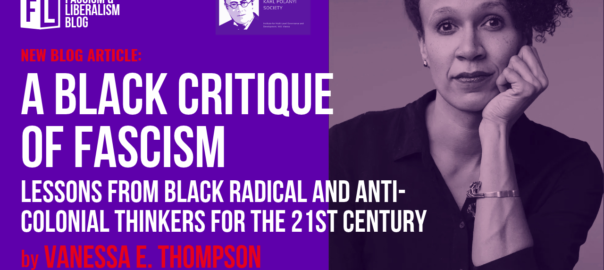
A Black Critique of Fascism: Lessons from Black Radical and Anti-Colonial Thinkers for the 21st Century

by Vanessa E. Thompson

30.10.2026

From genocidal colonial violence and the terror of racial apartheid and lynching regimes to mass incarceration and related methods of surplus containment, such as border regimes, these forms of rule have combined legal normality for some segments of society with systematic violence against racialized working-class and working-poor populations. Tracing the rich tradition of Black radical and anti-colonial critiques of fascism, Vanessa E. Thompson argues that we must not confine our analysis to European fascism of the early twentieth century. Moreover, Black radical and anti-colonial thinkers offer a perspective in which fascistization – that is, the transition toward more fascist forms of rule – is not regarded as the antithesis of liberal democracy but as embedded within liberal-democratic rationalities and projects. This perspective holds important lessons for renewing anti-fascist politics today: the task is not merely to combat the far right, but also to confront the social conditions and state dynamics in liberal democracies that drive fascistization.

This text first appeared in the German magazine LuXemburg. The Fascism & Liberalism Blog is honored to publish this shortened and translated version with the kind permission of Vanessa Thompson. 
 

“Fascist governments do not permit revolutionary or progressive opposition groups to exist, no matter how peaceful or nonviolent they are. It doesn't matter whether the fascist government simply outlaws the groups, like in Nazi Germany, or mounts a counterintelligence campaign to destroy opposition groups, like in the U.S.” - Assata Shakur, 1987

In light of the second Trump administration’s designation of Antifa as a domestic terrorist organization in 2025, the statement by the late Black revolutionary Assata Shakur appears strikingly prescient. Importantly, it represents a critique of fascism that is not limited to drawing analogies with the historical European cases, but identifies elements of fascist rule across different spatial and temporal contexts. The Black radical and anti-colonial theorists who developed this tradition understand fascism primarily in relation to capitalist social relations, crisis and the imperialist drive for expansion, and to forms of extra-economic violence that shape the dynamics of capitalism. What can we learn from their analyses at a time when discussions of a new fascism are once again dominated by Eurocentrism? 

Colonialism as a Prefiguration of Fascism

As early as the interwar years, Black Marxists and radical anti-colonial theorists argued that the fascism emerging in Europe was not a “new” phenomenon but had already been embedded in Europe’s colonial projects. Colonial techniques and forms of accumulation such as the legally protected exploitation of “unfree” labor and racial governance through violence and coercion were, in a sense, a prefiguration of fascism. From this perspective, the genocidal campaigns and methods of Belgian and German colonialism in present-day DR Congo (1885–1908) and Namibia (1904–1908) can be understood not only as precursors to the Nazi’s systematic mass murder, but as instances of what Alberto Toscano calls “fascism-before-fascism” [1].

At the time, Black and Third World Marxists such as George Padmore and C.L.R. James understood fascist rule as both a reaction to capitalist crisis and an expression of Western imperialism. Consequently, they saw “democratic” imperialism (as allegedly opposed to fascist imperialism) as incapable of truly combating fascism. Tellingly, the struggle of “democratic” (British and French) imperialism against European fascism left not only colonial rule intact but also the very conditions that had given rise to fascism in the first place.

“If the fascists win they will take the colonies back. If the ‘democracies’ win they will keep them. But whether ‘democracies’ win, or fascists win, the Africans remain slaves in their own country” - C.L.R. James, 1939

It was on these grounds that George Padmore, a Caribbean Marxist who organized dockworkers and sailors in Hamburg on behalf of the Comintern in the late 1920s and early 1930s, criticized the Comintern’s collaboration with the “democratic” imperialist powers – France, the United States, and Great Britain – in the fight against fascism. Rather than rejecting any popular front or cooperation between socialist and social democratic/centric forces per se, Padmore was obviously concerned about its political orientation. He was convinced that anti-fascist alliances would be ineffective if they left the root causes of fascism, including its colonial dimension, unaddressed. As Alberto Toscano also noted, in his 1936 book How Britain Rules Africa, Padmore argued that the racism of the settler colony was “the breeding-ground for the type of fascist mentality that is being let loose in Europe today” and that South Africa was “the world’s classic Fascist state” based on the “unity of race as against class” [2].

The Trinidadian historian C.L.R. James took a similar position, noting that after their victory in the First World War, Great Britain, France, and Belgium simply took over Germany’s colonies. His diagnosis in 1939 was equally bleak: “If the fascists win they will take the colonies back. If the ‘democracies’ win they will keep them. But whether ‘democracies’ win, or fascists win, the Africans remain slaves in their own country” [3]. With these arguments, Padmore and James anticipated Aimé Césaire’s better-known analysis in his Discourse on Colonialism (1950), in which he describes fascism as a “a formidable shock in return” of colonial violence that reverberated from the colonies back to the European metropolises (often translated, somewhat inaccurately, as “boomerang”). Césaire points out that as long as National Socialism was only being imposed on non-European peoples, Europeans could turn a blind eye to it, could excuse and legitimize it [4].

Racial Fascism in the Segregated United States

While the before-mentioned authors analyzed fascism from the perspective of the so-called periphery, Black radicals in the U.S. focused on the Western core. In his 1935 classic Black Reconstruction, the Marxist sociologist W.E.B. Du Bois emphasizes that fascist tendencies are deeply rooted in the structure of liberal democracies, also domestically [5]. He argues that following the Reconstruction – the rebuilding and reintegration of the U.S. South after 1865 – and the possibility of multi-racial class struggle and transformation, the capitalist class of plantation owners carried out a “counter-revolution of property”. Facing their defeat and the formal abolition of slavery, they shifted their strategy to integrating white workers into the political-ideological project of racist supremacy and the massive deployment of racist terror against Black and non-white workers. This included the introduction of new forms of forced labor such as the convict-leasing system and the Black Codes – a series of laws enacted in former Confederacy states explicitly designed to continue to limit the rights and freedoms of Black people to ensure their super-exploitation. A sophisticated legal apparatus enshrined racial segregation and prevented any form of social, economic, or political participation along racial lines. Additionally, parts of the executive state apparatus, particularly local and state law enforcement, often operated with considerable autonomy and in close collaboration with the Ku Klux Klan, terrorizing Black populations across the South. 

According to Du Bois, all of these are characteristics of fascism: the daily racist terror of the lynching regime, forced labor on the plantations and regimes of super-exploitation, the systematic dehumanization and racist segregation in all areas of life, the denial of civil rights, and the normalization of an apartheid regime. In sum, U.S. society was characterized by the coexistence of the rule of law for some and unrestricted “arbitrariness” for others. Du Bois’ analysis of fascism is thus surprisingly similar to the concept of the “Dual State” in the analysis of National Socialism by the Jewish political scientist Ernst Fraenkel. Fraenkel’s description of how legal normality and a regime of arbitrariness and coercion coexisted in Nazi Germany is regarded as a seminal work in the study of fascism. However, as Alberto Toscano points out in his book Late Fascism, racial fascism went unnoticed “because it operated on the other side of the colour line” [6]. In fact, structural racism shapes what is perceived as fascism in the first place and which coercive relations are considered a “normal” part of state rule.

According to Toscano, Black radical, Marxist, and anti-colonial approaches show that fascism should not be understood statically as a shift from liberal to fascist regimes, but rather as an ideological and political process that “targets racialized and subaltern population groups in differentiated ways” [7]. They demonstrate that fascism is not a uniform phenomenon conforming to a particular “template”, such as German or Italian fascism. Instead, colonial and racialized capitalism and imperialism were always accompanied by fascist potentials, ideological elements, and practices that developed before the rise of fascism in Europe.

Black Radical Anti-Fascism in the Post-War and Neoliberal Era

"Fascistization can unfold within liberal democracies rather than standing in fundamental opposition to them."

Black radical analyses of fascism in the above-described tradition remained relevant in the postwar era, too. The Black Caribbean communist Claudia Jones, the prisoner and Black Guerrilla Family member George Jackson, as well as the Black feminist philosopher Angela Davis each describe processes of fascistization as a recombination and intensification of power relations intended to block a potential revolution by the exploited and disenfranchised in times of crisis.

Claudia Jones, who was deported to England during the McCarthy era, analyzed McCarthyism as a process of fascistization that involved large-scale repression against leftists, workers, and anti-imperialist organizations [8]. In doing so, Jones showed that fascistization can unfold within liberal democracies rather than standing in fundamental opposition to them.

Two decades later, amid the crushing of revolutionary movements and the onset of the neoliberal counter-revolution, George Jackson identified another fascist conjuncture in the United States. Writing from his cell at the notorious San Quentin State Prison (before being shot and killed while attempting to escape in 1971) Jackson described the relationship between prisons and fascistization. According to Jackson, the function and expansion of the prison system characterized the transition from the plantation society to the integration of Black workers into the wage labor regime. However, Jackson did not view the prison, including its political-economic function, as a continuation of slavery, which was geared towards the production of cotton, sugar, and coffee based on “unfree” labor. Rather, he viewed the prison as a state method for the suppression of revolutionary resistance and containment of the primarily racialized subproletariat and surplus populations. In the face of escalating crises, the expansion of the repressive state helps to forcibly assert class power [9]. 

"Against the backdrop of the capitalist polycrisis and intensifying competition for resources, these systems of warfare – including borders, prisons, and deportation regimes – present the model of 'accumulation through repression'."

In the following years, this form of crisis response and regulation would also become an essential element of the authoritarian-neoliberal politics of Thatcherism. In their 1978 book, Stuart Hall and his co-authors coined the term “policing the crisis” to describe the authoritarian, police-driven targeting of marginalized and migrant segments of the working class [10]. Hall understood these developments as a prerequisite for the emergence of new right-wing politics and ideology. In a similar vein, Ruth Wilson Gilmore, in her 2007 book Golden Gulag, described the neoliberal counter-revolution as a shift from military Keynesianism to “post-Keynesian militarism” [11] where instruments of crisis management – prisons, police, and borders – were massively expanded and strengthened – also in liberal-democratic states.

The culmination of this development is what contemporary sociologist William I. Robinson identifies as the rise of a “global police state,” increasingly facilitated by new technologies [12]. Beyond its function as a crisis response, Robinson also highlights its capacity to generate profits. Against the backdrop of the capitalist polycrisis and intensifying competition for resources, these systems of warfare – including borders, prisons, and deportation regimes – present the model of “accumulation through repression.” In his view, 21st-century fascism advances through an alliance between the faltering liberal-authoritarian “reformism from above” and right-wing authoritarian projects. Although ideologically not completely coherent, this new bloc cooperates effectively in expanding the regimes of warfare and carcerality.

Lessons from Black and Feminist Abolitionists for the 21st Century

"Black radical, anti-colonial and feminist abolitionist thinkers teach us that a simple restoration of welfare states – distinguishing between “deserving” and “undeserving” poor – does not bring processes of fascistization to an end. Rather than focusing solely on the role of far-right parties and movements, anti-fascist struggles today must also target the state mechanisms that drive fascistization."

In the past years we have witnessed massive state repression against Palestine solidarity protests, the multi-billion-dollar expansion of border regimes, and the increasingly stratified exploitation, containment and racist control of “surplus” populations. All these developments show that fascistization does not require fascists to be in power. Whether at the external borders of the EU, in prisons, or in impoverished and heavily policed neighborhoods, racialized working class and working poor people have long been subjected to forms of fascist violence.

For years, abolition feminists in Brazil, the U.S., and Europe have argued that the “policing of the crisis”, that is, the criminalization and containment of migration and poverty, must become the focal points of anti-fascist struggles – as exemplified by the widespread protests against border regimes and violence, of which the ICE raids are just one articulation. Abolition feminists also link struggles against carceral violence with struggles against privatization, the commodification of land and against all forms of warfare. Calls for the socialization of care work likewise advance a vision of the demilitarization and “de-incarceration” of society [13]. Together, these abolitionist struggles pave the way for new forms of anti-fascist internationalism.

Abolition feminists thus expand the scope of anti-fascist struggles not only by focusing on the social conditions and crises that give rise to fascistization in the first place, but also by promoting a materialist anti-fascist politics centered on workers – both in production and social reproduction – and the struggles of so-called “surplus” populations. In doing so, they overcome the severe limits of historical European anti-fascism and conventional labor struggles as well.

Crucially, Black radical, anti-colonial and feminist abolitionist thinkers teach us that a simple restoration of welfare states – distinguishing between “deserving” and “undeserving” poor – does not bring processes of fascistization to an end. Rather than focusing solely on the role of far-right parties and movements, anti-fascist struggles today must also target the state mechanisms that drive fascistization. This approach can offer a genuine alternative to the emerging late fascism: through abolition – that is, the internationalist dismantling of racist, gendered, and capitalist relations of production and imperialist violence, as well as the institutions that perpetuate them, in favor of an abolition democracy. 
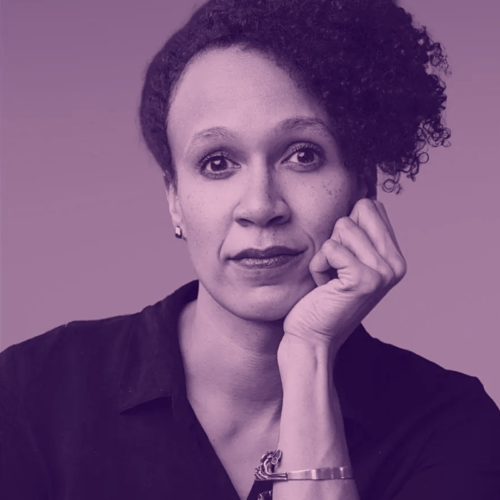
headshot Vanessa E. Thompson

Vanessa E. Thompson is Associate Professor for Black Studies at the Department for Gender Studies at Queen’s University, Canada. Her work focuses on the relationship between racism and state violence, abolition, anti-colonial theories, and internationalism.

References

  1. Toscano, Alberto. 2025. “The Changing Strategies of Counter-Revolution.” Communis, June 10, 2025. 
  2. George Padmore (1936) cited in Toscano, Alberto. 2023. Late Fascism. Race, Capitalism and the Politics of Crisis, London: Verso, p.28. 
  3. James, C. L. R.. 1939. “Why Negroes Should Oppose the War.” Marxists Internet Archive. 
  4. Césaire, Aimé. 2000 (1955). Discourse on Colonialism. New York: Monthly Review Press. 
  5. Du Bois, W. E. B. 1998. Black Reconstruction in America, 1860–1880. New York: Free Press. 
  6. Toscano, Alberto. 2023. Late Fascism: Race, Capitalism and the Politics of Crisis. London: Verso, p.29. 
  7. Toscano, Alberto. 2025. “Das Gefängnis als faschistisches Labor.” nd, June 9, 2025.
  8. Jones, Claudia. 1949. “An End to the Neglect of the Problems of the Negro Woman.” Political Affairs, June 1949, 51–67.  
  9. Rodney, Walter. 1971. “George Jackson: Black Revolutionary.” Maji Maji 5: 4–6. 
  10. Hall, Stuart, Chas Critcher, Tony Jefferson, John Clarke, and Brian Roberts. 1978. Policing the Crisis: Mugging, the State, and Law and Order. London: Macmillan. 
  11. Gilmore, Ruth Wilson. 2007. Golden Gulag: Prisons, Surplus, Crisis, and Opposition in Globalizing California. Berkeley: University of California Press. 
  12. Robinson, William I. 2020. The Global Police State. London: Pluto Press. 
  13. e.g. Bhattacharya, Tithi. 2024. “Social Reproduction Theory as Diagnostic, Abolition as Politics: Reimagining Anticapitalism.” Labor 21(4): 117–129. 

Further Reading

  • Burden-Stelly, Charisse, 2019: Claudia Jones, the Longue Durée of McCarthyism, and the Threat of US Fascism, in: Journal of Intersectionality 3(1), 46–66 
  • Kelley, Robin D. G., 2025: The Black Radical Tradition Against Fascism and Genocide: The Long Durée, Media Education Foundation,
  • Samudzi, Zoé, 2021: Paradox of Recognition: Genocide and Colonialism, in: Postmodern Culture 31  
  • Walia, Harsha, 2021: Border and Rule: Global Migration, Capitalism, and the Rise of Racist Nationalism, Chicago 
  • Zelik, Raul, 2025: Treiber des Faschismus, in: ak: analyse und kritik 716

F&L Blog Ann Pettifor

F&L Blog – In Search of Protection

In Search of Protection: Why Global Financial Markets Fuel the Far Right

by Ann Pettifor

09.07.2026

Why are so many people willing to trade democracy for authoritarian promises of protection? According to political economist Ann Pettifor, humans share a need for social, economic, and ecological security. This need, however, has been undermined by globalised markets in money, energy, food and housing as well as the US dollar standard. The consequent existential precarity is a primary reason why far-right leaders with their promises of protection and strength appeal to a growing number of people. Thus, Pettifor calls for a financial order that again subordinates global financial markets to public control.

Human Insecurity and the Need for Protection

Human beings have a fundamental need for security. In their book “Human Givens”, Joe Griffen and Ivan Tyrrell  outline a radical new framework for the practice of psychiatry, psychotherapy and counselling based on the idea that humans, like all living organisms, share innate needs. These inbuilt patterns are nature’s genetic endowment. According to Griffen and Tyrell, we seek to fulfill these emotional needs not only for our well-being, but ultimately for our survival.  Fortunately, our needs are only one half of the story, write Griffen and Tyrrell. Nature has also provided us with a wealth of resources to help us get those needs met.

According to the authors, one of our most important needs is security – or safe territory. An environment which enables us to lead our lives without experiencing undue fear and anxiety, and that ensures we develop fully. Our need to feel secure is closely connected, the authors explain, to our innate need for control and autonomy.

"the world has once again become profoundly insecure. Societies turn to authoritarian strongmen and women for protection from the globalised markets of our era"

Griffin and Tyrell’s insights allow us to acknowledge that when economic, social and ecological life becomes increasingly precarious, people do not simply demand more freedom – they demand protection. However – just as “in the early thirties, with an awe-inspiring vehemence”[1] – the world has once again become profoundly insecure. Societies turn to authoritarian strongmen and women for protection from the globalised markets of our era – markets in money, energy, food, and housing that, while enriching the already wealthy, have stripped millions of incomes, secure work, the right to a decent home, and affordable food. These insecurities have led many societies to turn away from what passed as democratic politics and towards far-right leaders promising protection. Donald Trump, for example, appealed to workers in the American Rust Belt by promising to protect jobs and incomes through walls against Mexico and China.

Thus, I argue, global financial markets are one of the key reasons why authoritarian leaders have become attractive again across the world. It is not inequality alone that drives the far right, but the widespread experience of insecurity generated by an international financial order that has subordinated democratic politics to global markets.

The recent turn away from democracy and towards authoritarianism has been remarkably rapid in historical terms and has spread across an extraordinary range of countries—from the United States under Trump, to India under Modi, Russia under Putin, China under Xi Jinping and Brazil under Bolsonaro, with many more countries like Indonesia, Ethiopia and Vietnam following similar trajectories. As the ‘Tyranny Tracker’ illustrates, authoritarian rule is no longer confined to a handful of countries but has become a defining feature of today’s political landscape. Of all 179 countries covered by the tracker, only 74 are classified as democracies, 25 as hybrid authoritarian regimes, and 80 as fully authoritarian regimes.

Authoritarianism and Its International Roots: From the Gold Standard to the Dollar Standard

“[the] bird’s-eye view of the quarter-century, 1914-39, shows clearly that change was sudden and world-wide, including in range, countries of the most various social and political complexion. Only a cause external to them all could have had such an effect" - Karl Polanyi 1940 [1]

What explains the remarkably simultaneous rise of authoritarian politics across countries with very different political traditions? As Karl Polanyi argued of the 1930s, “only a cause external to them all could have had such an effect.” The external cause of this era’s rise in authoritarianism worldwide, I argue, is the insecurity generated by the globalised financial system and the US Dollar Standard – a system that in many respects mirrors the gold standard of the 1930s. Polanyi described the “fount and matrix” of that earlier international order as the self-regulating market, built around markets in the fictitious commodities of labour, land and money. Much the same can be said of today’s financial order.

To paraphrase Polanyi, since President Nixon dismantled the Bretton Woods international financial architecture in 1971, little has been allowed to impede the expansion of private global markets in money, labour, energy, food and housing [2]. Prices, supply and demand have increasingly been left to market forces, while governments have retreated from regulating markets in the public interest. Neither price, nor supply, nor demand were fixed or regulated: only such policies and measures were introduced which helped to ensure the self-regulation of the market. The result has been an international economic order in which global markets have become the only organizing power in the economic sphere.

"[...] globalised markets increasingly disturbed and ruined our daily lives and livelihoods by way of financial, political and ecological volatility, leading periodically to catastrophic crises and causing growing insecurity"

Reflecting on the collapse of the Gold Standard and the rise of fascism, Polanyi concluded in a 1940 lecture that “neither liberal capitalism nor representative democracy could function satisfactorily under such conditions” [3]. His insight remains strikingly relevant today.

The willing surrender of the world’s parliaments and congresses to government by private, globalised markets in the neoliberal era, increasingly hollowed out political power and bred cynicism and disillusion with so-called democratic politics. The governance of globalised markets was not only deliberately detached from democratic, regulatory oversight, globalised markets increasingly disturbed and ruined our daily lives and livelihoods by way of financial, political and ecological volatility, leading periodically to catastrophic crises and causing growing insecurity.

The Neoliberal Age: Financial Crises and Wars

What ensued from these neoliberal market policies was a non-stopping wave of financial crises: The sovereign debt crises of low-income countries began at the fringes of the global economy in the 1970s, 80s and 90s. With the following dotcom crisis of the 2000s – which was caused by the widespread euphoria over the internet and new telecommunication technologies – financial crises shifted to the Western core.

Since the start of the twenty-first century, as awareness grew of the threat posed by ecological breakdown, societies have endured recurring global crises and growing precarity:  The world lurched from the Great Financial Crisis (GFC) of 2007-09, to the 2009-10 European debt crisis, to the collapse of the repo market, i.e. shadow banking, on 17 September 2019 which led to massive central bank bailouts. The wave of crises continued from the COVID-induced stock market crash in February 2020, to the shadow banking crash in March 2020, to the 2021-2024 global cost-of-living crisis.

In reference to the 1930s, Karl Polanyi argued that the economic system has led to a social and economic “transformation of planetary range […] topped by wars of an entirely new type in which a score of states have crashed, and the contours of new empires are emerging out of a sea of blood”. [4] Today, similar dynamics can be seen in Russia’s long war against Ukraine, the ongoing devastation in Gaza following the Hamas attack on Israel, and the subsequent immiseration and deliberate genocide of tens of thousands of Palestinians in Gaza. The disastrous 2026 war against Iran, led by Israel and the United States led to the closure of the Strait of Hormuz, driving energy prices sharply upward and intensifying both the cost-of-living crisis and global ecological pressures. 

Toward a Global Financial Order for Security

"we must once again draw on our own personal resources to build the international coordination and cooperation needed to restore humanity’s and the ecosystem’s profound need for stability, security and autonomy."

Taken together, these developments provide stark evidence that the contemporary US dollar-based financial order has become a destabilising force in global politics and material life. Looking at the multiple wars, rising costs and ensuing resource shortages there can be no clearer evidence that today’s US dollar standard of globalised financial markets threatens to physically destroy human society and to transform the ecosystem into a wilderness.

Yet this is not an inevitable condition. An international financial order that subordinated finance to democratic priorities has existed before. We did this as a world community, at Bretton Woods in 1944, when the world’s leading economists gathered to design an international financial system that rejected the globalisation of the 1930s, and built a system that subordinated global markets to the interests of states. These states worked inter-nationally to create what is known in all economic textbooks as ‘the golden age’. An age when governments exercised power over cross-border capital flows; used central bank powers to manage the creation of credit, and regulation to intervene in the conduct of markets in money, labour and land. It was an era in which humanity experienced relative peace, security and stability, thanks to the subordination of global markets to democratic regulation in the interests of society.

Society’s only hope today is to draw on nature’s wealth of resources to restore some sense of security and stability to both humanity and the ecosystem. The ability to mobilise those resources requires wise leadership, solidarity and community and the political power needed to, once again, subordinate global markets to the interests of society and the biosphere.In other words, we must once again draw on our own personal resources to build the international coordination and cooperation needed to restore humanity’s and the ecosystem’s profound need for stability, security and autonomy.

Ann Pettifor is a political economist, author, advisor and public speaker. Her work focuses on the global financial system, sovereign debt restructuring, international finance and sustainable development.

References

  1. Karl Polanyi, 1940. Lecture 1: The Passing of 19th Century Civilization
  2. Karl Polanyi, The Great Transformation, 1957, p.72
  3. Karl Polanyi, 1940. Lecture Four: Is America an Exception?
  4. Karl Polanyi, 1940. Lecture Four: Is America an Exception?, p. 4.

Further Reading

  • Pettifor A. (ed.) (2003) The Real World Economic Outlook: the legacy of globalization, debt and deflation. London: Routledge. 

  • Pettifor, A. (2005) The Coming First World Debt Crisis. London: Palgrave.

  • Pettifor, A. (2017) The Production of Money. London: Verso.

  • Pettifor, A. (2019) The Case for the Green New Deal. London: Verso.

  • Pettifor, A. (2026) The Global Casino: How Wall St Gambles with People and the Planet. London: Verso.

  • Polanyi, K. (1940). Lecture 1: The passing of 19th-century civilization. The Present Age of Transformation.

  • Polanyi, K. (1940). Lecture 4: Is America an exception? The Present Age of Transformation.

  • Polanyi, K. (1957). The great transformation: The political and economic origins of our time. Beacon Press.

F&L Blog – Muskism, Trumpism, Masculinism

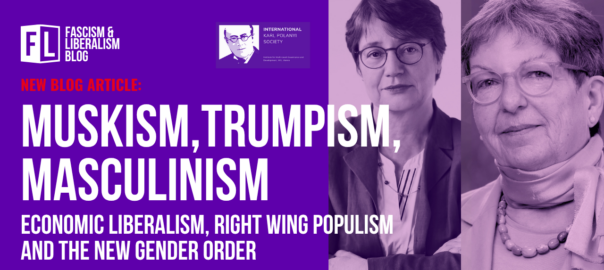
Muskism, Trumpism, Masculinism: Economic liberalism, right-wing populism and the new gender order

by Brigitte Aulenbacher & Birgitt Riegraf

21.05.2026

From “masculine energy” to “tradwives” – contemporary far-right political-economic movements are interwined with a new gender order which is not incidental, but core to understanding their rise, argue Brigitte Aulenbacher and Birgit Riegraf in this latest blog piece. With a focus on the USA, the authors compare the emergence of right-wing populism today, with roots in the aftermath of the 2007-08 financial crash, with the “countermovements” to economic liberalism witnessed by Karl Polanyi during the Great Depression. In contrast to their declared aims, both movements ultimately served to support liberal economic elites. The new era of “Muskism” and “Trumpism” carries on in this tradition, exemplified by the close relationship between governments and powerful tech elites. As a driving force of this development, the authors identify a new masculinism giving shape both to economic liberalism and the gender order.

The rise of contemporary right-wing populism: a Polanyian “countermovement”

“The demand for a more traditional and aggressive form of masculinity functions as an economically and politically charged resource: as a promise of economic and technological growth in times of crisis, and as a promise of order and control in a seemingly chaotic world."

Today’s populist far right has its roots in the early stages of neoliberal globalization. Karl Polanyi wrote his masterpiece The Great Transformation while witnessing the “movement” toward forced economic liberalism in the early 20th century and the emergence of „countermovements“ seeking protection from its destructive effects, such as the socialist, fascist-social and partisan movements, and the New Deal. While there are key differences between the stock market crash of 1929 and the neoliberal era’s financial crisis in 2008 (and their respective effects in terms of precarity, poverty, and social decline) there are historical parallels in that both marked important turning points which strengthened right-wing populism. Several developments point to the rise of the contemporary far right as such a Polanyian „countermovement“. Within Europe, Hans-Jürgen Bieling [1] identifies the crises of finance, poverty and forced migration in the face of wars as a historical „window of opportunity,“ which helped to promote right-wing parties and social movements, and their respective agendas and ideologies. Arlie Hochschild [2] came to a similar diagnosis with regard to the USA. 

At the same time, these movements contain inherent contradictions: they are what Klaus Dörre terms “ambivalox” – a mix of ambivalence and paradox [3]. Many right-wing parties combine economic liberalism with the promise of social protection by transforming questions of social justice into questions of belonging: in terms of “Volk“ (nation), ethnicity, race and citizenship. As found by Atzmüller, Décieux and Ferschli [4], this is used to justify austerity policies. By promising social advancement instead of decline, right wing parties and social movements attract the votes of the working and middle classes. The flipside of this promise is that social concerns are turned into anti-democratic action as they seek to undo emancipatory progress in the politics of equality, diversity, and inclusion as well as the rights of women, migrants and LGBTQI+ communities. At its core, right-wing populism uses identity politics to address the native male working and middle classes –  intermediated by emotions or “affective politics“ and the respective “affective narratives”, [5] while forcing economic liberalism and promoting the respective elites’ agenda. 

Trumpism and Muskism: an elites’ Polanyian movement

A deeper understanding of the phenomenon underlying “Trumpism” (as explored by Faude & Heinkelmann-Wild [6]), or “Muskism” can be gleaned from the recent work of Quinn Slobodian and Ben Tarnoff with On Muskism. A Guide for the Perplexed [7]. In it, the authors diagnose a new era of economic liberalism characterised by the following shifts: authoritarian deglobalization replacing neoliberal globalization; a reconfiguration of the relationship between the economy and the state; new modes of production combined with the reorganization of work and everyday life; as well as a heightened emphasis on technological progress and the relationship between humans and technology.

We put forward that such new alliances between representatives of the most powerful parts of the private sector — such as the tech industry — and authoritarian political forces, constitute a new Polanyian “movement”, one which moves toward forced economic liberalism as soon as the latter enter government. And this development is also inextricably linked to gender relations that are deeply embedded within this process of transformation, be it in Hungary, Argentina, or the USA. Drawing upon the concept of “hegemonic masculinity” by Raewyn Connell [8], we now examine masculinism as a driving force in terms of both the scope and direction of societal transformation. For the purposes of brevity, we limit our analysis to the USA.

Trumpism, Muskism and Masculinism

"If Trumpism or Muskism is characterized by an emphasis on national interests and a new form of technological and economic aggressiveness, this is — quite deliberately — intertwined with the propagation of a new “hegemonic masculinity“ and the celebration of “emphasized femininity.”

If Trumpism or Muskism is characterized by an emphasis on national interests and a new form of technological and economic aggressiveness, this is — quite deliberately — intertwined with the propagation of a new “hegemonic masculinity” and the celebration of “emphasized femininity” (as per Raewyn Connell,  enacted in ways that are compliant with, accommodating and subordinated to masculinism). We can hear this rearticulation, intensification, and reconfiguration of male dominance when Meta CEO Mark Zuckerberg calls for more “masculine energy” in business and society — thereby joining other tech giants in promoting an ideal of hyper-individualized, market-driven masculinity. This is then cast in opposition to a “feminine” — or even “effeminate” — energy, which is portrayed both as the very cause of economic, technological, and political insecurities, while appearing powerless to counter them. By contrast, this new masculinity actively embraces all such uncertainties as trials by combat, tests of mettle, and opportunities for personal growth. This embodies precisely what Connell conceptualizes as “hegemonic masculinity” — a construct, the restoration of which attempts to reinstate a lost social order by firmly re-cementing the boundaries of both nation and gender roles. Movements such as that of the “Tradwives”, as investigated by Scott and Day [9], in turn serve as the counterpart designed to stabilize the male hegemonies championed by Trumpism and Muskism.

As such, contemporary economic and neoliberal political transformations are inextricably linked to the enforcement of an aggressive model of hegemonic masculinity in two distinct ways: on the one hand, by directly conflating the propagated ideal — characterized by entrepreneurial combativeness and risk-taking, authoritarian assertiveness, disruptive social and technological innovation, and fantasies of technological control — with the demand for the rehabilitation and resurgence of aggressive male conduct. On the other, tech elites and the far right not only propagate visions of boundless market utopias, but simultaneously mobilize anti-institutional sentiments — sentiments directed, for instance, against equality policies and democratic procedures in general, disparaging these as both the root cause of societal ills and an impediment to social progress. In both instances, the demand for a more traditional and aggressive form of masculinity functions as an economically and politically charged resource: as a promise of economic and technological growth in times of crisis, and as a promise of order and control in a seemingly chaotic world.

Hegemonic masculinity as central to understanding today’s new economic order

Figures such as Elon Musk and Donald Trump exemplify this dynamic. Their public self-presentation fuses the call for economic libertarianism with a performative reaffirmation of a supposedly lost male sovereignty — whether adopting the persona of the disruptive entrepreneur or that of the authoritarian decision- and deal-maker who pointedly distances himself from any behavior connoted as non-traditionally masculine or feminine. These performances, then, constitute something far more than mere matters of style; rather, they are an integral component of a hegemonic project in which economic deregulation and the hollowing out and capturing of the state are inextricably interwoven with the rearticulation, intensification, and reformation of hegemonic masculinity and traditional gender relations.

The on-going rise of techno-libertarian and right-wing populist ideologies — premised upon the restoration of hegemonic masculinity — is thus the expression of a deeper, underlying dynamic. It is akin what Karl Polanyi in The Great Transformation described as economic liberalism’s  “utopia” of an economy and a society regulated by the market  — a process that, in this instance, is socially, culturally and politically shaped — and simultaneously intertwined — with a radicalized form of hegemonic masculinity that presents itself as a response to a perceived loss of control. It is therefore essential to take hegemonic masculinity seriously, not as a marginal phenomenon, but as a central foundation of contemporary processes of societal transformation.

Brigitte Aulenbacher

Brigitte Aulenbacher is Professor of Sociology at Johannes Kepler University Linz. She combines studies on science, domestic work, senior care and the digital transformation of work with the analysis of contemporary capitalism.

Birgitt Riegraf is Professor of General Sociology at the University of Paderborn. Her research focuses on the sociology of science and higher education, gender studies, critical analyses of the capitalist care economy, and questions of social inequality and intersectionality.

References

  1. Bieling, Hansjürgen (2017): Aufstieg des Rechtspopulismus im heutigen Europa – Umrisse einer gesellschaftstheoretischen Erklärung, in: WSI-Mitteilungen 70(8), S. 557–565. 
  2. Hochschild, Arlie (2016): Strangers in their own Land. Anger and Mourning on the American Right, New York/London. 
  3. Dörre, Klaus (2019): “Take Back Control!” Marx, Polanyi and Right-Wing Populist Revolt, in: Österreichische Zeitschrift für Soziologie 44, pp. 225–243.
  4. Atzmüller, Roland/Décieux, Fabienne/Ferschli, Benjamin (eds.) (2023): Ambivalenzen in der Transformation von Sozialpolitik und Wohlfahrtsstaat. Soziale Arbeit, Care, Rechtspopulismus und Migration, Weinheim 
  5. Faude, Benjamin/Heinkelmann-Wild, Tim (2025): Destruction or renewal? Trumpism and the Future of Global Governance, in: Global Public Policy and Governance 5, pp. 305–315. Link
  6. Sauer, Birgit (2026): Affektiver maskulinistischer Widerstand gegen Quotenimplementierung in Europa. Kämpfe um die (Un-)Sichtbarkeit von Frauen in der Politik, in: Feministische Studien 1/2026, S. 48-65; Bargetz, Brigitte/Eggers, Nina Elena (2023): Affektive Narrative: Theorie und Kritik politischer Vermittlungsweisen, in:  Politische Vierteljahresschrift 64, S. 221-246. 
  7. Slobodian, Quinn/Tarnoff, Ben (2026): Muskism. A Guide for the Perplexed, London. 
  8. Connell, Raewyn (1995): Masculinities. Oakland, California.
  9. Scott, Kate/Day, Linsey (2025). TikTok tradwives: femininity, reproduction, and social media, in: Gender and Education, pp. 1–18.

F&L Blog – Beyond Net Zero

Beyond Net Zero: Towards a Climate Politics that Can Defeat the Far Right

by Christopher Shaw

26.03.2026

Christopher Shaw holds Research Associate roles at both the University of Sussex’s School of Global Studies and the Working Class Climate Alliance, and is a leading voice in climate communications in the UK. Below, he argues that the UK’s liberal, technocratic net zero climate politics has reached its limits. By ignoring both the political roots of the climate crisis, and the voices of the working class, net zero has allowed itself to be instrumentalized by the far-right. Drawing on recent political developments, Shaw outlines what a climate politics, rooted in social justice and grassroots democracy, could look like, in the fight not just for heat pumps or electric cars—but a world that feels like home.

The UK’s net zero policy: preserving liberalism versus preserving life

As the centrist waters recede back down the beach of history, climate policies are left stranded and exposed on the shore, flapping about like so many dying fish. Who will fight for net zero now? Not the European Union it seems, which is busy shredding many of its flagship climate policies, whilst the long standing net zero consensus in the UK is now coming apart. Even climate researchers supportive of net zero remain divided over the ability of net zero to deliver emission cuts quickly and fairly. To cap it all, campaigners have seen twenty years of efforts to get people to adopt the low carbon behaviours needed to deliver net zero come to naught. The rapid and ongoing collapse of the net zero policy architecture leaves climate campaigners with two choices. The first is to double down on net zero, turning increasingly to geo-engineering and technological innovation as the primary tools used to fix the climate. This limits the need to involve people or politics. The only choice the public needs to make is whether to install an air source or ground source heat pump. The second option is to recognise that the climate fight is, and always has been, political. Campaigners are choosing the first option, a strategy destined to fail further and faster than ever before. Rather than trying to lift climate policy out of the democratic sphere, we need narratives that present climate change as a product of the same politics that have delivered austerity, inequality and war. Fixing climate change means fixing the political conditions that are generating these crises. If this is not a fight the existing liberal climate movement wants to take on, we will need a new climate movement, one that does not prioritise the preservation of liberalism over the preservation of life.

The myth of the good liberal citizen

"Support for net zero has also come to stand as a marker of whether or not you are a good liberal citizen."

There is more anger, resentment and fear abroad today than liberal politics can assimilate – liberal politics and the current public mood are as oil and water. Liberal climate policy remains wedded to the hope that the evidence-based application of intellect and reason will dissipate both greenhouse gases and public anger. Through calculation and rational deliberation we can fashion a painless technocratic and reformist path to the net zero land beyond history. Liberals look to an eternal tomorrow of ‘self-regulating citizens conducting resource-efficient and sustainable lives’, enjoying outdoor yoga, cycling to the repair cafe. The mainstream climate movement is blind to the true function of net zero; it is an idea created by the allies of capital as an instrument of control, handed over to the middle class liberal climate movement to then sell to the working class as their only hope of a decent life. Support for net zero has also come to stand as a marker of whether or not you are a good liberal citizen. It doesn’t matter if you enabled the bombing of 2 million Gazans or got rich from an exploitative finance system. If you are on board with net zero then you are part of the liberal climate family. As a consequence, your voice is more deserving of attention and obedience than a poor person of poor means who is critical of net zero. If you want to identify as a progressive then you have to support net zero. If you don’t support net zero you are a fascist.

Towards a climate politics that can defeat the far right

"The UK Green Party recently overturned a huge Labour majority without once mentioning climate change in their leaflets"

There is much excellent theoretical and practical work to draw on when thinking about what sort of climate politics can defeat the far right. Efforts to articulate and promote a Green New Deal offer vital insights for how to combine climate policy with an anti-austerity, anti-imperialist agenda. Community engagement projects across Europe have identified important knowledge about barriers and opportunities for combining climate action with social justice campaigns. These ideas will remain on the margins all the while climate organizations continue drawing from the same privileged strata of society, or insist any subaltern actors must adopt middle class values and norms before being allowed into the circle. The political shift we are seeing as parties of the left and far right gain momentum is an opportunity for the climate movement to jump to the left and engage in the battle for humanity’s future.

The UK Green Party recently overturned a huge Labour majority without once mentioning climate change in their leaflets, focusing instead on poverty and the destruction of public services. This reflects a deep public rift with the liberal climate agenda. It points toward the path we need to take — further and faster, in the opposite direction to that mapped out by net zero narratives: away from global and towards the local, away from work and towards play, prioritise the human over the machine, democracy over technocracy, the substantive over the abstract, equality over difference, the social over the individual. It is only from these foundations that we can undermine the allure of far-right politics, whilst building a climate strategy from the bottom up.

For a world that feels like home

"Such technologies may be a part of living in a carbon-constrained world, but the first task is to recreate the social world, to make a world people feel at home in, feel rooted in, have control over."

The failure of the liberal climate movement is in part a failure to understand human nature. Liberalism, and the climate policies it has birthed, wrongly assume there is a space above and beyond the human heart. We cannot escape our own subjectivity. Right-wing politicians would rather see the world destroyed than compromise their political beliefs. This is also true for liberalism. This is also true for climate campaigners. This is also true for you and me. I joined the climate fight because it seemed to me the best reason for the ecosocialist future I already wanted. I am not going to fight for a decarbonised capitalist future of ground source heat pumps, a modernised electricity grid, or more EV charging points, even if I thought such things would preserve a liveable future for my children. Such technologies may be a part of living in a carbon-constrained world, but the first task is to recreate the social world, to make a world people feel at home in, feel rooted in, have control over. There seems nothing so thrilling as this prospect. Whilst liberalism makes a fetish of free will and individual autonomy, the vast majority can see that the decisions about our future have already been made for us by experts and leaders. Net zero promised to let the targets be humanity’s guide and leave the politics behind. But actually what we need is maximum politics in climate policy, a genuine grassroots democracy, a mechanism for embracing and channeling public anger towards a world that feels like home, not an innovation hub.

Christopher Shaw holds Research Associate roles at both the University of Sussex's School of Global Studies and the Working Class Climate Alliance, and is a leading voice in climate communications in the UK.

Further Readings

  • Bernstein, Steven. F. (2001). The compromise of liberal environmentalism. Columbia University Press.
  • Crary, Jonathan. (2022). Scorched earth: Beyond the digital age to a post-capitalist world. Verso books.
  • Moyn, Samuel. (2023). Liberalism against itself: Cold War intellectuals and the making of our times. Yale University Press.
  • Rose, Matthew. (2021). A world after liberalism: Philosophers of the radical right. Yale University Press.
  • Shaw, Christopher. (2023). Liberalism and the challenge of climate change. Routledge.

F&L Blog – Silicon Valley Tech For Whom?

Silicon Valley Tech for Whom? From Flying Cars to AI-controlled Weapons Systems

by Claus Thomasberger

29.01.2026

What can the 1930s interwar period teach us about the growing power of Silicon Valley tech monopolies? Below, Claus Thomasberger contrasts two critical works on the role of technology: an article by the late anarchist anthropologist David Graeber, and a book by libertarian thinkers and Palantir executives Alexander Karp and Nicholas Zamiska. Combining these with Karl Polanyi’s observations of how corporate interests aided the rise of fascism and sidelining of democratic and civil liberties in the 1930s, he cautions against Karp and Zaminska’s vision of a merger of tech monopoly and state interests. Drawing parallels between Polanyi and Graeber, Thomasberger then shares ideas for how we might instead develop technologies that work in the interest of all, not elites.

In 2015—one year before Donald Trump’s first election—the much-too-early-deceased anthropologist David Graeber, leading figure in the Occupy Wall Street movement and self-described anarchist, expanded on his widely acclaimed 2012 article Of Flying Cars and the Declining Rate of Profit [1]. In the extended version, he directed even stronger criticism towards the government bureaucracies and economies of Western countries for losing sight of the needs and desires of the majority of the population. Technological progress, he argued, was being directed in ways that served the class interests of capital while ignoring the actual needs of society. Technologies were being steered toward enforcing labor discipline and the surveillance of people in and beyond the workplace. In place of the promised democratic control of technological progress, had come complex bureaucratic apparatuses. Not only technology, but social development as a whole, had gone astray. At the same time, the gap between economic and political systems had widened, while society’s control over both shrank.

A decade later, only a few weeks after Trump’s second inauguration, billionaire Alexander Karp, co-founder and CEO of defence contractor Palantir Technologies Inc.—who earned his doctorate in social theory from Goethe University in Frankfurt—and Nicholas Zamiska, the firm’s legal counsel, published a book in which they drew on Graeber’s critique. The Technological Republic: Hard Power, Soft Belief, and the Future of the West [2], quickly rose to number one on the New York Times Bestseller List. Karp and Zamiska, too, criticized today’s political system—, its inflexibility and overgrown bureaucracy. The government, they complain, has become unwilling and unable to promote large-scale technological breakthroughs— a task that in the past had been essential for the rise of the U.S. On the other hand, they accused U.S. companies—especially the Silicon Valley giants—of treating the U.S. government as an impediment to innovation instead of as a logical partner. Some Silicon Valley monopolies focusing on trivial products such as photo-sharing apps and chat interfaces had actively avoided working for the government and abandoned any serious efforts to improve and uplift society. “The vital yet messy questions of what constitutes a good life, which collective endeavours society should pursue, and what a shared and national identity can make possible have been set aside as the anachronisms of another age,” they concluded. At first, Karp and Zamiska’s critique appears surprisingly similar to Graeber’s, however, as we will see, its underlying vision and implications differ significantly.

Polanyi’s Warning

In 1932, a few months before Hitler came to power, Karl Polanyi published an article for the weekly Der Österreichische Volkswirt that began with the following observation:

A chasm has opened between the economy and politics. These scant words give the diagnosis of the times. The economy and politics, two manifestations of the life of society, have declared their autonomy and wage unceasing war against each other. They have become slogans under which political parties and economic classes pursue their opposing interests… There is no contemporary problem more worthy of the attention of well-intentioned people than this one. A society whose political and economic systems are in conflict is doomed to decline – or to be overthrown. [3]

Ever since universal suffrage had become a political demand, influential liberals – think of Lord Macaulay’s famous speech against the Chartist petition – had been well aware that the relationship between democratic politics and capitalism was the Achilles heel of liberal civilization in Europe. The outbreak of conflict between the political and economic system in the early 1930s meant defeat not only for the socialists, but for the new liberals of the interwar period as well.

Certainly, Mises, Hayek, and their followers never regarded democracy as a value in itself. Their primary goal was to limit the power of political rulers. Their reasoning was simple: autocratic governments—if not kept in check from outside by liberal forces, as in the colonies or later, for example, in Chile under Pinochet—would mostly tend to extend their rule without limits. Democratic politics, on the other hand, could be kept under control much easier, they believed, by steering public opinion. In the same year that Polanyi’s warning was published, Ludwig Mises proclaimed that “just because they cannot think for themselves the masses follow the lead of the people we call educated [i.e., liberal intellectuals like himself —author’s clarification]. Convince these, and the game is won” [4]. A decade earlier, in his book Public Opinion [5], Walter Lippmann had analysed how public opinion was “shaped” from above. Similarly, Edward Bernays had declared that “the conscious and intelligent manipulation of the organized habits and opinions of the masses is an important element in democratic society. Those who manipulate this unseen mechanism of society constitute an invisible government which is the true ruling power of our country”[6]. Or, in Hayek’s more cautious language: the central political task of neoliberal intellectuals is “to persuade the majority”[7]. to accept the rules of liberal capitalism.

Ludwig Mises proclaimed that “just because they cannot think for themselves the masses follow the lead of the people we call educated [i.e., liberal intellectuals like himself]. Convince these, and the game is won."

By 1933 at the latest, it had become obvious that this strategy had failed. The new liberals had lost their influence on public opinion and key political institutions. They had been unable to prevent the global economic crisis. Their arrogance had blinded them to the fact that the common people were perfectly capable and willing to think for themselves. Not only Mises and Hayek, but also Popper, Karl Polanyi’s brother Michael, Schumpeter, and other Central European neoliberals drew the same conclusion: they emigrated to the Anglo-Saxon world. The Walter Lippmann Colloquium in 1938 was a first attempt to get back on track. However, it was not until after the end of World War II that they made a new attempt to regain their influence on European politics from the U.S., by founding the Mont Pelerin Society. Countless other neoliberal think tanks followed.

For Polanyi, in 1932, there was no doubt: the abuse of the political and economic systems—the two vital institutions of capitalist market societies— in the struggle for specific interests undermined the integrity of society as a whole. Overcoming the division was in the interest of all, not just of a particular class. If society was to survive, the deadly struggle between democracy and capitalism had to end. And those forces able to show a way out—or at least give that impression—would win.

Socialism had sought to resolve this tension by extending democracy to the economic sphere. Fascism pursued the opposite goal: overcoming the conflict between capitalism and democracy by abolishing democracy. The corporative state aimed to directly intertwine the economic and political systems: economic planning, but not by a democratic society hostile to business—by the economic corporations themselves. To achieve this, democratic influence on the state had to be suppressed and parliaments, labour unions and socialist parties eliminated. The triumph of fascism, thus, was the result of the weakness of its opponents. Or, in Polanyi’s words: “Under the liberal and Marxist belief in the primacy of economic class interests, Hitler was bound to win.”

False Heroes: Founders and Founder-Led Companies

Even if Karp and Zamiska’s understanding of the problems seems quite close to Graeber’s, their answer, which they call “The Technological Republic,” points in a very different direction. The boundaries between business and government, they argue, must be dismantled. Only if the software industry is able to rebuild its bonds with state agencies—enabling the country to develop technological and AI capabilities through the integration of state and business—will it be capable of mastering the future. But to what end? What is the interest of U.S. society as a whole?

According to the two Palantir authors, one goal can unite the American nation: the belief in the superiority of American civilization and the preservation of U.S. supremacy on the international stage.

Leaving aside their long-winded discussions about founder culture and other American myths, what remains is one goal that, according to the two Palantir authors, can unite the American nation: the belief in the superiority of American civilization and the preservation of U.S. supremacy on the international stage. Given the emergence of geopolitical rivals threatening the U.S. dominance at all levels, this requires, above all, maintaining leadership in the military and weapons technology sector. The key vision: “A union of the state and the software industry—not their separation and disentanglement—[…] will be required for the United States […] to remain as dominant in this century as they were in the last.”[8] In other words, the Technological Republic aims essentially at a strengthening of the military-industrial complex under the auspices of artificial intelligence.

At the same time, democratic forms of decision-making play no role in the Technological Republic; in fact, any interference by the common people appears as a disruptive factor that would only disturb the integration of political and economic systems and weaken the U.S. vis-à-vis China and other countries.

The Washington Post (owned by Silicon Valley technologist Jeff Bezos) praised it as a “A Freethinker’s Manifesto.” However, the libertarian orientation underlying Karp’s and Zamiska’s argument led the Post—and many other reviewers—astray. Karl Polanyi would have agreed that the chasm between the economy and politics is a feature of the obsolete capitalist market society; it should and must be overcome. But he also warned that democracy would have to take the lead. Otherwise, personal freedom would be destroyed. If the individual is not conceived of as a responsible member of society, but as the embodiment of economic and political functions, individualism and freedom lose their foundation. “Anti-individualism is … the cue of all Fascist schools of thought,” Polanyi underlined in his analysis of The Essence of Fascism [9].

The heroes of the Technological Republic—the founders and founder-led companies—would enjoy full freedom, while ordinary people would struggle in vain to defend their democratic rights against the powerful.

The Technological Republic depicts—and the two authors would not deny this—the vision of a highly elitist form of society. Its heroes—the founders and founder-led companies—would enjoy full freedom, while ordinary people would struggle in vain to defend their democratic rights against the powerful. Despite libertarian claims, freedom in the Technological Republic is reduced to mere advocacy for founder-led companies. For the vast majority of people, the demise of democracy would also mean the irretrievable loss of personal freedom.

From Elite Power to Collective Self-determination

The focus of Polanyi’s research was never solely on critiquing the capitalist economy, but on understanding the relationship between the economy, politics, and society—or, as he put it, “the place of the economy in society.” David Graeber, in his own way, asked the same kind of question, warning that technology had been hijacked to serve bureaucratic and corporate control rather than human needs. Karp and Zamiska confront the same structural rupture, but their Technological Republic offers a solution that would fuse state and corporate power while sidelining democracy. If Polanyi’s studies of fascism teach us anything, it is that real alternatives must go beyond class interests and address the needs of society as a whole. Confronting visions like the Technological Republic requires developing democratic answers to the challenges of modern industrial society—answers rooted in democratic economic planning that includes all sectors of society, not just Silicon Valley monopolies. For Polanyi, this was the essence of democratic socialism. For us today, it may indicate paths that enable a future characterized by collective self-determination, rather than a future dictated by elitist alliances of power and profit.

Claus Thomasberger is a former Professor of Economics and Foreign Economic Policy at the Berlin University of Applied Sciences

References

  1. David Graeber: The Utopia of Rules. On Technology, Stupidity, and the Secret Joys of Bureaucracy. Melville House, 2015
  2. Alexander Karp and Nicholas Zamiska: The Technological Republic: Hard Power, Soft Belif, and the Future of the West, Crown Publishing Group, 2025
  3. Karl Polanyi: Economy and Democracy, in: Polanyi, Karl: Economy and Society (ed. M. Cangiani and C. Thomasberger), Polity Press, 2018, p. 68

  4. Ludwig Mises: Socialism. Yale University Press, 1962, p.23

  5. Walter Lippmann: Public Opinion, Harcourt, Brace and Company, 1922

  6. Edward Bernays: Propaganda, Horace Liveright 1928, p. 9

  7. Friedrich Hayek: The Constitution of Liberty, The University of Chicago Press, 2011, (CW Vol. XVII), p.167
  8. Alexander Karp and Nicholas Zamiska, p. 10
  9. Karl Polanyi: The Essence of Fascism, in: Karl Polanyi: Economy and Society (ed. M. Cangiani and C. Thomasberger), Polity Press, 2018, p. 87
F&L Blog - Andreas Novy Antifascist Climate Politics

F&L Blog – Building an Anti-Fascist Climate Agenda

Building an anti-fascist Climate Agenda

by Andreas Novy

15.01.2026

Can growth-critical progressives, ecomodernists, and anti-fascist liberals and conservatives find common ground to halt authoritarianism and address the climate crisis? This first piece of 2026 reflects a new area of focus for this blog—the link between neoliberalism, fascism, and the failure of climate politics. Andreas Novy, President of the International Karl Polanyi Society, explains why both “green” and “de-” growth agendas have so far proved unsuccessful in meeting climate targets, and why they are insufficient to defend democracies against fascism. To secure a liveable future, he advocates for moving beyond the climate policy silo to build broad alliances with movements that reject both fascism and neoliberal austerity, before outlining four cornerstones of a new, anti-fascist climate politics.

"Under an austerity regime, public funds will never be sufficient to finance the activities necessary to achieve climate targets.”

Current far-right reactionary movements not only share fascism’s anti-egalitarian aspirations, but the same will to merge economic and state power. Controlling the media and the courts, weakening civil society and the opposition, changing electoral rules, even the use of paramilitary violence—these are among the means by which they seek to stay in power. For this reason, we must exclude far-right parties from governing at all costs. 

This is, however, insufficient to prevent the return of radical forms of authoritarianism, eugenics, and state violence. Neither decarbonization nor the defense of liberal democracy will be successful if delinked from socioeconomic reforms that not only overcome neoliberalism, but also transform basic pillars of capitalist domination, especially unconditional property rights. 

Neither green growth nor degrowth can combat fascism alone

Today’s reactionaries use culture war rhetoric to camouflage their class war intentions. The Thiels, Musks, Mileis, Kickls and Weidels of this world are not populists but elitists who, self-consciously, increasingly defend their backward-oriented supremacist ideologies in public. To counter their strategy, neither mainstream ecomodernist “green growth” strategies, nor “degrowth” movements offer convincing alternatives. The former are naïve with respect to the political-economic preconditions of deep socio-ecological transformations. The latter underestimate the need for unconventional alliances to resist a civilizational backlash that aims at building hierarchical societies to guarantee a good life only for a select few. Such broad alliances are necessary, however, as the far right indiscriminately attack both sides, denouncing them as urban educated, often academic “elites”. 

The ecomodernist mainstream has long tried to convince enlightened business to adhere to a green agenda based on science and facts by “bribing” them with de-risking policies: green investment should be good for the environment and for profits. Still today, many believe that both economic and political liberalism are necessary for tackling the climate crisis in pluralist societies. Markets and private corporations together with democracy, human rights, and science offer, so the belief, the necessary preconditions to implement profound ecological changes, including—in line with Fridays for Future—the ability to “listen to science”. What this overlooks, however, is that economic liberal parties—such as Austria’s NEOS or Germany’s FDP—share with the far-right—such as FPÖ and AfD—a defense of market solutions and private property, and an aversion to redistribution. This point barely enters into contemporary debates, and yet, it has severe implications for current economic policies which prioritize competition and growth over achieving climate targets. This is justified—in line with economic liberalism—by austerity and geopolitical competition. And it is grounded in a common supremacist belief that, as per Friedrich Hayek, some must lead and others must follow.

Degrowth research, unlike ecomodernism, is critical of economic liberalism. Nevertheless, it reinforces a narrative that is inimical for alliance-building. If one wants to focus on human flourishing and planetary health, calling alternatives “de-” or “post-growth” risks trapping them in the same imaginary. Neuro-linguist George Lakoff illustrated in his book “Don’t Think of an Elephant“ what Michel Foucault demonstrated with respect to sexuality—showing how “free sexuality” and “demonize sexuality” remain prisoner of the same discourse (or put another way, the more one tries to shift the narrative “beyond growth”, the more the focus stays on growth). To avoid marginalization and build support for new objectives of wellbeing, and better approaches for coordination and planning, the climate movement needs a new language, new discourses and new framings that can move us from words to deeds.

Four cornerstones of anti-fascist climate politics

"Anti-fascist climate politics abandons the climate policy silo entirely, including futile debates on growth. And it shares the discursive field of anti-fascist politics which centers pluralism and socioeconomic security in times of turmoil."

Right now, climate policies follow a minimalist agenda, centered on the narrow concern of climate neutrality. Substitute this with a target of climate-friendly living however—linking mitigation and adaptation with ecological and social objectives—and such a ‘more-than-climate’ politics widens the horizon to include issues of fairness and social justice. This is an important starting point for creating anti-fascist politics. But anti-fascist climate politics would be more than this.

Anti-fascist climate politics abandons the climate policy silo entirely, including futile debates on growth. And it shares the discursive field of anti-fascist politics which centers pluralism and socioeconomic security in times of turmoil. This broad discursive field has four cornerstones:

First, it seeks to attract progressives, conservatives, and liberals who oppose the far-right. In times of climate crises and geopolitical tensions, the common denominator could be a “transformation by design” approach. This would attempt to alter the current mode of living and producing while maintaining the best of its values and institutions; individual freedoms and human rights being the dearest achievement of Western civilization. Due to the determination of reactionaries for systemic change, transformation is, therefore, a precondition not only for emancipatory transformations but also for preserving certain democratic and egalitarian traditions. This would challenge conservatives to choose between a liberal democratic order and authoritarians who share certain reactionary values. And it would force liberals to choose between an open, democratic, and pluralist society—or the unconditional defense of economic and property rights. 

Second, the key anti-fascist learning from the Great Depression of the 1930s was that a living wage and reduced costs of living must be key policy objectives. One can witness the relevance of this lesson today in the success of Mamdani affordable living campaign in New York, and Lula’s minimum wage and welfare policies in Brazil. Neoliberalism has created widespread insecurity and makes striving for a good and stable life an existential challenge. While low-income households struggle to meet basic needs, middle-income households often face relative deprivation, derived from rising cost of living and an eroding margin of comfort. As the latter are decisive swing voters, policies must not limit themselves to guarantee minimum provisioning, but link this to building public and social infrastructures that also reduce living costs for the middle classes. It needs “bread” and “roses” – for all. 

"Public planning and better coordination of business, science, civil society, and the state can improve the wellbeing of lower and middle classes by shifting from individual consumption to collective forms of provisioning."

Third, such a political shift is only possible with a radical de-concentration of economic power. If billionaires use political donations and can obtain digital platforms to buy the control of state apparatus, the public domain becomes their fiefdom and liberal democratic institutions vanish—a phenomenon we can currently observe in the US. Therefore, progressive taxation, wealth redistribution, and rigid anti-trust regulations—especially for digital platforms and intellectual property rights—are preconditions for science-based public debate and democratic decision-making. As long as commercial and social media remain under the control of billionaires who profit from the climate crisis, climate research is powerless, and sound arguments will never win against billionaire-financed fake news. 

Fourth, goods and services can become more affordable and sustainable if needs are satisfied less via commodities and more via infrastructures, such as by urban planning and buildings that maximize resource efficiency. Public planning and better coordination of business, science, civil society, and the state can improve the wellbeing of lower and middle classes by shifting from individual consumption to collective forms of provisioning—such as public transport, community care, social security and state pensions. This requires monetary and fiscal reforms—such as around budget rules, credit guidance and progressive taxation—to increase public funds, redirect investment and stop the transfer of riches to millionaires and billionaires.

Rejecting neoliberal austerity can unite climate and anti-fascist agendas

At this decisive moment, combatting austerity could be a starting point for creating unconventional alliances, as cuts in public spending affect both the lower and middle classes. This could become a key agenda for socioeconomic improvements. But there is much to gain for climate politics as well: under an austerity regime, public funds will never be sufficient to finance the activities necessary to achieve climate targets. And it might be the best way forward to avoid a reactionary systemic rupture that pushes Western civilization back into a 19th century-style society that maximizes the freedom of the privileged few with the correct genes. 

For all these reasons, the rebellion against the prevailing liberal economic paradigm should be at the core of a common agenda of climate politics and anti-fascist politics. 

Andreas Novy

Andreas Novy is associate professor and head of the ISSET Institute at WU Vienna and president of the International Karl Polanyi Society (IKPS).

References

  • Isabella Weber: Anti-Fascist Economic Policy (German-Language) in Jacobin, November 2024: Link.

F&L Blog – Four Learnings about the Interconnection of Fascism and Liberalism

Four Learnings About the Interconnection of Fascism and Liberalism: Yesterday and Today

Maie Klingenberg, Solveig Degen, and Andreas Novy

19.12.2025

Over the past months, a dozen articles on our newly founded blog have deepened our understanding of the entanglements between fascism and liberalism — both historically and today. As we look ahead to expanding our knowledge base with new authors and perspectives in the coming year, we want to use this final article of 2025 as a moment of reflection. Drawing on analyses and arguments that have been shared on our blog, we extract four learnings. Whether you are new to our blog or simply wish to revisit some of the central insights, this article is for you.

1.(Neo)liberal Austerity as an Attack on Democracy

Across several of the F&L articles, blog authors identified austerity politics as one of the central mechanisms that connect neoliberal and far-right agendas. But how does this connection actually play out? Here, we summarize two major insights.
The first is that we must begin to see the (neo)liberal call for “balanced budgets” as effectively withdrawing decisions about public spending from democratic control. As Colleen Schneider argued in her piece “Balanced Budgets, Broken Democracies”, the neoliberal orthodoxy treats government deficits as inherently problematic and insists that governments must adhere to strict fiscal limits. According to Schneider, the idea of balanced budgets, “has been used, consistently and across party lines, to justify austerity”. By this logic, governments have cut public services, rolled back welfare programs, and privatized state assets, thereby expanding the domain of markets into previously public spheres. Meanwhile, alternative understandings of the constraints on government spending have been sidelined.

As Pavlos Roufos argues in “Are We All Lisa Cook?”, the establishment of independent central banks as “non-majoritarian technocratic institutions” has served the same agenda of protecting capital accumulation against the interests of the majority. According to Roufos, independent central banks are commonly depicted as non-political institutions representing “the rational voice of the majority” and a pillar of democracy. In fact, public spending is being removed from democratic deliberation. After almost half a century of neoliberal hegemony, austerity is the new normal, legally codified in the EU’s Maastricht criteria and Germany’s debt brake.

The second major insight is that historically, such austerity measures weakened democratic forces and significantly helped the rise of 20th century fascism in Europe. After World War I and the collapsed Gold Standard, many countries underwent austerity programs to restore economic stability. According to Pavlos Roufos, it was a time of “outright hostility towards mass democracy” among liberals and conservatives, when leading liberal bankers lobbied to “insulat[e] monetary decisions from mass democracy” via central bank independence. In the case of Austria, the harsh enforcement of austerity measures mandated by the League of Nations was accompanied by an order to suppress any resistance by trade unions and political opponents, as Maria Markantonatou details in her article “Revisiting Polanyi’s warnings”, which describes how austerity politics enabled the rise of austrofascism. She cites Karl Polanyi in concluding that these measures “resulted in a decisive weakening of the democratic forces which might otherwise have averted the fascist catastrophe”. Strikingly, as Janek Wasserman points out in his article on “Functional Democracy” libertarian economist Ludwig van Mises “disparaged parliamentarianism and sided with conservatives and fascists in a quest for economic stability”. As Clara Mattei and Aditya Singh write in “Unmasking the Dehumanizing Logic of the Capital Order”, in Italy, the liberal establishment supported the rise of Benito Mussolini, as they “recognized that only an authoritarian state could defend the capital order”.

Drawing on these historical insights, it becomes apparent that liberalism and fascism are deeply entangled in their quest to minimize democratic control over public investments and monetary policy. Thus, fighting austerity measures and re-politicizing discourses around central banking and balanced budgets is of key importance for anti-fascist economics and politics in the 21st century.

2.A Shared Sinister View on Humanity as Self-fulfilling Prophecy

We draw a second key learning on the interconnection of liberalism and fascism from Natascha Strobl’s piece “A Perpetuum Mobile of Cynicism”. The article called our attention to the common psychological ground of fascism and neoliberalism: their shared negative conception of humanity where life is seen as a constant struggle for survival. Further, Strobl argues that “[o]ur experiences with neoliberalism confirm the fascist view that the world really is as bleak, ruthless and harsh as it has always been claimed to be”. Thus, it is instructive to think of fascists’ and neoliberals’ shared view of humanity as a sort of self-fulfilling prophecy.

According to Natascha Strobl, fascists as well as neoliberals — explicitly or implicitly — draw from Social Darwinism, seeing “survival of the fittest” as a desirable form of natural selection among humans. In this view, social welfare helps those who, in fact, do not deserve to make it. Here, an important parallel can be drawn to Nancy MacLean’s analysis of the historical genesis of the global libertarian and immensely influential think tank the Atlas Network. In her piece “Enchaining Democracy”, MacLean describes how the founders of the network were deeply influenced by the ideas of libertarian economist and Nobel laureate James M. Buchanan, who coined Public Choice Theory. According to this theory, politicians should be understood as self-interested actors whose actions are motivated by their own personal gain. He used this theory to explain why politicians would “overspend” in times of prosperity and not only in times of recession or crisis as Keynesians had argued before, thereby effectively “stealing” the money of wealthy taxpayers for their own political agenda. Buchanan’s view on taxes is far from a fringe view but gained immense popularity in conservative and liberal circles across the world – not least through the conscious efforts of libertarian think tanks, as we’ll return to later. In the view of Buchanan and the like, wealth is a sign of success in the civilizational struggle, leaving no reason to reward the losers of the game. On this ground, it is desirable to cut corporate and income taxes for the wealthy and to slash pensions, social benefits and investments in public infrastructure.

By applying their sinister logic to politics, neoliberals have created the conditions in which their outlook on society has become a reality for the majority: After half a century of austerity politics, life feels precarious and threatened for many, with fellow humans appearing as competitors in a zero-sum game over shrinking public services. Moreover, the promise to improve public services for everyone has lost credibility, as left-wing governments often fail to deliver due to international debt obligations or austerity written into constitutions. This loss of credibility, in turn, increases the appeal of centrist and far-right calls to exclude “undeserving outsiders” and “slackers” from access to public services.

3.The Rise of the Far Right as an Orchestrated Project from Above

While the rise of the far right might appear as an inevitable consequence of the socioeconomic grievances neoliberalism has created, many authors of our blog series reminded us that their ascent is not accidental, nor their victory a foregone conclusion.

As detailed by Nancy MacLean, the far right’s rise is the result of many years of groundwork by wealthy and powerful actors. Already in the 1970s, James Buchanan began building his market fundamentalist “counterintelligentsia” in order to push back on welfare policies. He won the billionaires Charles and David Koch to his cause, who began building the Koch Network of hundreds of like-minded, wealthy, conservative and libertarian donors, supporting right-wing organisations and education programs. A crucial part of this cosmos is the Atlas Network – the world’s largest think tank network, which provides enormous funds for libertarian research and has been shown to deliberately finance misinformation campaigns. Its entanglements – for example with the Mont Pelerin Society, the Friedrich Hayek Association in Germany, or the Austrian Economics Center – together with far-right parties such as AfD and FPÖ in Germany and Austria — exemplify the convergence of libertarian and far-right agendas.

Indeed, especially in times of crises, the capitalist class has something to win from an authoritarian state that protects business interests at all cost but is minimal in terms of public spending. This is also the reason why tech-oligarchs like Elon Musk and Peter Thiel have been trying to seize “the second Trump Administration as an opportunity to fundamentally reshape the federal government”, as Fred Block argues in his piece “Untangling Donald Trump”. In the interwar period, we can find similar, troubling alliances. As recounted by Clara Mattei and Aditya Singh, leading English banker Montagu Norman admitted to the equally influential American banker Jack Morgan Jr: “Fascism has surely brought order out of chaos over the last few years […]” and called Italian fascist leader Mussolini “the right man at a critical moment.”

What can we learn from this? While socioeconomic and psychological explanations for growing support for the far-right remain important, they are insufficient on their own. The far right’s current ascendancy must also be understood as the product of a sustained, decade-long effort by wealthy and powerful networks, especially those rooted in libertarian segments of conservatism.

However, while it is certainly true that fascist tendencies run deeply in our societies, Fred Block reminds us that the capitalist class is politically divided, with significant segments of the US business elite remaining firmly aligned with the Democratic Party. Far-right, libertarian projects, precisely because they depend on a group of extremely wealthy and powerful individuals, also tend to be incoherent and unstable. Block, for example, notes that Donald Trump’s erratic governance style – by “attacking so many different constituencies simultaneously” – could undermine the support of his voter base in the long run.

4.Ecological Crises as Accelerator of the Far Right

While it is obvious that far-right forces consisting of climate denialists and fossil rentiers will likely intensify ecological crises, we want to draw attention to the reverse: how escalating ecological crises accelerate the rise of the far right. Although the topic of ecological crises has not featured prominently on this blog so far, we want to highlight some of the major learnings we can draw from the contributions, firstly, because ecological crises form a critical condition setting today’s interplay of fascism and liberalism apart from past ones, and secondly, because we must resist the dangerous decline in attention paid to the climate crisis. Thus, we highlight two important causal mechanisms concerning the nexus between fascism, liberalism, and ecological crises.

First, the effect of austerity politics makes communities more receptive to far right narratives when experiencing ecological disasters. Simone Cremaschi presented this finding in his article “Profiting from Neoliberalism”, citing research that found that in Italian communities with lower levels of public services, far-right parties gained significantly after ecological shocks. The reason: communities that experience prolonged public service deprivation tend to develop narratives about abandonment by the government. They are not only ill-equipped to counter ecological shocks but quickly come to interpret such events as just another instance of state neglect. Thus, the initial assumption among progressives that communities would become supportive of climate politics once the effects of climate change were more tangible is called into question.

Second, as Julia Steinberger and Céline Keller highlight in their piece “Welcome to Cataclysm Capitalism”, “[m]ajor companies are no longer even bothering with greenwashing” and “have given up the slightest pretence of taking the climate and ecological crises seriously.” However, the point is not only about the shifting political climate in which big businesses are no longer held accountable for doing the tedious work that would be required to decarbonize entire industries. As Natascha Strobl argues, major industries such as the fossil industry are in fact the beneficiaries of antidemocratic agendas. As the practice of burning fossil fuels at the cost of present and coming generations would probably not stand a chance in truly democratic societies, fascism becomes declining industries’ best bet. Hence, we see the fossil industry “pumping money into the neoliberal-fascist ecosystem” according to Strobl.

Considering the major contestations around ecological policies led by liberal parties – as, for instance, experienced with the German “Heizungsgesetz” (heating law), the question remains how to make effective climate politics in the current political climate.

What will happen next?

Across a dozen blog articles, our authors have uncovered some of the profound tensions and contradictions between economic liberalism and democracy, an alliance once celebrated as the pinnacle of Enlightenment progress, even the “end of history.” The takeover of the far right we see today can, in many ways, be understood not as a rupture, but as a morphed continuity. As Daniela Caterina and her co-authors compellingly argue in their piece “From Berlusconi to Meloni”, “far-right forces are gaining ground across the world not by overcoming neoliberalism, but by reshaping it through further and deeper exclusionary, authoritarian, and nationalist politics”.

This reflection – though incomplete – has drawn together some of the key insights offered by our contributors. Our blog remains an evolving project, and we look forward to continuing this collective endeavor in the coming year.

Maie Klingenberg is a research assistant at the ISSET Institute at WU Vienna working on the democratization and deprivatization of provisioning systems.

Solveig Degen is a PhD student at the Centre for Social Critique in Berlin working on the socialisation of public services.

Andreas Novy

Andreas Novy is is associate professor and head of the ISSET Institute at WU Vienna and president of the International Karl Polanyi Society (IKPS).

References

  • Block, Fred. 2025. „Untangling Donald Trump: Between Liberalism and Fascism.“ Fascism & Liberalism Blog. International Karl Polanyi Society.
  • Caterina, Daniela, Adriano Cozzolino, Gemma Gasseau, und Davide Monaco. 2025. „From Berlusconi to Meloni: Right-wing Politics and the Making of Italy’s Neoliberal State.“ Fascism & Liberalism Blog. International Karl Polanyi Society.
  • Cremaschi, Simone. 2025. „Profiting from Neoliberalism: How the Radical Right Gains from Crumbling Public Services.“ Fascism & Liberalism Blog. International Karl Polanyi Society.
  • MacLean, Nancy. 2025. „Enchaining Democracy: The Koch Network’s Stealth Crusade for Free-Reign Capitalism.“ Fascism & Liberalism Blog. International Karl Polanyi Society.
  • Markantonatou, Maria. 2025. „Revisiting Polanyi’s Warnings: How Austerity Contributed to Fascism in Interwar Austria.“ Fascism & Liberalism Blog. International Karl Polanyi Society.
  • Mattei, Clara, und Aditya Singh. 2025. „Unmasking the Dehumanizing Logic of the Capital Order.“ Fascism & Liberalism Blog. International Karl Polanyi Society.
  • Roufos, Pavlos. 2025. „Are We All Lisa Cook? Central Bank Independence and the Politics of Depoliticization.“ Fascism & Liberalism Blog. International Karl Polanyi Society.
  • Schneider, Colleen. 2025. „Balanced Budgets, Broken Democracies: The Urgent Need to Democratize Money.“ Fascism & Liberalism Blog. International Karl Polanyi Society.
  • Steinberger, Julia, und Céline Keller. 2025. „Welcome to Cataclysm Capitalism: Confronting the Dangerous Merger of Neoliberalism and the Silicon Valley Far-Right.“ Fascism & Liberalism Blog. International Karl Polanyi Society.
  • Strobl, Natascha. 2025. „A Perpetuum Mobile of Cynicism: On the Symbiosis of Neoliberal and Fascist Views of Humanity.“ Fascism & Liberalism Blog. International Karl Polanyi Society.
  • Wasserman, Janek. 2025. „Functional Democracy: Polanyi’s Forgotten Antidote to Fascism and Neoliberalism.“ Fascism & Liberalism Blog. International Karl Polanyi Society.

F&L Blog – Functional Democracy

Functional Democracy: Polanyi's Forgotten Antidote to Fascism and neoliberalism

Janek Wasserman

11.09.2025

As Professor of History at the University of Alabama, Janek Wasserman specializes in modern Central European history and the development of economic thought, in particular, Austrian economic thought. In this short essay he traces the formation of Karl Polanyi’s ideas during his Vienna years (1919-1933), especially his theories relating to democracy, liberalism, and fascism. Prof. Wasserman puts forward that Polanyi’s pragmatic and humane proposal for a Functional Democracy – emphasizing the need for transparency and participation in economic and political decision-making – carries important lessons for today, and offers a powerful basis for rethinking economic, political, and social relations in the twenty-first century. 

Polanyi’s quest for a new, non-Marxist socialism ​

"The intervention of fascism...means the practical salvation of capitalism. It is not a return to liberal ‘laissez-faire’ but a planned economy that is led not by an anti-entrepreneurial democratic state but by ‘titans-of-industry’ capitalists themselves.”
Karl Polanyi

When Karl Polanyi emigrated from Hungary to Austria in 1919, he threw himself into the intellectual debates roiling Central Europe, infusing a distinctive blend of Christian spirituality, philosophical idealism, and liberal socialism.  He was disaffected by Communism after the failed Hungarian Revolution—and debates with his friend, the Marxist György Lukács—yet unconvinced about the efficiency or merits of free market capitalism. He argued instead for a system that honored the dignity of the individual.  

His first public Viennese intervention came during the Socialist Calculation debate of 1922. He had no interest in reigniting the dispute between free market liberals (such as Ludwig von Mises), Communists (the Bolsheviks), and the various socialists (Otto Neurath, Karl Kautsky). He agreed with liberals that a centralized bureaucracy could not solve the accounting and pricing problems of a modern economy. However, he disagreed that a capitalist economy was the only – or best – answer. A “practical” third way, pioneered by Otto Bauer, G.D.H. Cole, and Vladimir Lenin, suggested a better solution.  Building on this, Polanyi advocated for a “functional, guild-socialist-organized” form of socialism that opened space for democratic governance within the economy. This approach required democratic participation and transparency in all decisions as part of an “oversight” (Übersicht) apparatus. This functionalism necessitated a new, non-Marxist socialism.  

Morality as the common missing link between collectivist and capitalist approaches ​

Polanyi believed liberals, conservatives, and Marxists had failed to theorize an efficient and moral economy. Both liberals and collectivists were myopically focused on accounting as the basis of a functioning economy. While the former emphasized market prices and profits for decision-making; the latter stressed state statistics and production quotas. As he wrote in his essay “Sozialistische Rechnungslehre” (Socialist Accounting Theory), neither could justify their decisions based on social or moral principles: “Whether these goals are ‘theoretically’ right or wrong, possible or impossible, moral or immoral, contradictory or logical, accounting must remain indifferent (gleichgültig).” 

In Polanyi’s view, this moral agnosticism doomed both approaches as the foundation for a humane economy. A humane system must marry productive efficiency and social justice. Collectivism had failed to maximize technical output and achieve positive social outcomes, as the Bolshevik regime had already revealed. In the Capitalist model, too, technical production lagged because zero-sum competition hindered the efficient allocation and utilization of productive resources in various sectors, while the boom-and-bust nature of finance capitalism led to production gridlocks and bottlenecks. These technical failures left the common interest (Gemeinnützigkeit) by the wayside. 

The capitalist system had no means for understanding (or calculating) the social relations between people that—as opposed to prices— undergirded all economic production. Channeling the earlier Viennese reformer Josef Popper, Polanyi argued that this condition, “…contradicted the right to live that every member of society possesses.”

Centering democratic and transparent decision-making in a functional democracy ​

Polanyi’s termed his alternative the ‘functionally organized society’ (or ‘functional democracy’). Such a system would place democratic representation and transparent decision-making at the center of production and consumption decisions. Associations for producers and industries would co-exist alongside consumer societies. The political nature of these open negotiations ensured their effectiveness and ethics: “The commune is not only a political organ but the actual carrier of the higher goal of the common good.” Ongoing negotiations would assure just wages and prices, a reasonable distribution of goods and profits, an equitable allocation of productive resources, and acceptable levels of capital reinvestment. They would also engage people as active participants in economic and political processes. 

While liberals such as Ludwig von Mises objected that “functional socialism” lacked a clear executive power and remained “nebulous and vague” for Polanyi, the lack of a single basis of power was precisely the point. Functional socialism (or functional democracy) was not about naked power relations (Machtverhältnisse) but relationships of mutual recognition (Anerkennungsverhältnisse).

A need for empathy in economics ​

Polanyi saw oversight as the pathway to a transformed human order. Oversight concerned moral questions as much as material ones. Grappling with such disparate sources required empathy. As he wrote in “New Reflections Concerning Our Theory and Practice”: “Means of production are visible, tangible aspects of the external world, which are countable, measurable and externally ascertainable. The needs and hardships of another person, by contrast, we can only envision in some fashion, through mentally putting ourselves in his situation, through an empathetic experience of his needs and hardships, through entering into them within ourselves.” Only through interpersonal interactions could human beings understand one another’s needs. Administrative bodies and unions could assist with external (material) oversight, but inner (intersubjective) oversight required democratic self-organization.

How neoliberalism’s 'cruel rationality' paved the way for fascism ​

“Never and nowhere did Hitler promise to his followers the abolition of the capitalist system. Rather, the essential thrust of his program consisted in a belief in the healthy functioning of the capitalist system within the nationalist state.”
Karl Polanyi

Polanyi would later link the failures of liberal economics with the rise of fascism—the twin causes of the crises of the 1930s. His critiques of contemporaries such as Mises, Friedrich Hayek, and Walter Lippmann, not to mention classical British political economists, formed the core of his analysis of early neoliberalism, which culminated in his 1944 The Great Transformation. 

He utilized the young Marx’s ideas of alienation to critique liberal categories of goods, labor, land, and capital. In “Community and Society,” Polanyi lamented the cruelty that passed as rationality in liberal society: “Grotesque perversions of common sense take on the semblance of rationality under the way of what is supposed to be an economic law.” Labor became, “a commodity to be bought and sold, like cucumbers. That to this commodity a human being is attached is treated as an accidental feature of no substantial relevance.” The use of money exacerbated alienation, obscuring the reality of human relations behind the seemingly objective notion of value. The fetish of capital was, “the most disastrous to the emancipation of mankind,” because it effaced the accumulated human labor in capital goods.

In their quest for stability, neoliberals embraced illiberalism ​

The specter of fascism increasingly haunted Polanyi’s thoughts. He saw it as an atavistic reaction against the failed promises of liberalism, even as it entrenched capitalist relations. Polanyi associated fascism with the growing rift between liberal economics and democracy. Contemporary liberals such as Mises disparaged parliamentarianism and sided with conservatives and fascists in a quest for economic stability, thus destroying the very freedoms they claimed to support. Fascists responded to the spiritual needs that liberalism had betrayed. Politically, fascism was anti-democratic and illiberal; it supported authoritarianism and dictatorship. Economically, it opposed democratic socialism and capitalism, preferring a corporatist economy. Its “anti-capitalism” focused on finance capital (with an antisemitic stamp) rather than economic inequality or property relations. Ideologically, it emphasized ideas of race, blood, myth, and empire against reason, humanity, law, and democracy.

For Polanyi, fascism failed as a solution because it destroyed individual freedom and re-entrenched capitalism. This was his major contribution to fascist theory and an important note on modern capitalism: “The intervention of fascism in this sense means the practical salvation of capitalism, and indeed with the help of revolutionary transformations of the entire state and social system. It is not a return to liberal ‘laissez-faire’ but a planned economy that is led not by an anti-entrepreneurial democratic state but by ‘titans-of-industry’ capitalists themselves.” Polanyi saw fascism’s total subordination of the state and society to the economy as the culmination of liberal economistic fantasies. Fascism and the market fundamentalism of neoliberalism had much in common. 

Polanyi saw national socialism as capitalism rooted in a nationalist state ​

By the time Polanyi left Vienna in 1933 he had developed powerful critiques of fascism, liberalism and capitalism. Polanyi’s analysis of Othmar Spann’s universalism, the Austro-Fascist Constitution of May 1934, and National Socialism laid bare their claims of “true democracy” and anti-capitalism. For Polanyi, Spann was an intellectual pioneer whose system anticipated the Fascists and Nazis. But Spann’s corporatist system left economic control in the hands of the elites.  In  “Spanns faschistische Utopie,” Polanyi concluded, “His utopia confirms that the essence of fascism guarantees the control of property owners and managers of the means of production over the economic chamber, establishing the power of that chamber over society as a whole.” 

Polanyi made the same point about Austro-Fascism, whose leaders paid lip service to Catholic social theory yet rooted their power in capitalist economics. Polanyi disparaged the May Constitution as, “an embodiment of religious and racist fundamentalism,” and, “the arrival of theocracy.” The corporate bodies in the Austrian state had no democratic representation; everyone was appointed.  

National Socialism failed Polanyi’s test even more egregiously. Within months of gaining power, Hitler abjured attacks on the wealthy and promised an end to economic experimentation. Polanyi declared acidly in “Hitler und die Wirtschaft,” “Never and nowhere did Hitler promise to his followers the abolition of the capitalist system. Rather, the essential thrust of his program consisted in a belief in the healthy functioning of the capitalist system within the nationalist state.” Nazi leadership clearly had no interest in the “S” in the NSDAP. 

No alternative? Revisiting Polanyi's powerful call for a functional democracy ​

“[Social freedom] is based on the real relation of men to men… Being free therefore no longer means, as in the typical ideology of the bourgeois, to be free of duty and responsibility but rather to be free through duty and responsibility.”
Karl Polanyi

Recasting Marx’s thought in a humanist vein allowed Polanyi to imagine a popular front against fascist capitalism. It opened the door to a “sphere of the personal.” In “On Freedom” Polanyi conceptualized a new theory of social freedom: “[It] is based on the real relation of men to men… Being free therefore no longer means, as in the typical ideology of the bourgeois, to be free of duty and responsibility but rather to be free through duty and responsibility.” Our reimagined communities would not be the realm of individual freedom imagined by liberals, nor the völkisch dystopias of the fascists. They would rest on mutual dependence, empathy and social freedom.

Ninety years later, Polanyi’s lessons endure. Fascism and far-right populism pose renewed threats to the world order. Capitalist individuals and corporations once again accommodate illiberal politicians in the name of shareholder value and profit. Meanwhile, participatory democratic proposals and democratic socialism are dismissed as utopian: there is no alternative to capitalism.  

Yet as centrist political parties struggle to mobilize their eroding bases—thanks to failed neoliberal policies which offer little to most citizens—we would be wise to revisit Polanyi’s critiques, and ideas. His positive program for functional democracy is a powerful alternative to both the sclerosis of neoliberal centrism and an emboldened far-right populism.

Janek Wasserman is Professor of History at the University of Alabama.

Further Reading

  • Dale, Gareth. Karl Polanyi: A Life on the Left. New York: Columbia University Press, 2016. 
  • Polanyi, Karl. Chronik der großen Transformation. Artikel und Aufsätze (1920-1945). Edited by Michele Cangiani and Claus Thomasberger. 3 vols. Marburg: Metropolis, 2003. 
  • Polanyi, Karl. Economy and Society: Selected Writings. Edited by Michele Cangiani and Claus Thomasberger. Cambridge, UK: Polity, 2018. 

Advertising image for the F&L blog post by Natascha Strobl

F&L Blog – A Perpetuum Mobile of Cynicism

A Perpetuum Mobile of Cynicism: on the Symbiosis of Neoliberal and Fascist Views of Humanity

Natascha Strobl

28.08.2025

Economic liberalism and fascism often present themselves as opposites. Fascist forces claim to represent an anti-capitalism that is actually an anti-modernism and economic liberalism sees itself as a bulwark against totalitarianism but, in reality, means anti-communism. Despite all the alleged and actual contradictions, there is a decisive common source of these two ways of thinking: they share a negative image of humanity. Neoliberal capitalism sees individuals in constant struggle with each other. Only through eternal competition can something like innovation or progress come about at all. This idea of competition originates from the structure of the work process and the associated performance ideology and is transferred from there to all areas of society. Starting with the earliest competition for educational places from kindergarten onwards, through living space to relationships and the health sector – every area of society is permeated by acts of competition, selection and the creation of winners and losers.

In neoliberalism, it is important to see the situation of the losers as morally justified and, as a result, to ostracize them from society. Those who do not manage to be among the winners do not deserve to receive any help from society. This is how a neoliberal society produces few winners and many losers. Economically, this can be clearly seen in the ever-increasing concentration of wealth. But it is also visible in the rising potential for frustration in society. The promised goals and markers of prosperity (being able to afford a house, vacation, car) are achievable for fewer and fewer people. In consequence, there are not only more and more people who can be considered ‘losers’ of neoliberalism, they also increasingly feel like such. 

The neoliberal, hegemonic ideology frames this as people’s own failure and argues that they don’t deserve it any other way. This neoliberalization of everyday life goes hand in hand with a weakening of democratic institutions, which appear powerless in the face of business and industry influence and consequently act solely in their interests. What remains is a loss of trust in democratic institutions, as well as in (public) media and science. According to sociologist Wilhelm Heitmeyer “authoritarian temptations” thrive, as can be seen in the increasing success of far-right parties and movements.

Life as Constant Struggle

Neoliberalism shares this cynical view of humanity with fascism. Fascism also sees people as beings to be harassed and sanctioned, and who live in constant struggle with each other. The ethnic element adds a further level: Not only individuals, but also peoples, cultures or “races” are in competition with each other and have to assert themselves against each other. Both concepts of humanity are thus united by an essentially Malthusian or Social Darwinist view of humanity. It is about eating or being eaten. Applying this view of humanity to a society means living in constant fear and insecurity of all other people. Solidarity, community and cooperation are not only impossible, but they are also undesirable and portrayed as harmful.

Neoliberalism and Fascism – a Perpetuum Mobile

In countries such as Austria and Germany, the post-war consensus consists of a fragile agreement on democratisation, the promise of political equality, and an economic system based on inequality. Political intervention in the first post-war decades contained the social Darwinist roots of this system. However, from the implementation of neoliberal policies in the 1980s onwards, these roots began to reappear openly. This was accompanied by attempts to reduce democracy, particularly in the world of work. Trade unions and workers’ representatives were disempowered. Neoliberal think tanks and lobbies have formed a kind of state within the state, pursuing opaque policies under the guise of neutrality. Since the 1970s, they have also funded biased research through donations to universities. At the same time, they have set up astroturf organisations and engaged in disinformation and culture war campaigns. Neoliberal protagonists are therefore guilty of the very things they accuse others of. This neoliberal ecosystem is a prime example of how socio-political, authoritarian, right-wing extremist and even fascist agendas naturally accompany their hard economic liberal agendas.

Neoliberalism thus prepares the ground for fascism by hegemonizing a cynical and negative view of humanity. Once it is generally accepted that nothing is guaranteed and that any minimum standard is considered decadent, it is much easier to curtail or abolish regulating institutions. This means rolling back state control and that everyone is being pitched against everyone else. This is precisely the essence of undertakings like DOGE. They dismantle democracy, both discursively and institutionally. The result is a world in which there is no longer any security or trust. Experiences of solidarity are becoming increasingly rare. Everyday life becomes a constant struggle for survival in competition with other people. The tenor is clear: there is not enough for everyone, and you must make sure that you are one of the winners. Nobody is looking out for you, so you don’t have to look out for anyone either.

Fascist Promises

Fascism pushes this precarious state further by affirming and reinforcing it. Our experiences with neoliberalism confirm the fascist view that the world really is as bleak, ruthless and harsh as it has always been claimed to be and at the same time opens up the opportunity to dismiss the left (or what one considers to be the left) as naive dreamers. Neoliberalism destroys the existing order and security, each of which is democratically underpinned. Fascism, on the other hand, offers a promise of order and an authoritarian, hierarchical and elitist security – the authoritarian temptations mentioned above. Without the prior destruction of liberal democracy through neoliberalism, however, fascism would not be possible. Fascism could not prevail on its own, as it has neither the roots nor the resources to do so. It absolutely needs the upheavals and crises of (neoliberal) capitalism in order to gain a mass base at all.

Fascism obtains this mass base through a promise of order, security and value through belonging. In its basic social Darwinist-genocidal attitude, this order can only be achieved through an act of purification. This purification means the ethnic selection of undesirables, be they ethnic, religious or social groups. This selection promises the exclusion of those elements that cause insecurity. These are scapegoats. But even for those who are part of the new order, authoritarian security actually consists of permanent insecurity. You are integrated into a national community from which you can be excluded at any time. In a state of security created through fascism you have to live in constant fear of everyone around you. This shows the negative, cynical and social Darwinist view of humanity shared by neoliberalism and fascism. Everyday life is characterized by insecurity and fear.

Fascism and Capital

However, none of this happens in a vacuum. Fascism becomes an option for capital factions when their own business model, and thus their ability to accumulate capital, is disrupted and cannot be saved democratically. This, for instance, currently applies to the fossil fuel economy: Oil and gas have no future – and that is why these very industries are now pumping money into the neoliberal-fascist ecosystem. Fascism thus becomes a strategy for the persistence of declining or emerging business models. There are also industries that need the support of an authoritarian state because their ability for profit-making is much lower in a democracy. This, for example, also includes the tech industry – be it the social media giants who desire to end all regulation, the surveillance industry or corporations who want to silence debates on the (un)ethical use of artificial intelligence – these business models cannot fully develop in a functioning democracy.

Whether fascism prepares people for capitalism or vice versa is somehow irrelevant — both statements are equally true. Fascism and capitalism are symbiotic systems. They have their own logic and can exist independently, but they benefit from each other and share a common basis. This basis is the education of humans to be compassionless. This lack of compassion is directed towards others, who consequently deserve to die. However, it is also directed inward, meaning, from a neoliberal point of view, one never deserves a life without fear or the right to simply live with dignity. The core of neoliberalism and fascism is therefore a negative view of humanity that does not grant individuals any dignity in their own right but instead categorises and evaluates them according to their performance and usefulness, as well as their ancestry and genetic characteristics.

Natascha Strobl is a political scientist and journalist. She is an expert on right-wing extremism and the New Right. Her book "Radikalisierter Konservatismus. Eine Analyse" was awarded the Bruno Kreisky Prize for Political Books.

Further Reading

  • Heitmeyer, Wilhelm: Autoritäre Versuchungen (2018)
  • Horkheimer, Max: Die Juden und Europa. Authoritarian State. Reason and self-preservation 1939-1941 (1967)

  • Polanyi, Karl: The Great Transformation. Political and economic origins of societies and economic systems (1944/1973)

F&L Blog – Enchaining Democracy

Enchaining Democracy: The Koch Network’s Stealth Crusade for Free-Reign Capitalism

by Nancy MacLean, edited by Solveig Degen

21.08.2025

In the past decade, it has become ever more obvious that US politics are in profound crisis. A government that once claimed to be of, by, and for the people has been captured by oligarchs and corporations whose agendas are driving unmatched inequality and planetary crisis. With the first and now second presidency of Donald J. Trump, even elementary norms of civic decency were imperiled. Anyone who follows US politics knows this – however, what you may be struggling to figure out is how things have come this far and what the rise of the US Radical Right means for the wider world.

The full-fledged attack on democracy we are witnessing at the moment has been fed by many streams, of course. They include long-growing movement conservatism, the Religious Right, as well as the white Supremacist Right that has resurfaced with a vengeance of late. All of these are important, and have yielded votes to effect radical policy change, but, in this blog piece, I want to discuss another, often overlooked piece of the puzzle: the billionaire-funded libertarian right.

Over the past decades, Charles Koch, CEO of the fossil heavy-weight Koch Industries and 22nd richest man in the world and his late brother David have assembled a vast network of over 600 like-minded wealthy donors into what is now the largest private political network in the world. It spans research institutes, think tanks, and advocacy organizations, and far exceeds the size and sophistication of any national party. This network has become a powerful delivery vehicle for its libertarian and increasingly authoritarian agenda. We’ve seen its fingerprints in the Brexit campaign, in billionaire support for fascist parties in Europe, in the growing collaboration of far-right parties and neoliberal think tanks, and in the ascent of the Trump administration itself.

In this piece, however, I do not want to talk about the scale and audacity of the Koch network’s bid for power, but closer examine the underlying ideology and ideas this network has weaponized to climb from utter marginality to breathtaking power. Why do I think understanding these ideas and their origin matter so much? Because there is an unmarked hazard in our current situation in how the noisiest threats are getting the most attention. Donald Trump – whom I’ve come to think of as the Distractor in Chief – draws nearly all media attention, but not enough attention is paid to the plan which is moving along apace out of the spotlight: In the 30 states now dominated by the Republican party, the Koch network – which has bent the Republican party to its purposes in federal departments, agencies, and in the courts – aims to permanently rewrite the rules of US society. This is important to understand: The dismantling of the US democratic system is not led by a president with a limited attention span and bad temper, but by a highly strategic network that is archly determined, breathtakingly well-funded, and acting globally.

Forget Chicago: The Crucible of Buchanan‘s Virginia School

In recent years, much ink has been spent on exposing the rise, ideas, and machinations of the so-called Chicago School of Economics. People such as Naomi Klein with her influential book The Shock Doctrine, Philip Mirowski in his book Never Let a Serious Crisis Go to Waste, or Quinn Slobodian’s Globalists and Hayek’s Bastards provide detailed and insightful accounts of how the ideas of the Chicago School have gained traction in policymaking and slowly reshaped global economic policy. However, through my research on the Atlas Network in Democracy in Chains and my archival work at George Mason University, I learned that it was another – so far mostly unacknowledged – strand of economic thinking that has had far more influence on the Koch network’s development and political strategy. I learned that it was the Nobel laureate and public choice economist James M. Buchanan whose work supplied the strategic path that the Koch network pursues.

Buchanan, who grew up in Tennessee, completed his PhD at the Chicago School of Economics and was president of the Mont Pelerin Society. In 1986, he won the Nobel Prize for Economics for having pioneered a new way of thinking called public choice economics. Public choice economics also became influential in political science and law – and, as I learned through my research, among activists and elected officials on the Right. What made Buchanan’s work new was – in his phrase – that he developed an economic analysis of politics. He applied Chicago-style and Austrian-style libertarian economic assumptions to political actors to argue that they should only be understood as individuals rationally seeking their personal self-interest – not the common good as they claimed.

With public choice economics, Buchanan turned new attention to what he liked to call ‘the rules of the game of politics’: to the taxing and spending incentives of the political process, and to how altering the rules of the process might yield different outcomes. That theoretical premise led Buchanan to a new explanation of deficits because he made sense of why the governments would overspend in times of prosperity, not just depression or recession as Keynesian economics would predict. As a thinker who specialized in public finance and who identified with the political Right in the South, often criticizing “Eastern elites”, Buchanan made it his mission to find ways to reduce taxes and shrink the expanding public sector, then in its heyday of expansion.

In this way, his ideas were closely aligned with Milton Friedman and the liberal economic Chicago-school agenda, but Buchanan’s subset school – the Virginia School of Political Economy – was always distinctive and tendentious from Chicago-school ideas: Buchanan himself said, looking back, that his goal was ‘to tear down’ the very idea of ‘the public interest’ and economics for the ‘common good’ as Chicago followers proclaimed. For libertarians like Buchanan, there is no common good. Any such notion of shared purpose of democratic governments violates the individual liberty of the minority. The minority he was concerned with was that of wealthy taxpayers who do not share the majority’s view of the public interest. And government, Buchanan and his colleagues argued, all but steals their property, if it taxes them for purposes they do not share.

Indeed, even in his scholarly work he made this point very agitationally. In what he viewed as his master work, The Limits of Liberty, written during the 1970s crime panic, Buchanan compared government ‘coercion’ of the unwilling taxpayer to ‘the thug who steals his wallet in Central Park’. He spoke of net tax recipients as ‘parasites on the productive’; he warned of ‘predators and prey’. His very vocabulary made fellow citizens appear as menaces, not even truly human. It is a vocabulary that is disinhibiting, one that licenses hostility. And it, too, is rife on the Right today and mirrored in claims such as made by Elon Musk that “the fundamental weakness of Western civilization is empathy”.

But Buchanan did not stop with developing theory that he hoped would undermine the legitimacy of the modern welfare and regulatory state. Believing fiercely in the rightness of his cause, he moved in the 1970s from scholarship to organizing to apply that theory, urging right-wing donors to help build a ‘counterintelligentsia’. How? By creating what he called ‘a gravy train’ to bring men into the libertarian fold and train them for intellectual battle with Keynesians and social justice advocates.

Buchanan taught Charles Koch that for capitalism to thrive, democracy must be enchained: not overthrown in a coup, but rather quietly rigged so that it can no longer provide what citizens expect of it – from workers’ rights and retirement benefits to protection from discrimination and environmental destruction. Beginning in the early 1970s, Buchanan and Charles Koch allied to transform the model of government that Western capitalist nations built up over the twentieth century seeking a way to make the US – and the world, in fact – conform to an arch vision of economic liberty, a kind of free-reign capitalism beyond the reach of voters and their governments. As Charles Koch once put it “I want to build the kind of force that propelled Columbus to his discoveries”.

Libertarian Model Constitutions and Regulatory Test-Labs

As Buchanan started organizing, he also shifted from diagnosis to prescription; he began developing the field he called constitutional economics. In the belief that all existing constitutions were ‘failures’ as far as protecting the wealthy minority from the grabbing majority was concerned, Buchanan set out to design a new legal regime – one that would protect capitalists from government. He took pride in being an ‘academic entrepreneur’, and his venture into constitutional economics showed his acute sense of timing: For he turned to constitutional design in the mid-1970s just as the military junta of General Augusto Pinochet in Chile was facing intense international pressure to return to representative government.

Pinochet’s regime wanted to lock in the radical transformation of the political economy it had forced upon the country, including the privatization of social security and education. In 1980, the dictatorship’s corporate allies invited Buchanan to Santiago to try out his ideas for how to devise a constitution that would protect capitalism from government; the result, Chile’s so-called ‘Constitution of Liberty’ – ratified in a rigged plebiscite – is still achieving that purpose: In 2019, 20 people lost their lives in the massive struggle for a new constitution that might again be responsive to the will of the vast majority.

Sadly, the Chilean experience is not a detour of purely historical interest, but rather, a case of past as prologue. That kind of constitution – a constitution not of checks and balances, but of locks and bolts – has been coming to the United States for several years and is now on the verge of national government take-over with the second presidency of Donald Trump. The first moves in these directions were already visible in 2010, when in North Carolina a radicalized Republican Party, dominated by Koch-backed Tea Party figures, won majorities in both houses of the state legislature and introduced the same prescriptions Buchanan advocated for. What unfolded in North Carolina was a stunning barrage of radical rules changes on the Chilean model: These included extreme gerrymandering, union suppression, attacks on public education, rejection of Medicaid expansion, and environmental regulation rollbacks. “Getting dramatic economic change at the federal level is very difficult”, Tim Phillips, President of the Koch organizing enterprise Americans for Prosperity, later explained “[so] a few years ago, the idea we had was to create model states. North Carolina was a great opportunity to do that”.

To appreciate the nature of this ‘shock and awe’ strategy of libertarian warfare, it helps to know that Buchanan had long urged his teammates on the Right to stop focusing on who rules and study the rules. He explained to like thinkers and those who funded them – including Charles Koch – that if you did not like the outcome of public policy over a long period of time, you must focus laser-like on systematically changing the rules of governance.

Activists mobilising against such policy changes have long focused all their efforts on demonstrating to elected Republican representatives the massive impact these reforms have on the welfare of the general population and especially the poorer segments of society, often believing that showcasing the detrimental effects they have on people would sway officials to revert them. However, what these activists often do not realise are that the men pushing this agenda are not misinformed about the likely consequences – they fully understand that the policies they introduce inflict harm on many of their fellow citizens, but, it is crucial to realise that they truly believe that their endgame is worth that price. To wit: the libertarian morality deems it better to have people die from lack of health care than receive it from government, from taxes paid by others. This, really, is what they mean, ultimately, by personal responsibility: you should be on your own, for all your needs. And if you fail to anticipate and save for those future needs, you deserve your fate. Not only that your suffering will have instructive value for others in the new world the libertarians are ushering into being: watching what happens to you, as government no longer helps you, will teach others that they must save. What they seek, in short, is a world in which we are kept from using government to help ourselves and one another: by ironclad new rules.

The Koch Network’s Promotion of Libertarian Transformation on Every Continent

The Koch project, as a project of social and political transformation, is so radically new in human history – in its scope, audacity, and strategic sophistication – that the social sciences lack even a concept for it. The Koch donor network funds an infrastructure of literally hundreds of organizations – all working to radically alter government and society in a quest to bring unfettered free-reign capitalism into being. Just as Marxists know a workers’ revolution will have to be international to succeed, so have the members of the Koch network reached the same conclusion: Their vehicle is the so-called Atlas Network, which at this writing claims over 400 affiliates in 95 countries, their operations partly funded by Koch and allied capitalists, with heavy support from fossil fuel-based fortunes.

In fact, Atlas can now claim to be the largest think tank network in the world. Yet, the organization is all but unknown to most scholars and trackers of neo-liberalism. Atlas presents itself to the global public as a non-profit body “strengthening the worldwide freedom movement”. Its mission, according to its website, is to “[increase] global prosperity by strengthening a network of independent partner organizations that promote individual freedom and are committed to identifying and removing barriers to human flourishing”.

As in the case of the Koch network’s operations in the US, the rhetoric of freedom packages a cause which does more than simply compete in the marketplace of ideas to win converts. Even from the very limited investigations undertaken to date, numerous Atlas affiliates have been found to sway public opinion with disinformation, operate in secrecy, violate tax laws on charitable endeavors, and more. Most concerning here is the key role several of its affiliates have played in the rise of right-wing populism, the topic with which I will end.

Nowhere is the application of the whatever-it-takes-to-win ethos of Atlas more chilling than in Central Europe, the original spawning ground of Nazism. Some Atlas participants are building cosy relationships with neo-Nazi parties in Germany, Austria and other EU countries. As the European economic historian Janek Wasserman explains “the transnational emergence of the ‘New Right’ demonstrates an alarming degree of interaction between rightists and “Austrian” supporters of free markets and economic liberty”. Where one side brings numbers and street energy, the other brings wealthy donors, highly placed political and intellectual allies, and a coherent policy agenda.

In Austria itself, two organizations that got most of their seed money from the Koch Foundation and the Atlas Network, the Friedrich Hayek Institute and the Austrian Economics Center, saw some of their leading members join the Freedom Party of Austria (FPÖ). A right-wing populist party par excellence, it is anti-immigrant, ethnonationalist, and hostile to the European Union. In other words, a seed bed of incipient neo-Nazim. The Director of the Friedrich Hayek Institute, Barbara Kolm, has served the FPÖ as an economic advisor, denouncing the EU and trumpeting the US Tea Party, all in the name of Hayek and Austrians. But, then, she succeeded in bringing the FPÖ to embrace the economic agenda of the arch-capitalist donor network: including deregulation, privatization, decreased corporate and income taxes, and decreased social services.

To conclude, the Koch network’s project is unprecedented in scale and ambition. It is a global, strategic, and well-funded assault on democracy, aiming to chain popular power in the name of capitalist freedom. To understand our crisis – and act on it – we must unmask the ideas behind this project, name the networks that sustain it, and build coalitions that defend our existing democratic systems, as well as promote the economic strategies that are needed to sustain them: anti-austerity measures, stronger redistribution mechanisms, resilient social systems, and effective environmental protection guidelines. The stakes are nothing less than our collective ability to decide our future and prevent a reign of billionaires who see empathy as humanity’s biggest weakness.

Nancy K. MacLean is an American historian. She is the William H. Chafe Professor of History and Public Policy at Duke University. Her research focuses on race, gender, labor history and social movements in 20th-century U.S. history.

Further Reading

  • MacLean, Nancy. 2017. Democracy in Chains: The Deep History of the Radical Right’s Stealth Plan for America. London, UK: Penguin Books.
  • Slobodian, Quinn. 2025. Hayek’s Bastards: Race, Gold, IQ, and the Capitalism of the Far Right. Brooklyn, NY: Zone Books.
  • Wasserman, Janek. 2020. The Marginal Revolutionaries: How Austrian Economists Fought the War of Ideas. New Haven: Yale University Press.