Category Archives: Media

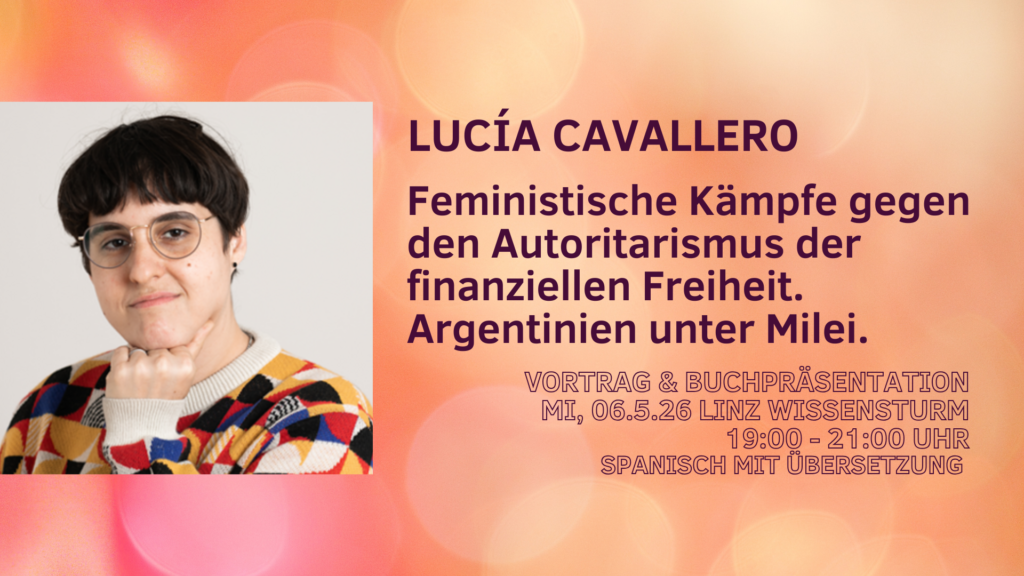
Vortrag und Buchvorstellung von Lucí Cavallero: Feministische Kämpfe in Argentinien unter Milei

LUCi cavallero - Femi­nis­ti­sche Kämpfe gegen den Auto­ri­ta­ris­mus der finan­zi­el­len Frei­heit. Argentinien unter Milei.

April 29th, 2026

6. MaI LINZ WISSENSTURM

In diesem Vortrag wird Luci Cavallero ihr jüngstes Buch „Contra el autoritarismo de la libertad financiera“ (tinta limón, 2025, mit Verónica Gago) vorstellen, in dem sie analysiert, wie im Namen der Freiheit die Finanzmärkte das Leben der Mehrheit regieren. Sie zeigt, dass der Begriff der Freiheit im zeitgenössischen Finanzkapitalismus eine zentrale Rolle spielt – angetrieben von den neuen Rechten und gelenkt von Konzernen, die Reichtum in algorithmischen und extraktiven Formen konzentrieren.

Ausgehend von ihren jüngsten Forschungen im argentinischen und lateinamerikanischen Kontext wird Cavallero die Verflechtungen von Neoliberalismus, Autoritarismus und Antifeminismus untersuchen, die in der sogenannten „finanziellen Freiheit“ ihr Fetischkonzept, ihre großspurige, aber zugleich perverse Hülle finden – angesichts der beschleunigten Verarmung und sozialen Grausamkeit. Abschließend wird sie die Kämpfe der argentinischen transfeministischen Bewegung gegen den Vormarsch der extremen Rechten beleuchten sowie deren Widerstand zur Verteidigung anderer Formen von Leben, Gemeinschaft und Freiheit.


Der Vortrag wird auf Spanisch gehalten und vor Ort auf Deutsch übersetzt.

Übersetzung: Fatima El Kosht, das kollektiv

Moderation: Johanna Neuhauser, JKU Linz


Luci Cavallero ist Soziologin und Forscherin an der Universität Buenos Aires. Ihre Forschung konzentriert sich u.a. auf Schulden und Geschlecht. Sie ist Aktivistin bei Ni Una Menos, einer feministischen Bewegung, die sich gegen geschlechtsspezifische Gewalt einsetzt. Sie hat zusammen mit Veronica Gago „A Feminist Reading of Debt“ (2021) und „Der Haushalt als Versuchslabor Feministische Kämpfe um Mieten, Haus- und Heimarbeit“ (2023) veröffentlicht. 


VHS Linz in Kooperation mit der Abteilung für Gesellschaftstheorie und Sozialanalysen (Johannes Kepler Universität Linz), das kollektiv (kritische bildungs-, beratungs- und kulturarbeit von und für migrant*innen) und dem Center Interdisziplinäre Geschlechterforschung Innsbruck (CGI) der Universität Innsbruck sowie dem Institut für Frauen- und Geschlechterforschung (IFG), dem Institut für die Gesamtanalyse der Wirtschaft (ICAE), dem Arbeitsbereich Globale Soziologie und Entwicklungsforschung (alle Johannes Kepler Universität Linz), dem Institut für angewandte Entwicklungspolitik (IAE), der International Karl Polanyi Society (IKPS) und maiz (autonomes zentrum von & für migrantinnen). 


Luchas feministas en Argentina bajo Milei


En esta conferencia, Luci Cavallero presentará su último libro, “Contra el autoritarismo de la libertad financiera” (tinta limón, 2025, con Verónica Gago) en el que analiza cómo, en nombre de la libertad, las finanzas gobiernan la vida de las mayorías. La autora muestra que el concepto de libertad desempeña un papel central en el capitalismo financiero contemporáneo, impulsado por las ultraderechas y dirigido por corporaciones que concentran la riqueza en su forma algorítmica y extractiva.


A partir de sus últimas investigaciones en el contexto argentino y latinoamericano, Cavallero examinará las interrelaciones entre el neoliberalismo, el autoritarismo y el antifeminismo, que encuentran en la llamada “libertad financiera” su concepto-fetiche, ropaje grandilocuente y a la vez perverso frente a la velocidad del empobrecimiento y la crueldad social. Por último, analizará las luchas del movimiento transfeminista argentino contra el avance de la ultraderecha, así como su resistencia en defensa de otras formas de vida, comunidad y libertad.


La conferencia se impartirá en español y se traducirá al alemán in situ.

Traducción: Fatima El Kosht, das kollektiv

Moderación: Johanna Neuhauser, JKU Linz


Luci Cavallero es socióloga e investigadora en la Universidad de Buenos Aires. Su investigación se centra, entre otras cosas, en la deuda y el género. Es activista de Ni Una Menos, un movimiento feminista que lucha contra la violencia de género. Publicó junto a Verónica Gago “A Feminist Reading of Debt” (2021) y “Der Haushalt als Versuchslabor Feministische Kämpfe um Mieten, Haus- und Heimarbeit” (2023).

den Auto­ri­ta­ris­mus der finan­zi­el­len Frei­heit. Argentinien unter Milei. 

Luci Cavallero (Buenos Aires), Forscherin und Aktivistin bei Ni Una Menos, stellt ihr jüngstes Buch „Contra el autoritarismo de la libertad financiera“ (2025, mit Verónica Gago) vor. In dem Buch untersuchen die Autorinnen die Verflechtungen von Neoliberalismus, Autoritarismus und Antifeminismus, die in der sogenannten „finanziellen Freiheit“ ihr Fetischkonzept finden. 

Luci Cavallero kommt im Mai 2026 nach Österreich und wird drei Vorträge halten: 

Innsbruck: 5. Mai, 18:00 Uhr, am Center Interdisziplinäre Geschlechterforschung Innsbruck

Linz: 6. Mai, 19:00 Uhr, am  Wissensturm, Volkshochschule Linz und Abteilung für Gesellschaftstheorie und Sozialanalysen, JKU Linz

Wien: 7. Mai, 18:30 Uhr, an dem IPW,  Universität Wien, Arbeitsbereich Geschlecht und Politik in Kooperation mit dem Arbeitsbereich internationale Politik und der Forschungsgruppe Lateinamerika

Wir freuen uns auf viele interessierte Zuhörer*innen in Innsbruck, Linz und Wien!

ES WIRD UM ANMELDUNG bei der VHS Linz gebeten!

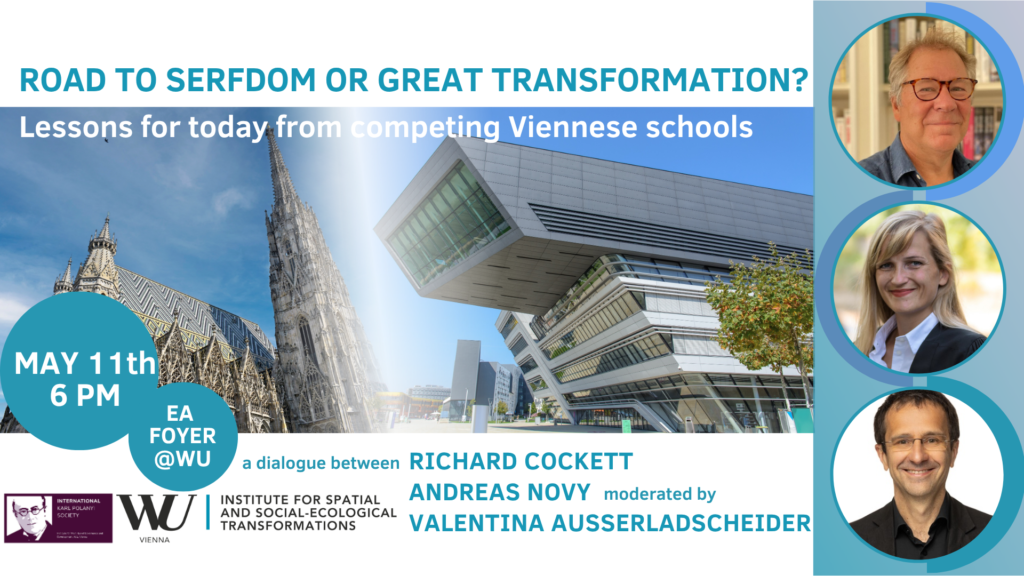
Road to serfdom or great transformation? Lessons for today from competing Viennese schools

Road to serfdom or great transformation?
Lessons for today from competing Viennese schools

April 28th, 2026

A dialogue between Richard Cockett and Andreas Novy,
moderated by Valentina Ausserladscheider 

We cordially invite you to join us for an evening event at WU Executive Academy’s Foyer on May 11th, 2026 at 6pm 
 
At the beginning of the 20th century, the cosmopolitan city of Vienna was a global hub of intellectual cross-pollination, influencing everything from psychology to art to advertising. This is the premise of historian and Economist journalist Richard Cockett’s pathbreaking book, Vienna: How the City of Ideas Created the Modern World.
Arguably one of Vienna’s most enduring legacies has been the “Austrian School” of economics. Developed by Ludwig von Mises and Friedrich von Hayek, its liberal values of personal and economic freedom would prove influential in major economies in the latter part of the 20th century. Yet, the Austrian School developed its ideas in direct tension with the radical social welfare model of 1920s Red Vienna. While Hayek and Mises saw such state intervention as the first step on the “Road to Serfdom,” to Karl Polanyi – the “other” Viennese economist – it encompassed his vision of a “mixed economy”, where democratic freedoms are upheld, and markets serve social needs. 
As today’s liberal world order faces increasing threats – often from self-described liberals – the panel will discuss the relevance of the competing Viennese schools in navigating an uncertain future.
 
Venue: Wirtschaftsuniversität Wien, Welthandelsplatz 1, Foyer of Executive Academy
Time: May 11th 2026, 6 pm
Organized by  IKPS and ISSET (WU)
 
SPEAKERS:
Richard Cockett, historian & economist
Andreas Novy, WU Vienna and International Karl Polanyi Society
MODERATION:
Valentina Ausserladscheider, University of Vienna
We are looking forward of seeing many of you there!

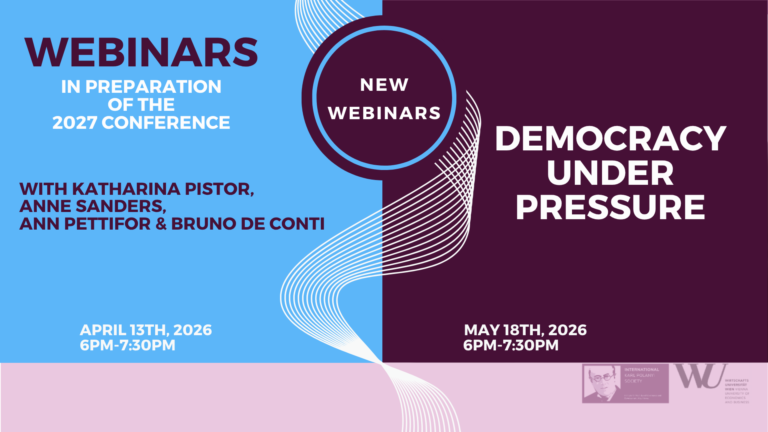
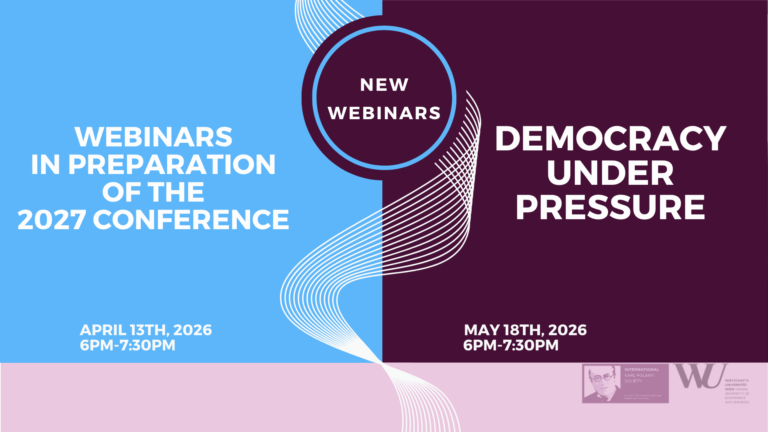
TWO Webinars in preparation for the “Democracy under Pressure” 2027 Conference

JOIN us for TWO WEBINARs to prepare the 2027 conference

March 26th, 2026

We, the International Karl Polanyi Society (IKPS), the Institute for Spatial and Social-Ecological Transformations (ISSET) and the Institute for Law and Governance cordially invite you to join our webinars in preparation for the 2027 conference “Democracy under Pressure.” After the discussion of texts by Friedrich Hayek and Carl Schmitt and their understanding of freedom and democracy, of the state and markets and of fascism and liberalism in our Reading Circle, the webinars will further engage in discussions about alternatives to the current radicalization of neoliberal thought.

The webinars will take place via Zoom on the following dates,  starting at from 6pm (CET=:

  • Mon, April 13th, 2026, 6pm:
    “The Law of Capitalism and How to Transform It”
     The first webinar  will present and discuss Katharina Pistor’s new book “The Law of Capitalism and How to Transform It” and its implications for understanding and overcoming the erosion of democratic institutions across the globe.
    In her book, Katharina Pistor argues that capitalism is not just an economic system; it is a deeply entrenched legal order that enables private wealth accumulation and shields it from democratic oversight. She demonstrates how legal codes privilege capital and corrode social cohesion by favouring certain assets, markets, and property relations, with far-reaching implications for democracy and the climate crisis. This places law at the centre of any response to these converging challenges.
    The webinar will explore if and how legal and economic structures need to be transformed to counteract these challenges. What roles can lawyers, economists, legislators, and civil society play in reshaping the legal foundations of capitalism? And, how feasible is such a transformation in the current political conjuncture?


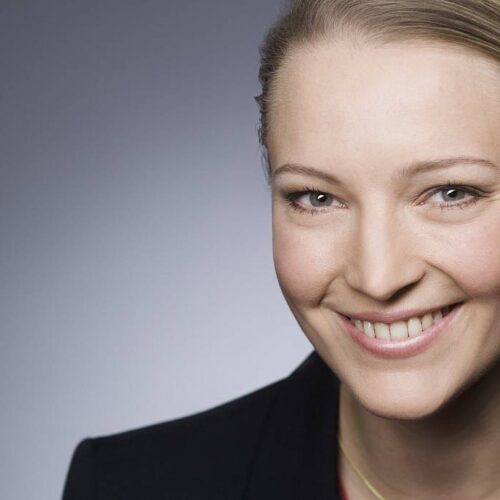
    Katharina Pistor is Edwin B. Parker Professor of Comparative Law at Columbia University. She is a leading scholar and writer on corporate governance, money and finance, property rights, and comparative law and legal institutions.

    Anne Sanders holds the Chair of Civil Law, Corporate Law, Family Business Law and Judicial Research at Bielefeld University. Her research focuses, among other things, on legal issues of sustainable entrepreneurship and the concept of steward ownership.

    Verena Madner, Head of the Institute for Law and Governance at WU, will moderate the discussion with Katharina Pistor and Anne Sanders.

    Please register via this form by April 10th in order to receive a link to participate.


  • Mon, May 18th, 2026, 6pm:
    “Global Finance and Fascism: Yesterday and Today”

    The second webinar will discuss learnings from the great transformation following the Great Depression after 1929 for better understanding and combatting the emerging far-right reactionary movements today. The focus of the exchange will be on identifying differences and similarities of the respective manifestations of economic liberalism and reactionary political-cultural movements and parties in both moments, including the joint attack on democratic and egalitarian institutions by economic liberals and cultural reactionaries. 

    The webinar will start discussing the political consequences of the demise of the gold standard in the 1930s and the resultant increased national policy space – for fascism as well as reformism. Of special interest are similarities and differences in the center and on the periphery of the world economy. The webinar will continue by discussing the implications for the current conjuncture: What are the prospects for global finance given the current crisis of neoliberal globalization? How does the ongoing dominance of global financial markets in the 2020s contribute to the proliferation of far-right movements and what would be the prospects for progressive politics of a recurrence of disintegrating global financial markets? 
    Andreas Novy will moderate the discussion with Ann Pettifor and Bruno De Conti.
    Please register via e-mail for a link to participate.


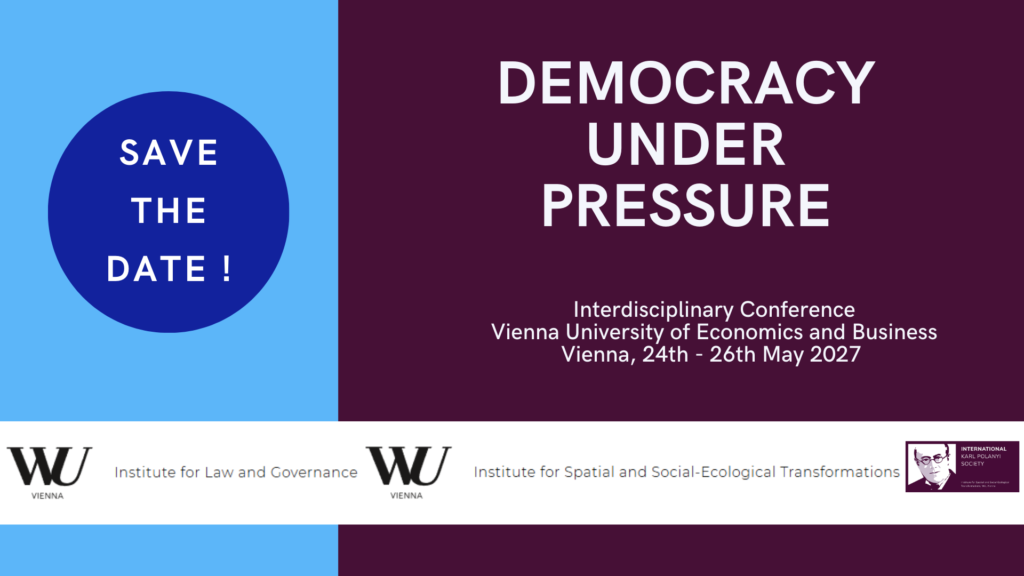
The webinars are being held in preparation for the conference on “Democracy Under Pressure: Lessons From Past Authoritarian Crises” which will take place 24 to 26 May 2027 in Vienna, organized by the Institute for Law and Governance, the Institute for Spatial and Social-Ecological Transformations (ISSET), and the International Karl Polanyi Society (IKPS). Please find the save the date for the conference here

We are looking forward to your participation and to an exciting exchange!

Andreas Novy, Verena Madner and Stefan Mayr

WEBINAR DETAILS:

1st WEBINAR
“The
Law of Capitalism and How to Transform It”

Date:
April 13th, 6PM (CET) via Zoom

Participants:
Katharina Pistor, speaker,
(Columbia Law, USA)
Anne Sanders, discussant,
(Bielefeld University, Germany)

Moderation:
Verena Madner

2nd WEBINAR
“Global Finance and Fascism: Yesterday and Today”

Date:
May 18th, 6PM (CET) via Zoom

Participants:
Ann Pettifor,
Bruno De Conti
(University of Campinas, Brazil)

Moderation:
Andreas Novy

Organised by:

Institute for Law and Governance (WU Vienna)
Institute for Spatial and Social-Ecological Transformations (WU Vienna: ISSET)
International Karl Polanyi Society (IKPS)

FURTHER READINGS:

SPEAKERS

Anne Sanders

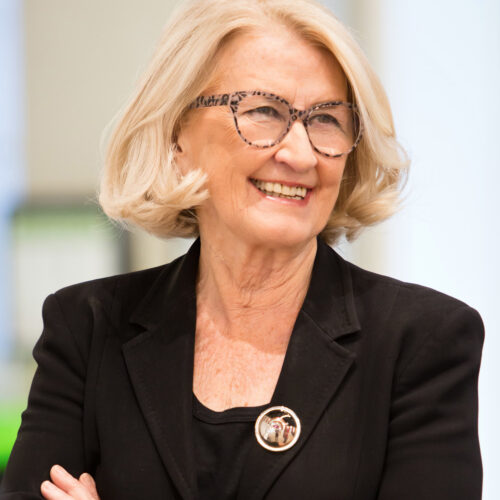
Ann Pettifor

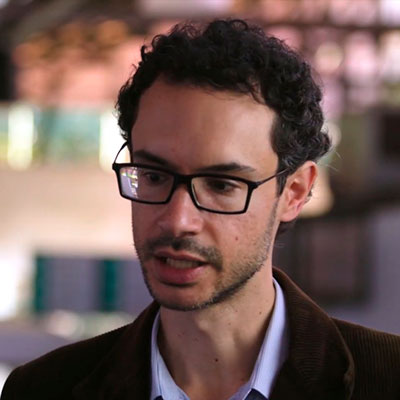
Bruno De Conti

Katharina Pistor

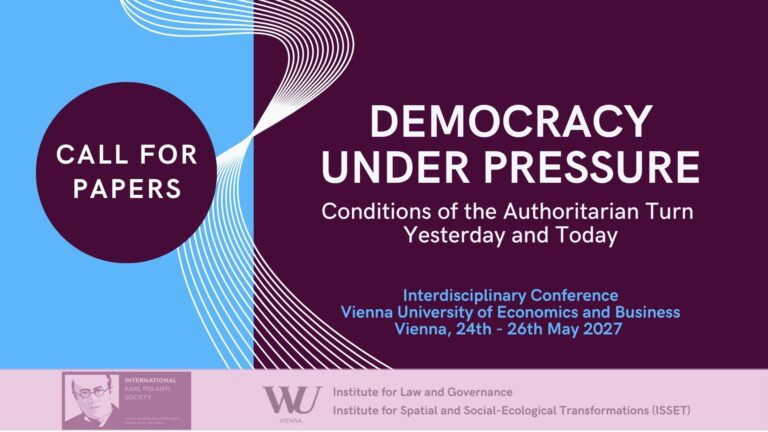
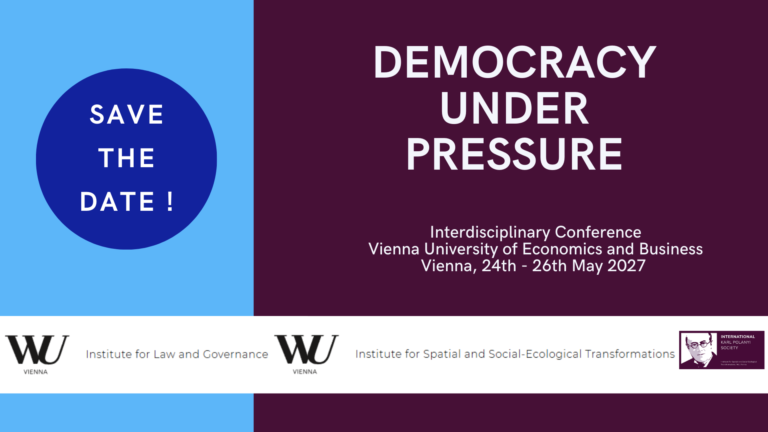
2027 CONFERENCE: DEMOCRACY UNDER PRESSURE

SAVE THE DATE: CONFERENCE (2027)

The Institute for Law and Governance, the Institute for Spatial and Social-Ecological Transformations (ISSET) and the International Karl Polanyi Society (IKPS) at WU Vienna University of Economics and Business cordially invite you to the interdisciplinary conference on:

Democracy Under Pressure: Lessons from past authoritarian crises

Date:
May 24th-26th, 2027

The 2020s have witnessed a troubling erosion of democratic institutions across the globe. In the US, MAGA questions electoral legitimacy and undermines state administrations and fundamental rights. In general, “illiberal democracies” and “electoral autocracies” challenge constitutional courts and related checks and balances. Consequently, contemporary societies in established democracies face multiple threats to democratic resilience, including the return of fascism.

This interdisciplinary conference addresses this urgent challenge through a specific lens: It seeks to explore how intellectual debates from a past period of democratic crisis—the 1920s and 1930s—can provide insights into current dilemmas.

While history does not repeat itself, it is often said to rhyme. The conference will connect historical debates on markets, law, and authority to analyses of contemporary challenges to liberal democracies posed, inter alia, by digital surveillance, gendered anti-feminism, inequality, climate crisis, and imperialism. To shed light on today’s authoritarian turn, we will explore competing diagnoses from four pivotal thinkers— Friedrich von Hayek (“state interventionism leads to fascism”), Karl Polanyi (“fascism defends capitalism while sacrificing democracy”), Hans Kelsen (“democracy is based on pluralist compromise”), and Carl Schmitt (“sovereignty means the power to decide on the state of exception”).

Vienna—a city whose history embodies both the promise and fragility of democratic experimentation—offers the ideal setting for this urgent conversation.

The Department of Socioeconomics at WU, our academic home base, is an interdisciplinary faculty, uniting economists, social scientists, and legal scholars—a unique institution in the German-speaking context.

“While history does not repeat itself, it is often said to rhyme.”

Core Questions

Rather than contemplating ready-made answers, the conference will investigate burning issues related to contested democracies past and present: Are economic liberalism and political authoritarianism related and if so, how do they intersect? What can the 1920s-30s teach us about socioeconomic causes of constitutional fragility and political collapse? How do current technological and politico-economic developments impact contemporary forms of authoritarianism? And how can we move from “what went wrong then” to “what and how to transform today?”.

Methodological Approach

The conference employs three complementary methods.

  • Textual Reconstruction: Close reading of primary sources to understand each thinker’s arguments in their strongest form, avoiding caricature while identifying genuine tensions and contradictions by connecting texts to their context.
  • Comparative Historical Analysis: Examining case studies of democratic resilience and collapse in the interwar period (Austria 1933-34, Germany 1930-33) and contemporary cases (Hungary, Poland, Spain’s Catalan crisis, US, Brazil for example) to identify patterns and divergences.
  • Cross-Disciplinary Dialogue: Structured panels pairing legal scholars with economists, and historians with political theorists, to explore how different disciplinary perspectives illuminate—or obscure—connections between economic processes and political-legal outcomes.

Format

Three days of keynotes, cross-disciplinary panels, and round table discussions to examine the intersections of socioeconomics and law. Sessions will be organized around substantive problems rather than individual thinkers, ensuring genuine dialogue across perspectives.

Our call is aimed at scholars from various disciplines, including economics, economic sociology, law and political economy, constitutional theory, political science, and history.

Expected Outcomes

The conference seeks to foster scholarly networks capable of sustained interdisciplinary engagement with democracy’s present crisis. Rather than providing predetermined conclusions, it seeks to clarify what historic debates can—and cannot—teach us about contemporary challenges to democratic institutions and socioeconomic development. It aims to achieve a better understanding of the underlying politico-economic and socio-cultural conditions of the current authoritarian turn, thereby contributing to a new research programme at the intersection of socioeconomics and law.

Full call and registration details coming soon.

DETAILS

Date:
May 24th-26th, 2027

Facilitation
:

Institute for Law and Governance
Institute for Spatial and Social-Ecological Transformations (ISSET)
International Karl Polanyi Society (IKPS)
(WU Vienna University of Economics and Business)

Keynote Speakers:
Katharina Pistor (Columbia Law)
Quinn Slobodian (Boston University)

Quinn Slobodian

Katharina Pistor

Organised by:

Institute for Law and Governance
Institute for Spatial and Social-Ecological Transformations (ISSET)
International Karl Polanyi Society (IKPS)
(WU Vienna University of Economics and Business)

More info coming soon:

Watch this space for more info.

SPEAKERS

Quinn Slobodian

Katharina Pistor

Michael Burawoy (1947-2025) and the 2 Karls

REMEMBERING MICHAEL BURAWOY (1947-2025)

December 23rd, 2025

A VOLUME OF APPRECIATION

This year started with an incredible academic and personal loss by the shocking passing of Michael Burawoy. 

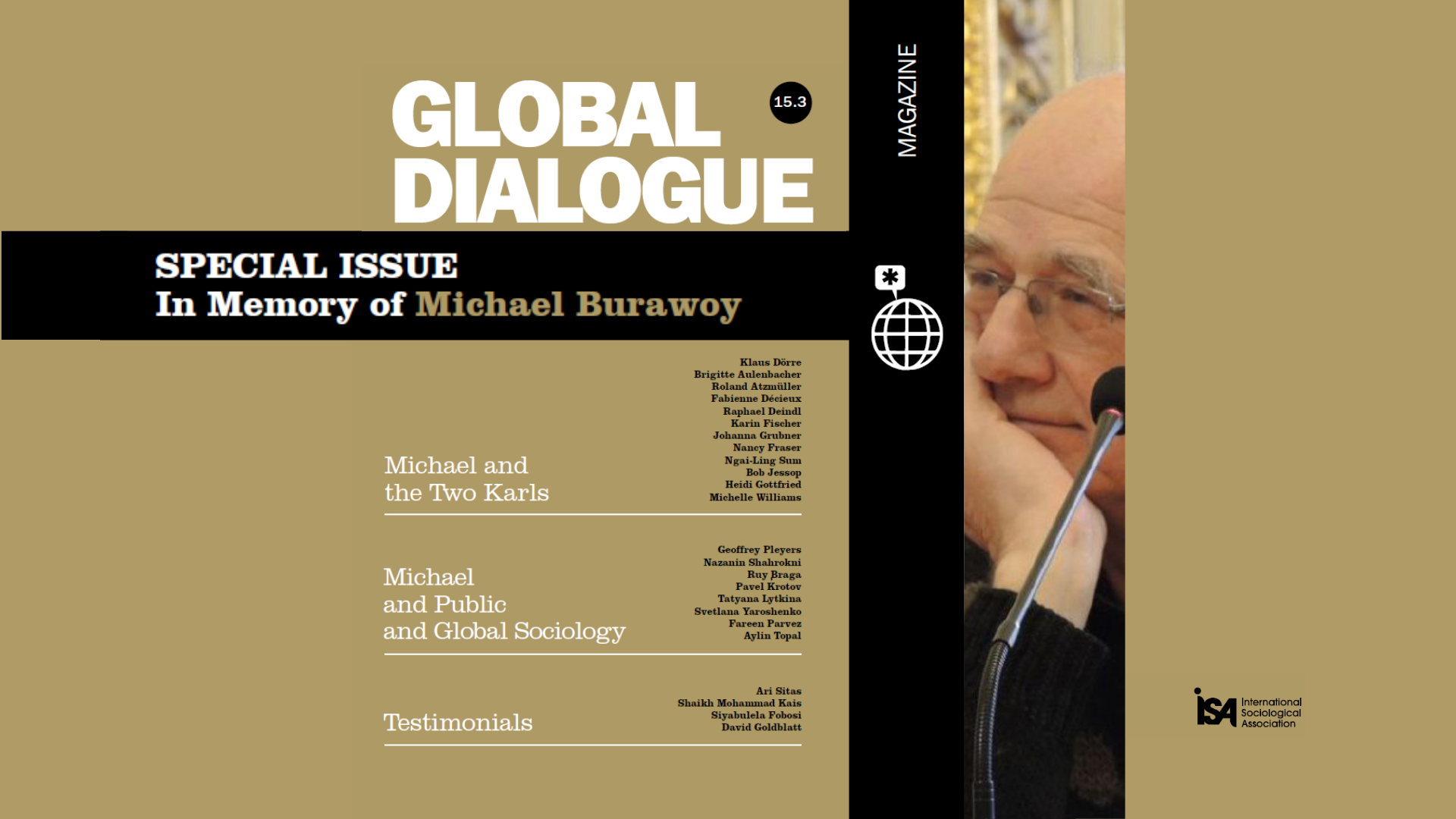
He has not only inspired his students and colleagues with his sociological Marxism and his take on Karl Polanyi, he has also inspired the foundation of the IKPS and has enriched discourse within our community. We invite you to take a look at the most recent edition of Global Dialogue, which is a bouquet of stories, insights and appreciations by colleagues like Nancy Fraser, Klaus Dörre, Global Dialogue Editor Breno Bringel and many more. 

Our Board Members Brigitte Aulenbacher, Fabienne Décieux and Roland Atzmüller, together with collegues have also taken the time to reflect on their experiences with Burawoy and his work in “Michael and the two Karls” and we warmly recommend this volume. Even more authors reflect on Burawoy’s legacy in the section “Michael and Public Global Sociology” and share their experiences in “Testimonials”.

Michael and the two Karls

Sociological Marxism: What Remains to be Done
by Klaus Dörre, Emeritus Professor, University of Jena, Germany
 
Resisting Exploitation
by Brigitte Aulenbacher, Roland Atzmüller, Fabienne Décieux, Raphael Deindl, Karin
Fischer and Johanna Grubner, Johannes Kepler University Linz, Austria
 

For Michael Burawoy: An Appreciation
by Nancy Fraser, New School for Social Research, USA

Michael’s Public Sociology and the Attention Economy
by Ngai-Ling Sum and Bob Jessop, Lancaster University, UK

Michael Burawoy Unbound
by Heidi Gottfried, Wayne State University, USA

The Tree of Michael Burawoy’s Sociological Marxism

by Michelle Williams, University of Witwatersrand, South Africa

We thank Global Dialogue and the International Sociology Association for the collaboration and the use of their source material and all the contributors to this issue.

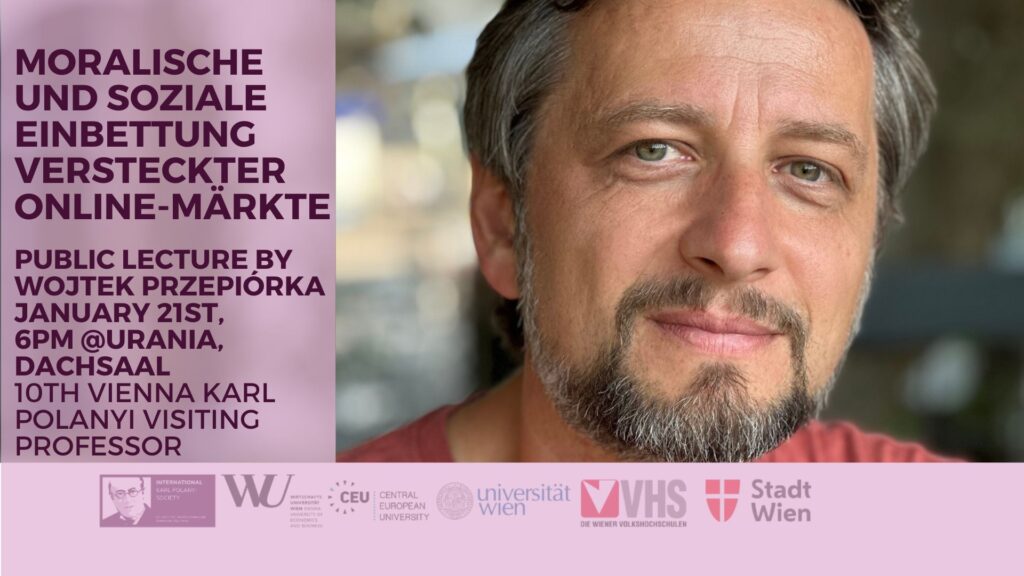
EVENT! Public Lecture by 10th Vienna Karl Polanyi Visiting Professor Wojtek Przepiórka

PUBLIC LECTURE BY WOJTEK Przepiórka
"MORALISCHE UND SOZIALE EINBETTUNG VERSTECKTER ONLINE-märkte"

December 22nd, 2025

Public lecture by WOJTEk przepiórka (in german)

On January 21st, 2026 the Vienna Karl Polanyi Visiting Professorship will be awarded for the tenth time. This semester’s Visiting Professor Wojtek Przepiórka will hold his Public Lecture in the Dachsaal at the Vienna Urania at 6pm. 

Kenyote: “Moral and social embedding of hidden online markets”

“How do people build trust and maintain cooperative relationships of exchange in anonymous online markets for illegal goods? These so-called crypto markets, hosted on the Dark Web, operate without the legal and institutional protections that usually regulate trade. Instead, they rely on a mix of formal reputation systems and informal community practices. Drawing on Karl Polanyi’s concept of embeddedness, our research shows that reputation formation in hidden online markets depends not only on self-interest but also on moral motives such as fairness and responsibility. Many traders provide feedback to maintain the collective good of trustworthy ratings. At the same time, ratings alone are not enough. Even in illegal and anonymous environments, markets remain embedded in social and moral life, which shows that cooperation can arise even where legal institutions cannot reach.

We are looking forward to seeing many of you there and kindly ask you to register! 

In the meantime you can find out more about Prof. Kenworthy, our Visiting Professorship and view our other upcoming activities!

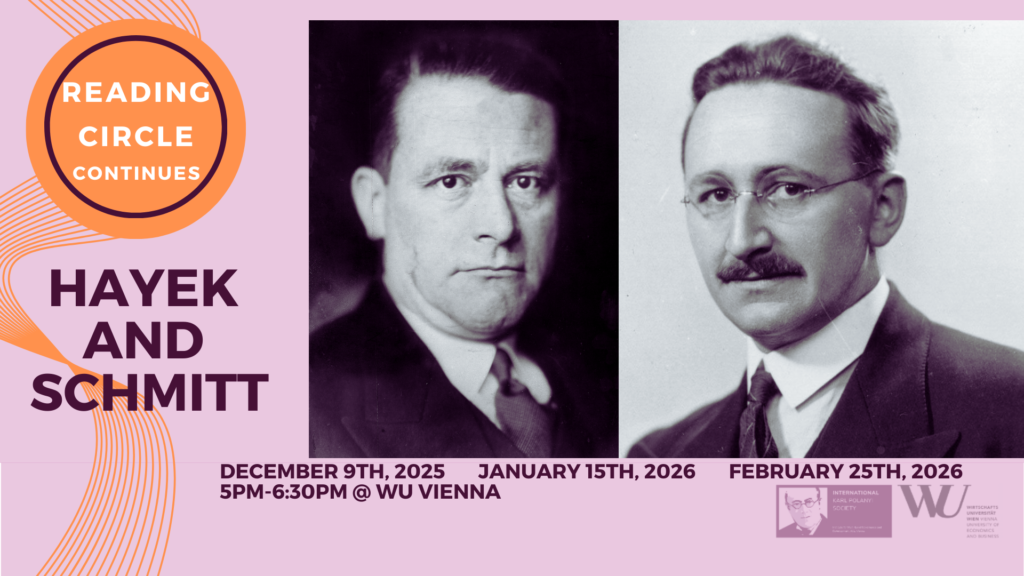
Reading Circle BACK IN SESSION: Friedrich Hayek and Carl Schmitt

December 1st, 2025

OUR READING CIRCLE IS BACK IN SESSION

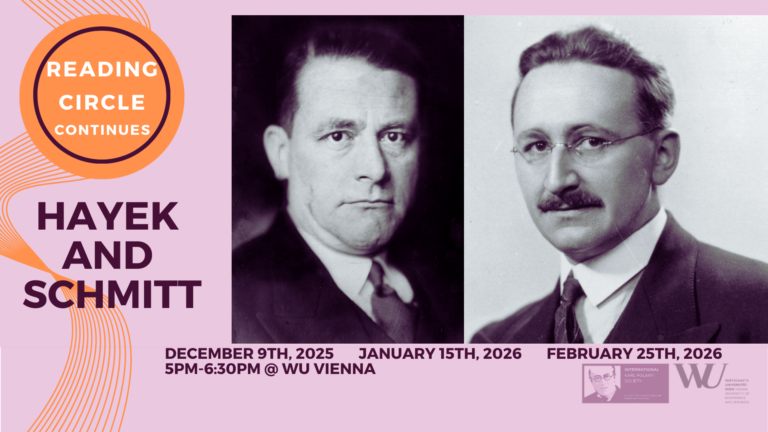
Reading Circle on Friedrich Hayek and Carl Schmitt

We, the International Karl Polanyi Society (IKPS), the Institute for Spatial and Social-Ecological Transformations (ISSET) and the Institute for Law and Governance cordially invite you to join our reading circle on “Socioeconomics and Law.”

This reading circle will serve as a preparatory event for an upcoming international conference, titled “Socioeconomics and Law – The conditions of the authoritarian turn yesterday and today” that is set to take place in Vienna from May 24th to 26th 2027. At this conference and in the lead-up to this conference, we aim to engage in discussions about alternatives to the current radicalization of neoliberal thought, particularly its alignment with non-democratic and non-liberal political and legal ideologies.

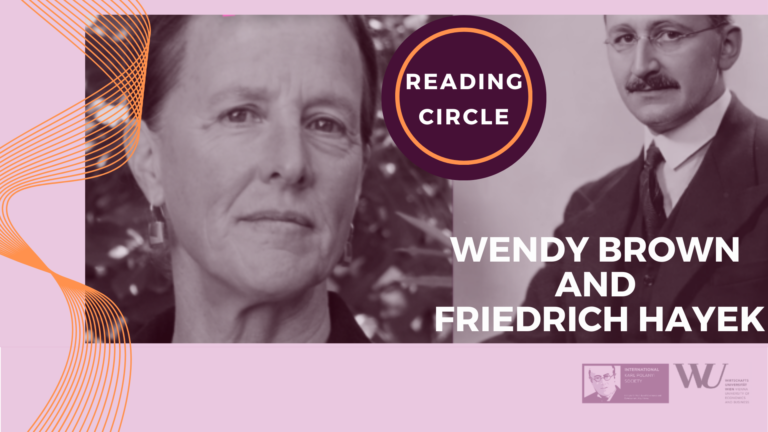
After the first round of the reading circle that focused on Wendy Brown’s (2019) “In the Ruins of Neoliberalism”, the upcoming sessions will deal with texts by Friedrich Hayek and Carl Schmitt, diving into their understanding of freedom and democracy, of the state and markets and of fascism and liberalism.

The sessions will take place at Vienna University of Economics and Business (WU) on the following dates from 5pm – 6.30pm CEST:

  • Tue, December 09th, 2025, 5pm-6.30pm, WU, Building AD.0.090 (Sitzungssaal 6):
    The Road to Serfdom by Friedrich Hayek (Introduction, Chapter 1 and 2)
  • Thu, January 15th, 2026, 5pm-6.30pm, WU, Building D4.3.106:
    The Constitution of Liberty by Friedrich Hayek (Chapter 16)
  • Wed, February 25th, 2026, 5pm-6.30pm, WU, Building D4.3.106:
    Texts by and about Carl Schmitt

    -Bielefeldt, H. (1997). Carl Schmitt’s critique of liberalism: systematic reconstruction and countercriticism. Canadian Journal of Law & Jurisprudence10(1), 65-75.
    -Schmitt, C., (1922) Political theology: four chapters on the concept of sovereignty – CHAPTER 1
    -Schmitt, C., (1932) The Concept of the Political – CHAPTERS 2 & 3

To enable international participation there is also the possibility to participate in a hybrid mode. Please register via e-mail for a link to participate online.

We are looking forward to your participation and to an exciting exchange!

Andreas Novy, Verena Madner and Stefan Mayr

As additional introductory texts for the reading circle we recommend:

The new blog of the IKPS on Fascism and Liberalism: Yesterday and Today criticizes the deeply ingrained belief that economic liberalism is conducive to democracy.

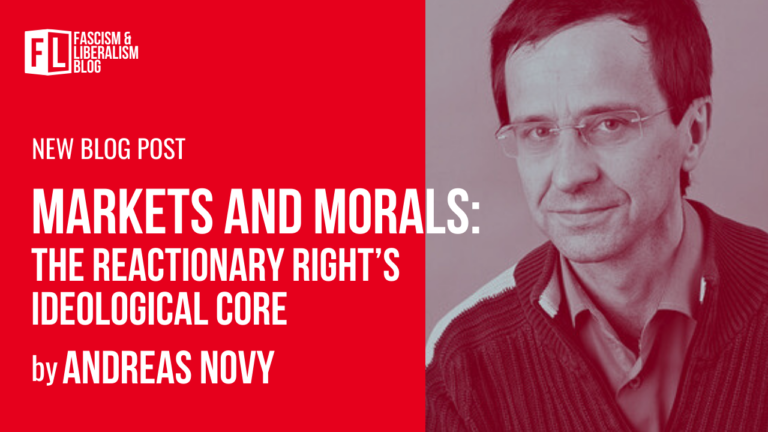
Furthermore, Andreas Novy highlights – based on Wendy Brown – the role of markets and morals in Hayek’s work: Markets and Morals: The Reactionary Right’s Ideological Core.


Polanyi in Graz

POLAYNYI-exhibition in graz

October 10th, 2025

invitation!

You are cordially invited to the finissage of our german Polanyi exhibition in Graz on November 4th where Brigitte Aulenbacher will present the “Life & Works of Karl Polanyi”!


This fall our German Karl Polanyi exhibition is shown in Graz, hosted by the Styrian Chamber of Labour.

The finissage will be held on November 6th at 4 PM at the Otto-Möbes-Academy in Stiftingtalerstraße 240 in Graz, Austria.

Our Vice-President Dr. Brigitte Aulenbacher from the Johannes Kepler University Linz will speak on the “Life and Works of Karl Polanyi” and share her insights on his biography and publications.

LOCATION:
Otto-Möbes-Academy, Stiftingtalerstraße 240; Graz, Austria.

EVENT! Public Lecture by 9th Vienna Karl Polanyi Visiting Professor LUCAS CHANCEL

PUBLIC LECTURE BY LUCAS CHANCEL
"ENERGY, INEQUALITY and DEMOCRACY"

Public lecture by LUCAS CHANCEL

On May 21st, 2025 the Vienna Karl Polanyi Visiting Professorship will be awarded for the ninth time. This semester’s Visiting Professor Lucas Chancel will hold his Public Lecture in the Dachsaal at the Vienna Urania. 

Keynote: Energy, inequality and democracy

Energy has always been at the heart of social inequalities, shaping hierarchies and power dynamics throughout history. 

From agrarian societies reliant on solar energy to fossil-fueled industrial revolutions, access to and control over energy resources have driven economic and political struggles. 

This lecture will explore how different energy regimes—from land-based wealth in pre-industrial societies to coal and oil-driven economies—have structured social orders, fueled conflicts over wealth distribution, and shaped political decisions about ownership and governance. Drawing on insights from economic history and environmental sciences, we will examine past efforts to democratize energy systems and how these lessons can inform today’s debates on ecological transition. 

Challenging the idea that energy history is purely technical or politically predetermined, this talk will argue that moving away from fossil fuels raises fundamental questions of power and wealth redistribution—questions that remain unanswered: 
Who will control energy and material resources in the future?
How can ecological constraints lead to greater socioeconomic and political equality? 

By revisiting historical models of energy socialization in the 20th century, this lecture will advocate for a democratic energy system as essential to a future in which societies reclaim power over markets—within both the limits and possibilities of the material world.

EVENT! Public Lecture by 8th Vienna Karl Polanyi Visiting Professor Anke Hassel

PUBLIC LECTURE BY ANKE HASSEL Was wird aus der Arbeit? - "THE FUTURE OF WORK"

On January 8th, 2025 the Vienna Karl Polanyi Visiting Professorship will be awarded for the eighth time. This semester’s Visiting Professor Anke Hassel will hold her Public Lecture in the Dachsaal at the Vienna Urania. 

Kenyote: Was wird aus der Arbeit? – The Future of Work

How is work organized in current times? What significance does work have in our lives and for social cohesion? These questions have gained urgent topicality; without taking them into account, individual and social designs for the future cannot be developed. Workload and lack of appreciation are important issues that also play a role in political satisfaction. The thesis of the “end of work” is a thing of the past. In the meantime, the perspective of a “flexibilised working society” dominates, in which more and more people are participating, but at the same time still has not solved the compatibility with work in relation to the family.

The modern world of work, with its sometimes contradictory parts, is like a puzzle. In the lecture, Anke Hassel explains how social change, immigration, technologies and structural change are giving work a new meaning. Finally, she explains to what extent the boundary between work and leisure time is blurred and asks the question of whether the socialization of work leads to more or less freedom.”

In the meantime you can find out more about Prof. Hassel, our Visiting Professorship and view our other upcoming activities!

“Was wird aus der Arbeit? – The Future of Work”

January 8th, 2025; 7:00 PM (CET)
Dachsaal, Urania
Uraniastraße 1
1010 Wien

Organised by:

IKPS, 
University of Vienna,
Central European University,
WU Vienna,
Volkshochschule Wien,
AK Wien