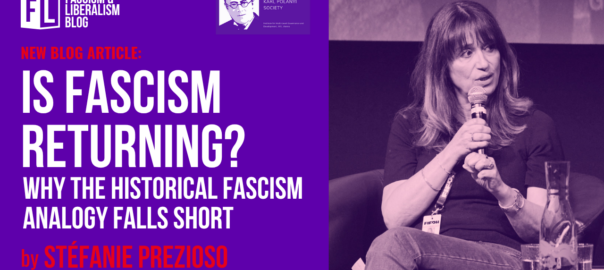

Is Fascism Returning?
Why the Historical Fascism Analogy Falls Short
by Stéfanie Prezioso
10.09.2026
The resurgence of the far-right has revived a familiar question: are we witnessing a return of fascism? According to historian Stéfanie Prezioso, the widespread use of the term ‘fascism’ as a template for understanding today’s far-right movements risks obscuring what is new about contemporary right-wing radicalisation. She argues that while today’s movements share important features with historical fascism, they operate under fundamentally different economic, political, and social conditions. Therefore, Prezioso calls for a more comprehensive analysis of the changing form of the far-right under the conditions of twenty-first-century capitalism.
Is there any point in reviving the concept of fascism? The central place that fascism occupies in the history and ‘mental territory’ of the 20th century explains why this concept is so frequently referenced, along with iterative nouns such as ‘recurrence’ and ‘return’. It is undoubtedly legitimate to want to place the current rise of the far-right within a broader historical context. However, it is precisely this ‘archaeological’ work (in the Foucauldian sense) that leads me to categorically reject the idea that we are reliving the 1920s and 1930s. Rather than focusing on historical analogies, I argue that we should concentrate on current movements and ask what is distinctive about today’s far-right – and, in particular, its relationship with contemporary capitalism.
The Problem of Looking Backward
In fact, the term ‘fascism’ poses numerous problems. Firstly, there is no consensus on its definition, despite – or perhaps because of – the hundreds of thousands of pages devoted to it. For historian Ian Kershaw, for example, attempting to define fascism is akin to trying to nail jelly to a wall.[i] Secondly, the term is marred by its numerous polemical or derogatory uses – social fascism, Islamo-fascism, crypto-fascism, and so on – to the extent that, as historian Robert Paxton points out, “it stirs up more heat than light today”.[ii] Third, and more importantly in my view, invoking fascism also amounts to a certain kind of laziness, as it spares us from analysing what is radically new about the current processes of right-wing radicalisation among a significant section of bourgeois forces on a global scale. This does not mean that today’s far right poses fewer problems than the emergence of fascism after the First World War. Quite the opposite. It means that we need to better understand the specific conditions under which it is developing.
Those intellectuals, trade unionists, and politicians who attempted to understand the rise of fascism at the time – using the tools of the late nineteenth century – did not truly grasp what they were dealing with. Consider the antifascists, who — from 1919 to 1922 when Mussolini and his Blackshirts had not yet come to power in Italy and could still be stopped — remained fixated on the idea that fascism was either a reactionary movement similar to those they had previously encountered or a docile tool in the hands of the bourgeois state and big capital. Even worse, some Marxists such as Amadeo Bordiga[iii] claimed that there was no fundamental difference between fascism and parliamentary democracy. There was a profound misunderstanding of what was new about ‘this political animal’ at the time: a mass movement of civil society with a powerful paramilitary component (hundreds of thousands of men in uniforms), largely independent of traditional bourgeois forces, structured and organised for its own purposes and objectives. This relative autonomy in its march to power, however, did not ultimately prevent fascism from becoming a precious conveyors of the interests of the most aggressive sections of imperialist capital once it reached the state apparatus.
A similar risk arises today. Those who adorn the concept of fascism with a litany of prefixes — neo-, techno-, post-, para-, eco-, and so on — do not truly grasp what they are dealing with. The current proliferation of variations on the term merely masks the disorientation in the face of a situation that may recall the dark hours of the twentieth century but is nevertheless radically new.
As Foucault wrote in the 1970s, “any analysis that seeks to produce a political effect by resurrecting old spectres is doomed to failure. It is precisely because we are unable to analyse something that we seek to resurrect the spectre of its return”[iv]. Instead of describing today’s extreme shift to the right by resorting to often superficial analogies, we should recognise the fundamental differences that separate us from the 1920s and 1930s. Above all, we must take into account the transformation of the capitalist economy, including globalised value chains and the dominance of the financial sector, the decline in the organisation of civil society — such as political parties, unions, and associations — and the strengthening of state apparatuses that escape democratic control, as discussed by Nicos Poulantzas.[v]
Past and Present ‘Fascistisation’: Continuities and Decisive Differences
My research focus on the historical developments in Italy led me very early on to question the many static, term-for-term comparisons between the 1920s–1930s and the early 21st century, which uncritically relied on Robert Paxton’s (2004) model.[vi] I also questioned the predictive and mobilising virtues of using such a ‘fire alarm’. Ongoing socioeconomic and political upheavals have moved us ever more clearly away from the interwar period. As we are no longer at the beginning of this rising tide of new far-right movements, it is crucial that we strive to understand these movements’ specific characteristics.
Yet this does not mean that there are no continuities between historical fascism and today’s far right. Historical fascism itself was not without antecedents: it drew on reactionary, nationalist, and racist right-wing movements that had developed during the nineteenth century. Hannah Arendt, for instance, demonstrated that these movements were situated within the context of imperialism and historians such as Stehrnell have also traced the ideological origins of fascism back to 19th-century Francevii.
Today’s far-right movements undoubtedly share a common foundation with historical fascism and anti-democratic right-wing movements of the nineteenth century, including nationalism, racism, authoritarianism, a rejection of class conflict in favour of national and popular unity, the scapegoating of minorities (e.g. migrants, Muslims and Jews), machismo, and LGBTQI-phobia. Anyone who does not fit their conception of the nation, whether a minority or a political opponent, is stigmatised or criminalised, and this rejection is used as a tool for electoral mobilisation. This rejection of otherness is accompanied by an exclusionary, identity-based discourse that aims to legitimise authoritarian policies by claiming to defend a ‘threatened’ community.
Such phenomena, I argue, emerge in contexts of prolonged economic, social, and moral crisis characterised by a loss of trust in traditional forms of political representation. However, such parallels have their limits: historical fascism emerged in the aftermath of the First World War, following the revolutionary wave of 1917–1920. At that time, the USSR embodied a horizon of hope for millions of workers — a situation without parallel today. Historical fascism was also economically statist and interventionist, whereas contemporary far-right movements aim to privatise the public sphere to open it up to private capital. This is precisely what Milei’s ‘chainsaw’ symbolises, in line with the Reaganite and Thatcherite rhetoric of the 1980s.[viii] Moreover, while far-right movements have always challenged democratic freedoms, historical fascism involved organized strong mass mobilisation, a feature lacking in today’s far-right movements, even if they are able to mobilise a large number of voters, as was more recently the case in Saxony-Anhalt.
Historical fascism also relied on paramilitary formations, such as the Blackshirts and the SA. These were aimed at destroying the labour movement’s powerful organisations which had certainly suffered defeats but still retained considerable strength amid a profound crisis of capitalism. Such political formations no longer exist; currently, fascist splinter groups are marginal and loosely organised.
In contrast, major far-right parties exert their influence through the electoral process. In his book Hyperpolitics, Anton Jäger identifies this as one of the main differences between historical fascism and the far-right today.[ix] He argues that, unlike in the interwar period, levels of politicisation in society are high, yet they are not organised along left- or right-wing lines. Alberto Toscano[x] thus describes a fascism largely stripped of its mass movement, which retains the ideal of national rebirth driven by a union of the ‘productive classes’ — a theme that has animated all far-right movements since the second half of the nineteenth century. Jäger’s and Toscano’s work therefore highlight that we should resist a simple equation between today’s far-right and historical fascism. The point is not to deny the continuities, but to understand why the same ideological elements can produce different political forms under different historical conditions.
Why Context Matters: Fascism in the Longue Durée
As Richard Saull et al. wrote in their introduction to a significant book on ‘The Longue Durée of the Far Right’, it is crucial to challenge the prevalent assumption that fascism represents the ‘supreme stage’ of the political spectrum.[xi] In reality, fascism acquired its particular form through a specific conjunction of crises: the crisis of the capitalist regulatory regime, the disintegration of the international order based on the treaties that ended the First World War, and the imminent threat of revolution. The political form that emerged from these conditions cannot be treated as a model that is simply transfarable to other contexts without caution. This way of viewing the far-right differs from interpretations that focus too exclusively on the realm of ideas and discourse. It is also a matter of understanding the far-right as a phenomenon rooted in concrete economic, social, and political dynamics. To understand its development, we therefore need to ask how contemporary capitalism produces insecurity and conflict, how states respond to these crises, how political representation is changing, and how different fractions of capital relate to the new right.
Enzo Traverso’s term ‘post-fascism'[xii] is undoubtedly the term with which I disagree the least, precisely because the prefix “post” can be understood as signaling an incomplete transition. This allows us to consider both continuity and rupture. The breeding ground for many contemporary far-right movements was established in the 1920s and 1930s and is connected not only to Nazi-fascism but also to the experience of colonial rule by “democratic” states. Yet the distinctive characteristics of the twenty-first-century far-right are no less significant than those of the interwar period — hence the difficulty in describing this new ‘morbid phenomenon’, to borrow Gramsci’s term.
Anti-Fascist Struggle in the Twenty-First Century
The anticipatory nature of the term ‘fascism’ risks misleading current struggles against the far-right. While history can help shed light on the present, it can in no way predict the future, provided we do not view it as eternal repetition. Understanding how Italian fascism and German National Socialism triumphed does not necessarily mean that we will be better equipped to confront the rise of new authoritarian — or even totalitarian — regimes. We do not know in advance the forms that their development will take. The term ‘fascism’, thus, traps us in the past. We must stop isolating fascism from “the longue durée” of the far-right, which has its roots in the nineteenth century and continues to this day. The detached use of the term ‘fascism’ obscures precisely this connection to the long-term history of the far right. By constantly presenting fascism as the ultimate stage of the far right, we contribute to turning it into a static archetype divorced from the history of capitalism — a ‘parentheses’, as the liberal philosopher Benedetto Croce argued. [xiii]
I believe we could be facing even more dramatic situations. In the 1920s and 1930s, there was at least a powerful, organised socialist and communist movement, as well as an aspiration to overthrow the capitalist order and a sense of purpose. Today, that horizon seems largely blocked. This requires us to examine not whether fascism is simply “returning,” but how the far right is being transformed by the conditions of twenty-first-century capitalism. In other words, it compels us to examine the fundamental antagonism between democracy and capitalism, particularly in its imperialist phase, to examine how economic and social crises reshape political representation and to conduct an in-depth analysis of the history of the right and its most radical factions during times of crisis.

Stefanié Prezioso is a Marxist historian, and Associate Professor of Political and Social Sciences at the University of Lausanne.
References
- Ian Kershaw, To Hell and Back: Europe, 1914-1949, Penguin Books, 2016, p. 246
- Elisabeth Zerofsky, “Is it Fascism ? A Leading Historian Changes His Mind”, The New York Times, Oct. 23, 2024.
- Amadeo Bordiga, “I rapporti delle forze sociali e politiche in Italia (II)”, Rassegna Comunista, Oct. 31, 1922, n. 30-31, p. 1461
- Michel Foucault, “La sécurité et l’État”, Tribune socialiste, Nov. 24-30 novembre 1977, in Dits et écrits, t. 3, Paris, Gallimard, 1993, p. 387.
- Nicos Poulantzas, State, Power, Socialism, London, Verso, 2000 (first English edition 1980).
- Robert Paxton, The Anatomy of Fascism, New York, Alfred A. Kopf, 2004.
- Hannah Arendt, The Origins of Totalitarisnim. Expanded Edition, New York, Library of America, 2025 (first edition 1948); Zeev Sternhell, Neither Right nor Left. Fascist Ideology in France, Princeton, Princeton University Press, 1986.
- See Quinn Slobodian, Hayek’s bastard. The Neoliberal Roots of the Populist Right, London, Allen Lane, 2025
- Anton Jägger, Hyperpolitics. Extreme Politicization Without Political Consequences, London Verso, 2026.
- Alberto Toscano, Late Fascism. Race, Capitalism and the Politics of Crisis, London, Verso, 2023.
- Richard Saull et al., “The longue durée of the far-right : an introduction”, in Id. (eds), The Longue Durée of the Far Right. An international historical sociology, New York, London, Routledge, 2015.
- Enzo Traverso. 2017. Les nouveaux visages du fascisme. Éditions Textuel
- Benedetto Croce, “Discorso inaugurale al Congresso di Bari il 28 gennaio 1944 “, in Gli Atti del Congresso di Bari. Prima libera assemblea dell’Italia e dell’Europa liberata, 1944.