Tag Archives: capitalism

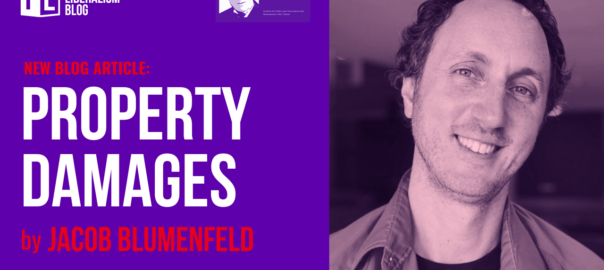
title page for the F&L blog post "Property Damages" by Jacob Blumenfeld

F&L Blog – Property Damages

Property Damages

by Jacob Blumenfeld

13.02.2026

Does private property secure freedom, or train us for domination? In this article, philosopher Jacob Blumenfeld traces how liberal ownership rights shape social relations, trigger ecological conflict, and foment authoritarian desires. His claim is not that all forms of private ownership corrupt individuals. Rather, he argues that the specific legal form of liberal property rights – granting exclusive control over socially necessary resources – enables relations of power, resentment, and authority that prime authoritarian movements. In an age of climate crisis and deepening inequality, the future hinges on the question of how property relations are organized: for private ends – or for social needs.

In a speech on January 21st in Davos, Donald Trump asked, rhetorically, in relation to Greenland: “Who wants to defend something on a lease?” To defend something, he implied, one must first own it. The need for protection becomes the justification for possession. Trump’s remark expresses a familiar liberal conviction: authority appears legitimate when grounded in ownership, and ownership is only legitimate if you take on ‘responsibility’ and can defend it. Property rights, thus, do not only allocate resources, they allocate decision-making power. Whoever owns decides; others adapt. This article examines the ideological roots of such thinking and discusses the political consequences of that ordinary arrangement posing the question: does owning property make you more prone to fascism? Does acquiring a taste of sovereign authority over an external thing slowly translate into a desire to dominate people as well? If you treat the world fundamentally as property, characterized by the right to use and abuse things at will, then isn’t it only a matter of time before you overstep the boundary between thing and person?

Property is Power

If slavery is the origin of property rights, as David Graeber once argued, then being a property owner is an education in dominion, the authority to dispose over what is mine by commanding the wills of other people. The right to an external thing is a license to treat others in certain ways in relation to the thing at hand. My legally sanctioned authority over this land, these assets, and those machines gives me the legitimate power to determine how others may or may not use them, irrespective of the social consequences. Treating something as property flattens the salient normative distinctions between items of personal use, societal infrastructures, natural landscapes, and means of production, as if they could all be simply mine or yours, ours or theirs, without further thought. Property is power over people, masked as a relation of power over things. Whether a pair of shoes or a pair of companies, a piece of land or a piece of writing, I can develop or destroy what’s mine as I see fit. Whether the air is polluted, food wasted, tenants evicted, or ecosystems plundered, that is not my concern. Freedom trumps consequences.

Liberalism is founded on the right to private property, but private property is also what breaks liberalism. For what better way than owning property is there for learning how to be a dictator? If this is true, then the bedrock of liberal freedom is made from the same material as the authoritarian longings it is supposed to ward off. Or maybe we have it backwards. Does not owning property make you more prone to fascist tendencies? If you don’t have anything at all to call your own, does that make you jealous of those who do? Resentful, hateful, you see others as threats or competitors, as rivals scrambling for scarce jobs, limited resources, and even romantic companions. Dependent on bosses, managers, and landlords, you despise those not above you—you want to be them—but those beside you and below you. They are the ones taking your job, raising costs, committing crimes. Squeezed between employers and unemployed, between owners and beggars, you seek an outlet for affirming your unrecognized status, for exercising the power of possession over property you don’t have. A class of vulnerable people—women, migrants, minorities—fills the void of property and upon them you exert your dominion. But resentment does not remain a private feeling—it seeks a public form. It looks for a figure who can promise to restore what should be yours, someone who can bring back greatness, who can give you a share of domination as compensation for a share of ownership.

The Liberal Paradox of Private Property Rights

Damaged subjects, damaged objects, damaged society—property leaves wreckage in its wake, whether you have it or you don’t. But what is property after all? And isn’t this about private property, not property as such? The term property can refer to a thing that is owned, to rules of ownership, or to the right to control the use of something. Ownership usually entails rights of exclusion: the authority to legitimately exclude others from determining the use of something, including the right to possess, to control, to sell, to destroy, and so on. Private property—as opposed to public, common, open access, social and other forms of ownership—grants the authority to decide on the use of something to a single person, although “person” here is not a human being, but a juridical category. This right to exclude others from having a say in determining the use of goods is the anti-democratic core of liberal democracy, and it is morally permitted due to the alleged gains that private property contributes to securing individual freedom and fostering economic efficiency.

"Property organizes our ethical relations, our ecological conditions, and our subjective identities. It habituates us to a grammar of command and deference"

But private property is not a simple one-way relation between owner and owned. Rather, the relation extends in multiple directions out from the self: from self to others, from self to world, and from self to self. Property, in other words, is a social relation, a world relation and a self-relation. It shapes how we relate to each other, how we treat nature, and how we treat ourselves. Property organizes our ethical relations, our ecological conditions, and our subjective identities. It habituates us to a grammar of command and deference. While owning personal possessions need not be problematic, at the societal level, private control over infrastructure, housing, or productive assets magnifies the dominating, sovereign power of private property over social life. That is why it’s so important to prevent social property relations from being structured in ways that are beyond democratic control. Letting private persons with ownership rights determine the fate of the natural environment, visual media, medical developments, or technological investments, to name a few, can cause immense damage not only to social institutions and complex ecosystems, but also to the psychological well-being of individuals themselves.

The paradox is that liberal property rights, in their very atomism, bind human beings together on a planetary scale through our forced inclusion in global markets. We are individually empowered to exclude each other, yet collectively unable to escape one another. Therein lies the dual power of property rights: separating us in ways that foster regression and binding us in ways that elicit material transformation.

Critical Property Theory

There has been a renaissance of critical property theory in recent years. Eva von Redecker has shown how authoritarian tendencies emerge as a kind of reflexive phantom possession over amputated rights to dominate others. Daniel Loick argues that property rights themselves deform the subjects who exercise them, and thus demands a non-appropriative relation to the world. Brenna Bhandar has traced the colonial violence embedded in legal techniques of property such as title by registration, while Robert Nichols has demonstrated how states create property through acts of dispossession. Across these approaches, a common theme emerges: property is not a neutral legal tool but a central site of social conflict, whether over housing, data, land, finance, and the environment, or wherever we have a stake in determining the boundaries of mine and yours.

"To treat nothing as property would block the will’s need to externalize itself. But to treat everything as property would be a scandal for ethical life, reducing all relations to the grammar of possession."

This insight has deep philosophical roots. Hegel described property as an “external sphere of freedom,” the domain in which the free will gives itself objective form in the world and can be recognized as such by others. For Hegel, property is a necessary but still one-sided realization of freedom. It must be taken up into richer ethical and political relations—family, civil society, and the state—if freedom is to acquire substance and direction. To treat nothing as property would block the will’s need to externalize itself. But to treat everything as property would be a scandal for ethical life, reducing all relations to the grammar of possession.

The political stakes of this ambiguity become stark in moments of crisis. In a 1934 essay on the relation between liberalism and fascism, Herbert Marcuse highlighted the property-centered definition of liberalism offered by Ludwig von Mises: liberalism, according to Mises, can be summed up in a single word—property, specifically private property in the means of production. From this premise follows both an unqualified defense of capitalism and a qualified tolerance for authoritarian rule, insofar as it is seen as a temporary bulwark against socialism. When property becomes the supreme value, the line between defending freedom and excusing domination grows perilously thin.

Max Horkheimer captured the view from below with brutal clarity: for those who live at the sharp end of economic power, liberal and authoritarian regimes often blur together. What changes is not the experience of hunger, police, or compulsion, but the language in which these realities are justified.

Liberal Property and Authoritarian Politics

A contemporary echo of this logic surfaced in Trump’s recent Davos speech, cited at the top. Ownership in Trump’s liberal-fascist rhetoric is bound explicitly to protection, and protection is bound to war—both legally and psychologically. What is not asked is what should be defended by whom in the first place. The fact that property must be defended is taken as retroactive justification for making it “mine.” Whether concerning oil, airspace, land, or minerals, the right to determine the use and abuse portions of the world as one’s property is the underlying premise of geopolitical struggle. Trump just made it explicit.

Also in Davos, Canadian prime minister Mark Carney defended what he calls the ‘liberal international order’ against Trump’s openly proprietarian language. Yet the contrast is less absolute than it appears: the liberal world order has long protected property claims through sovereignty, contracts, and international law, thereby limiting open territorial conflict while simultaneously enabling asymmetric control over resources, labor, and development across the global economy. Recognition and domination formed two sides of the same structure: internally pacified through rights, externally extended through markets, finance, and extraction.

"[...] conflicts increasingly appear in direct form as disputes over entitlement - who may dispose over shared conditions of life, and who must adapt."

Whether in Ukraine, Venezuela, or Gaza, it seems as if the recognition of formal property rights has suddenly ceased to play a role in geopolitics. But what is changing is not the respect for property as an international principle altogether, but the weakening of the discursive and juridical mediation around which property was previously organized. As the language of sovereignty loses its stabilizing force, conflicts increasingly appear in direct form as disputes over entitlement – who may dispose over shared conditions of life, and who must adapt. Those who have the power to take and defend property with force increasingly shape the future of the planet. Breaking the capacity of these claims to determine our collective fate for the gain of a few at the expense of the many is one of the defining political tasks of our time.

Under conditions of ecological crisis, these dynamics intensify further still. As material conditions deteriorate, struggles over access to energy, housing, water, and security sharpen. Claims of “mine” and “yours” harden, becoming less negotiable and more willing to enlist authoritarian means—which is what we are arguably witnessing in international politics already. Managing a declining economic order becomes a central political problem. If investment, infrastructure, and resource allocation remain governed primarily by markets and private rights, the burdens of transition will be distributed through mechanisms that amplify inequality, exclusion and violence. Demands for protection slide into demands for war.

Socialization or Regression

If authoritarian tendencies are rooted in the contradictions of liberal property rights, familiar liberal remedies, such as more rights, better juridical procedures and stronger institutions are unlikely to suffice. As long as the external sphere of freedom remains privately monopolized, the gap between formal equality and material power will continue to generate political and affective pressures that can be mobilized in illiberal directions. However, the alternative is not the abolition of property but its socialization, or rather, the abolition of one kind of property through its socialization: the democratization of the powers of use, control, and investment over the basic infrastructure of society so as to plan a better future together. Socialization means transforming property from a private claim backed by exclusive rights into a collective capacity oriented toward shared needs and democratic priorities. It asks who gets to decide what is built, extracted, funded, maintained, or allowed to decay. It seeks to expand the external sphere of freedom beyond the boundaries of private title – a necessary precondition for a more just and sustainable social order, particularly regarding the ownership of society’s central means of reproduction.

"When property relations fail to secure mutual recognition and the satisfaction of basic needs for large segments of society, they become politically damaging. The defense of private ownership transforms from a claim of freedom into a demand for domination."

In this sense, socialization is a struggle for recognition at the level of material life. It aims to make democracy effective not only during the election cycle but in the everyday organization of production, reproduction, and ecological repair. It is an attempt to align formal equality with real capacities to shape one’s conditions of existence. When property relations fail to secure mutual recognition and the satisfaction of basic needs for large segments of society, they become politically damaging. The defense of private ownership transforms from a claim of freedom into a demand for domination.

Property is not simply something individuals have. It is a social relation through which freedom, dependence, and mutual obligation are organized. How that relation is structured will shape not only patterns of inequality but the very forms of politics that appear plausible, legitimate, or necessary in moments of crisis. Property damages, and damage demands compensation. In a world of climate breakdown and deepening precarity, the stakes of property are nothing less than the kinds of futures we make possible—or foreclose.

Jacob Blumenfeld is a philosopher and postdoctoral fellow at the Centre for Social Critique in Berlin. His work spans critical property theory, the normative foundations of socialization, climate change and subjectivity, Fichte’s critical theory, and the moral philosophy of Günther Anders.

References

  • Angebauer, Niklas; Blumenfeld, Jacob; Wesche, Tilo (ed.) (2025): Umkämpftes Eigentum. Eine gesellschaftstheoretische Debatte. Suhrkamp.
  • Bhandar, Brenna. 2018. Colonial Lives of Property. Duke University Press.
  • Blumenfeld, Jacob. 2024. The Concept of Property in Kant, Fichte, and Hegel. Routledge.
  • Graeber, David. 2011. Debt: The First 5000 Years. Melville House.
  • Hegel, G.W.F. 1991 [1820]. Elements of the Philosophy of Right. Cambridge.
  • Horkheimer, Max. 1973 [1940] . “The Authoritarian State” in Telos 15: 3-20.
  • Loick, Daniel. 2023. The Abuse of Property. MIT Press
  • Marcuse, Herbert. 2009 [1934]. “The Struggle against Liberalism in the Totalitarian View of the State.” in: Negations: Essays in Critical Theory. Mayfly.
  • Mises, Ludwig von. 1985 [1927]. Liberalism. Liberty Fund/Cobden Press
  • Nichols, Robert. 2019. Theft is Property! Duke University Press.
  • Redecker, Eva von. 2020. “Ownership’s Shadow”. Critical Times 3 (1): 33–67.

Related Posts

WebSlider

F&L Blog – Welcome to Cataclysm Capitalism

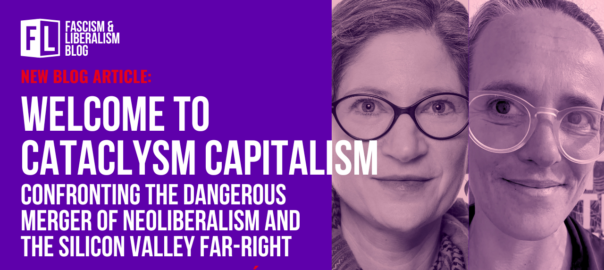
Welcome to Cataclysm Capitalism: Confronting the dangerous merger of neoliberalism and the Silicon Valley

far-right

by Julia Steinberger & Céline Keller

06.11.2025

According to Julia Steinberger, Professor of Societal Challenges of Climate Change at the University of Lausanne, and political graphic artist, expert in wealth-warped worldviews and climate activist Céline Keller, we have entered a new economic era: that of ‘cataclysm capitalism’—a merger of neoliberal and far-right ideology espoused by the ‘tech bros’ of Silicon Valley. Going even beyond previous neoliberal efforts to curb the capacity of democracies to enact pro-social and pro-environmental regulation, cataclysm capitalism dispenses with any illusion of ultimately serving the greater good. Entire categories of human beings are deemed dispensable, along with a livable planet. The authors argue our current politics and academia are ill-equipped to face the speed and scale of this new threat. To counter it, more people need to understand what we are up against, and organise around a positive alternative vision worth fighting for.

Note: This blog entry is an extended version of a recent Guardian column [i].

The ground is shifting beneath our feet so fast that it is dizzying: reading a newspaper or opening social media feels like embarking on a stomach-churning rollercoaster ride, except instead of drops, loops and twists, we plummet through genocide, planetary destruction, and the erosion of democracy and rule of law. Like in the first lines of Muriel Rukeyser’s poem I lived in the first century of world wars: “Most mornings I would be more or less insane.” [ii] (The whole poem is well worth reading.)

For anyone who wants to create a better, more equal, safer future, who wants to believe in the goodness of humanity, who wants to use their reason and emotions to make sense of the swirling evil chaos, and find some way forward, some meaning to life, these are crazy-making times. Domains we are taught from infancy to regard as separate—the economy, politics, war, environment, social relations, philosophy, science, culture, communication—all come swirling together, in ways that make the previous campaigns around socialism, labour rights, human rights or ecology, seem both quaint and obsolete, like Don Quixote tilting at windmills.

Here the warning words of Ngũgĩ wa Thiong’o in Decolonising The Mind [iii] ring loud: “Possibilities of triumph or victory are seen as remote, ridiculous dreams. The intended results are despair, despondency and a collective death-wish.” Keeping alive the “possibilities of triumph” is thus a vital act of resistance in itself. Indeed, later on, Ngũgĩ wa Thiong’o explains “Any blow against imperialism … is a victory for all anti-imperialist elements … The sum total of these blows not matter what their weight, size, scale, location in time and space makes the national heritage.” We would substitute “human dignity” for “national heritage”, but you get our point. [It is worth noting that Ngũgĩ wa Thiong’o’s argument on resistance is echoed in international law (both UN General Assembly Resolution 2625 and the Universal Declaration of Human Rights). Violence against civilians is in all cases prohibited by the Geneva Convention.]

If you are like us, you cling like a drowning person to anyone who can help make sense of even some facets of our times. The thinkers, mainly historians, who have already contributed to this “Fascism and Liberalism” blog are some of these beacons in the dark for us: the words of Nancy MacLean, Natascha Strobl, and Clara Mattei help us understand and navigate the perfect storm of our time.

Our goal in this piece is threefold: to illuminate the confluence of neoliberal and Silicon Valley far-right, and the existential dangers of this merged ideology; to cover how ill-equipped our current polities and academies are to face this new threat; and to present some ideas for fighting back. Ready for a different kind of roller-coaster? Let’s go. 

Trump’s Democracy-dismantling Alliance of Fossil Companies, Tech-Bros, and Billionaires

Everything is moving too fast. The Trump administration has torn through US government, universities and health organisations, firing tens of thousands of employees, jailing migrants and dissidents, eliminating billions in funding, destroying core science and health infrastructure, intimidating universities into silence and complicity. Israel, with full US support, is enacting genocide in Gaza, attacks on the West Bank, and bombing-territorial raids on Syria, Lebanon, Qatar and Yemen. Russia’s attacks on Ukraine are ramping up, with no end in sight. Major corporations and world governments have given up the slightest pretence of taking the climate and ecological crises seriously.

The EU block, led by the supposedly enlightened Ursula von der Leyen, is following all of these trends: steadfast in its support of Israel, attacking dissidents and progressive NGOs, and swinging hard to the neoliberal right, following Mario Draghi’s disastrous “Competitiveness Compass.” [iv] This report has been treated as a serious, grownup technocratic piece of policy guidance, but it is soaked through with neoliberal fervor for social and environmental deregulation, and enthusiasm for the same technologies as Trump-Musk: AI, space, automation, military build-up. Planning and regulation are shamelessly mobilised for technologies serving powerful elites, while the rest of the population is sacrificed on the deregulation altar of social austerity and accelerating ecological impacts.

The scope and speed of the attack is dizzying. It is almost impossible to keep up with the ongoing destruction, let alone to organise the resistance. None of this is accidental.

We need to understand the why and how of the Trump blitzkrieg to counter it in the US and recognise it fully in the EU. The dizzying pace of the attack can be traced to Trump’s long time strategist Steve Bannon, a self-described “accelerationist,” and aligns with his information warfare tactic to “flood the zone with shit,” to confuse, disengage and disorient. Whether on climate or Covid, rumours, lies and, conspiracy theories create a chaotic cacophony, leaving the public disoriented, fearful, and prey to oversimple Trumpist messages: blame the woke, the migrants, the trans, the Muslim, the doctors, the scientists. Now we can understand why Musk bought Twitter/X: to support Bannon’s shit-flooding agenda.

Within the accelerating chaos, there is a deliberate pattern, a plan. Last autumn, two major forces of Trump world came together during the “Reboot 2024” conference: the fossil-fuel funded Heritage Foundation, author of the “Project 2025” plan for Trump’s first year in office, and the billionaire tech magnates, like far-right Peter Thiel and his favoured theorist, Curtis Yarvin. Although we don’t know exactly who attended or what was said, the meeting clearly proved decisive. Subsequently, the tech magnates poured generously into Trump’s campaign, with Musk alone donating more than $250 million.

What we now see being implemented is a collaborative effort: the hostile government takeover described in Project 2025, merged with Yarvin and the tech bros dream to “reboot” a whole country, replacing the outmoded “democracy software” with something far less accountable and more business-friendly. Or, to be precise, more friendly to their business: regulatory positions eliminated, enabling  cryptocurrency to bypass democratic oversight, dismantling public agencies like NASA to favour Musk’s SpaceX, meanwhile replacing fired government employees with their own AI products. Musk’s chosen name for his Trumpland operation, Department Of Government Efficiency, is, of course, a corrupt advertisement for his own  cryptocurrency DOGE, but it is also a clear nod to Yarvin’s RAGE, Retire All Government Employees.

With the neoliberal Heritage Foundation and the tech billionaires setting the course, many industries are sensing the winds of change. Major companies are no longer even bothering with greenwashing or statements of green investments, they are dropping all pretence of responsibility for a liveable world. The climate and ecological implications of this shift are as disastrous as they are deliberate. We need an appropriate name for this new era of fossil companies’ and tech bros’ accelerating attack on democracy and the planet: perhaps cataclysm capitalism will do.

What is new about Cataclysm Capitalism?

Cataclysm capitalism is the worthy heir to neoliberalism and its disaster capitalism. As Naomi Klein described in her epoch-marking Shock Doctrine, neoliberal economic ideology took advantage of crises to deregulate economies, privatise public services, hobble trade unions and civil society, and generally create conditions that were ideal for private wealth accumulation and disastrous for equality, work and welfare. Cataclysm capitalism does all of this, but goes several steps further. The pace of change is accelerated, the dismantling of public institutions more complete, the attack on democracy more overt. Entire industries are captured, like social media, with the goal of forever dominating the information space and imposing pay-to-participate monopolies. Perhaps the most frightening aspect is that the industries laughing in the face of planetary and social destruction have made a clear calculus: they don’t need prosperous economies to profit. Neoliberalism at least claimed to be serving a form of greater good via rapacious market dominance. Cataclysm capitalism is dispensing even with even this illusion.

The fossil-fuel companies, the right-wing tech magnates, the financial companies hurrying in their wake, like the global giant BlackRock, have convinced themselves that they don’t need prosperous economies to prosper themselves. They have learned to profit from disruption, destruction and misery. They know from experience that immiserated populations still have human needs, and therefore will endure exploitative working conditions and go deep into debt to keep themselves and their families alive. And so what if multitudes fail and die, from lack of food, healthcare, climate disasters or some combination thereof? Many of the cataclysm capitalists are modern-day eugenicists. According to their belief system, those who will die from the hardships they are creating are by definition weak and undeserving of life. It doesn’t hurt that a major growth sector of cataclysm capitalism is security, public or private. After all, someone has to keep the hungry mobs away from the palaces of the elites. A key harsh lesson here is that those with the most wealth and power have already reconciled themselves to the sacrifice of the rest of us, ideologically and economically. The greater good is antithetical to their vision.

Paradoxically, the creation of vast economic insecurity secures right-wing and even far-right politics. As Karl Polanyi pointed out in his epic “Great Transformation,” this was already a major factor in the rise of Hitler in Germany. Voters in a constant state of fear and stress, without a clear understanding of the political system that is creating the hardships from which they are suffering, are an easy, indeed ideal, prey for far-right rhetoric blaming migrants, woke, trans and so on for all their ills. Sadly, since neoliberal ideology has devoured previously center-left factions (of the UK Labour party as of the US Democratic party), we are left with much less of an organised opposition, and much more of a pipeline to accelerating disaster. The EU as a block, following Draghi’s Competitiveness Compass, marches along in lockstep.

The picture we present is grim, but clear enough. We are faced with an organised plan of hostile takeover of democracy, coupled with a dismantling of the economy in favour of the sectors and industries most beneficial to the fossil-fuel and tech magnates, to our detriment and the detriment of all life on Earth. What can we do? What should we do? We propose a  three-pronged plan to start. This is by necessity short and schematic, but hopefully enough for you to get started.

Three Steps to Counter the Cataclysm Capitalists’ Attacks on Democracy

First, understanding is power. We need to learn more about the devourers of our world, from the fossil fuel think tanks of the Atlas Network to the far-right tech accelerationists. We need to explain to our fellow citizens who we are facing, and what their ultimate plan is. Replace helpless fear with knowledgeable anger.

Second, we need to organise, come together, in trade unions, in neighbourhood groups, in any and all collectives we can form. Since almost all of us, at this point, were raised in neoliberal cultures of individualism and isolation, organising sounds dauntingly foreign and difficult. It might be helpful to learn that our social ineptitude was created by design, not by accident, and is integral to the endeavour of disaster capitalism. In reality, human beings are among the most cooperative animals, with impressive innate capacity for dialogue and collective decision-making. Quite literally, organising is what we, as social animals, were born to do. At its most basic forms, organising consists in gathering people, raising awareness of the causes of our common problems, discussing possible avenues of action, putting them into operation. Rinse, repeat, make it part of your life’s hobbies and work. Because it is work, no doubt, but it is also social, and should include plenty of fun and more light-hearted moments and activities.

Third, we need to respond to the Trump-Musk project at the strategic level, not blow by blow. We know we can expect nothing but destruction and corruption from them: we have to put forward a positive vision, worth fighting for. We would describe it, from the perspective of research on well-being within planetary boundaries, as scientifically-informed democratic decision-making for the common good. This also means creating our own organisations for mutual aid and protection of the vulnerable. We have everything to lose if we don’t, and everything to gain if we do.

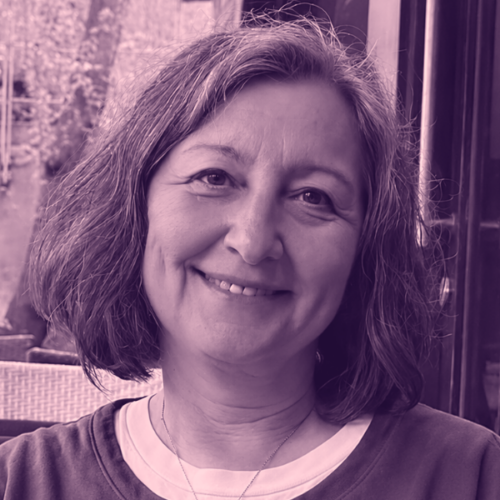
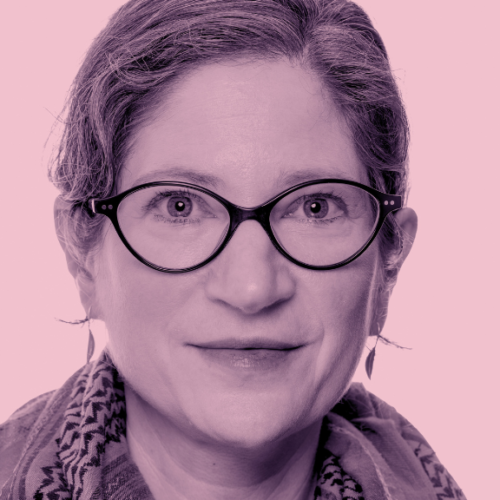
Author picture

Julia Steinberger is Professor of Societal Challenges of Climate Change at the University of Lausanne

Author picture

Céline Keller is a political graphic artist, expert in wealth-warped worldviews, and climate activist

References/Further Readings

  • [i] Steinberger, Julia. 2. April 2025. Trump and Musk have ushered in the era of cataclysm capitalism. But I have a plan to counter it. The Guardian. https://www.theguardian.com/commentisfree/2025/apr/02/donald-trump-elon-musk-capitalism-us-democracy
  • [ii] Rukeyser, Muriel. 1968. “Poem (I lived in the first century of world wars).” In: The Speed of Darkness.
  • [iii] Ngũgĩ wa Thiong’o. 1986. Decolonising the Mind: The Politics of Language in African Literature. London: James Currey / Boydell & Brewer, pages 2-3.
  • [iv] European Commission. 2025. The future of European competitiveness. Luxembourg: Publications Office of the European Union. https://commission.europa.eu/topics/eu-competitiveness/draghi-report_en

Related Posts

Advertising image for the F&L blog post by Natascha Strobl

F&L Blog – A Perpetuum Mobile of Cynicism

A Perpetuum Mobile of Cynicism: on the Symbiosis of Neoliberal and Fascist Views of Humanity

Natascha Strobl

28.08.2025

Economic liberalism and fascism often present themselves as opposites. Fascist forces claim to represent an anti-capitalism that is actually an anti-modernism and economic liberalism sees itself as a bulwark against totalitarianism but, in reality, means anti-communism. Despite all the alleged and actual contradictions, there is a decisive common source of these two ways of thinking: they share a negative image of humanity. Neoliberal capitalism sees individuals in constant struggle with each other. Only through eternal competition can something like innovation or progress come about at all. This idea of competition originates from the structure of the work process and the associated performance ideology and is transferred from there to all areas of society. Starting with the earliest competition for educational places from kindergarten onwards, through living space to relationships and the health sector – every area of society is permeated by acts of competition, selection and the creation of winners and losers.

In neoliberalism, it is important to see the situation of the losers as morally justified and, as a result, to ostracize them from society. Those who do not manage to be among the winners do not deserve to receive any help from society. This is how a neoliberal society produces few winners and many losers. Economically, this can be clearly seen in the ever-increasing concentration of wealth. But it is also visible in the rising potential for frustration in society. The promised goals and markers of prosperity (being able to afford a house, vacation, car) are achievable for fewer and fewer people. In consequence, there are not only more and more people who can be considered ‘losers’ of neoliberalism, they also increasingly feel like such. 

The neoliberal, hegemonic ideology frames this as people’s own failure and argues that they don’t deserve it any other way. This neoliberalization of everyday life goes hand in hand with a weakening of democratic institutions, which appear powerless in the face of business and industry influence and consequently act solely in their interests. What remains is a loss of trust in democratic institutions, as well as in (public) media and science. According to sociologist Wilhelm Heitmeyer “authoritarian temptations” thrive, as can be seen in the increasing success of far-right parties and movements.

Life as Constant Struggle

Neoliberalism shares this cynical view of humanity with fascism. Fascism also sees people as beings to be harassed and sanctioned, and who live in constant struggle with each other. The ethnic element adds a further level: Not only individuals, but also peoples, cultures or “races” are in competition with each other and have to assert themselves against each other. Both concepts of humanity are thus united by an essentially Malthusian or Social Darwinist view of humanity. It is about eating or being eaten. Applying this view of humanity to a society means living in constant fear and insecurity of all other people. Solidarity, community and cooperation are not only impossible, but they are also undesirable and portrayed as harmful.

Neoliberalism and Fascism – a Perpetuum Mobile

In countries such as Austria and Germany, the post-war consensus consists of a fragile agreement on democratisation, the promise of political equality, and an economic system based on inequality. Political intervention in the first post-war decades contained the social Darwinist roots of this system. However, from the implementation of neoliberal policies in the 1980s onwards, these roots began to reappear openly. This was accompanied by attempts to reduce democracy, particularly in the world of work. Trade unions and workers’ representatives were disempowered. Neoliberal think tanks and lobbies have formed a kind of state within the state, pursuing opaque policies under the guise of neutrality. Since the 1970s, they have also funded biased research through donations to universities. At the same time, they have set up astroturf organisations and engaged in disinformation and culture war campaigns. Neoliberal protagonists are therefore guilty of the very things they accuse others of. This neoliberal ecosystem is a prime example of how socio-political, authoritarian, right-wing extremist and even fascist agendas naturally accompany their hard economic liberal agendas.

Neoliberalism thus prepares the ground for fascism by hegemonizing a cynical and negative view of humanity. Once it is generally accepted that nothing is guaranteed and that any minimum standard is considered decadent, it is much easier to curtail or abolish regulating institutions. This means rolling back state control and that everyone is being pitched against everyone else. This is precisely the essence of undertakings like DOGE. They dismantle democracy, both discursively and institutionally. The result is a world in which there is no longer any security or trust. Experiences of solidarity are becoming increasingly rare. Everyday life becomes a constant struggle for survival in competition with other people. The tenor is clear: there is not enough for everyone, and you must make sure that you are one of the winners. Nobody is looking out for you, so you don’t have to look out for anyone either.

Fascist Promises

Fascism pushes this precarious state further by affirming and reinforcing it. Our experiences with neoliberalism confirm the fascist view that the world really is as bleak, ruthless and harsh as it has always been claimed to be and at the same time opens up the opportunity to dismiss the left (or what one considers to be the left) as naive dreamers. Neoliberalism destroys the existing order and security, each of which is democratically underpinned. Fascism, on the other hand, offers a promise of order and an authoritarian, hierarchical and elitist security – the authoritarian temptations mentioned above. Without the prior destruction of liberal democracy through neoliberalism, however, fascism would not be possible. Fascism could not prevail on its own, as it has neither the roots nor the resources to do so. It absolutely needs the upheavals and crises of (neoliberal) capitalism in order to gain a mass base at all.

Fascism obtains this mass base through a promise of order, security and value through belonging. In its basic social Darwinist-genocidal attitude, this order can only be achieved through an act of purification. This purification means the ethnic selection of undesirables, be they ethnic, religious or social groups. This selection promises the exclusion of those elements that cause insecurity. These are scapegoats. But even for those who are part of the new order, authoritarian security actually consists of permanent insecurity. You are integrated into a national community from which you can be excluded at any time. In a state of security created through fascism you have to live in constant fear of everyone around you. This shows the negative, cynical and social Darwinist view of humanity shared by neoliberalism and fascism. Everyday life is characterized by insecurity and fear.

Fascism and Capital

However, none of this happens in a vacuum. Fascism becomes an option for capital factions when their own business model, and thus their ability to accumulate capital, is disrupted and cannot be saved democratically. This, for instance, currently applies to the fossil fuel economy: Oil and gas have no future – and that is why these very industries are now pumping money into the neoliberal-fascist ecosystem. Fascism thus becomes a strategy for the persistence of declining or emerging business models. There are also industries that need the support of an authoritarian state because their ability for profit-making is much lower in a democracy. This, for example, also includes the tech industry – be it the social media giants who desire to end all regulation, the surveillance industry or corporations who want to silence debates on the (un)ethical use of artificial intelligence – these business models cannot fully develop in a functioning democracy.

Whether fascism prepares people for capitalism or vice versa is somehow irrelevant — both statements are equally true. Fascism and capitalism are symbiotic systems. They have their own logic and can exist independently, but they benefit from each other and share a common basis. This basis is the education of humans to be compassionless. This lack of compassion is directed towards others, who consequently deserve to die. However, it is also directed inward, meaning, from a neoliberal point of view, one never deserves a life without fear or the right to simply live with dignity. The core of neoliberalism and fascism is therefore a negative view of humanity that does not grant individuals any dignity in their own right but instead categorises and evaluates them according to their performance and usefulness, as well as their ancestry and genetic characteristics.

Natascha Strobl is a political scientist and journalist. She is an expert on right-wing extremism and the New Right. Her book "Radikalisierter Konservatismus. Eine Analyse" was a bestseller and was awarded the Bruno Kreisky Prize for Political Books.

Further Reading

  • Heitmeyer, Wilhelm: Autoritäre Versuchungen (2018)
  • Horkheimer, Max: Die Juden und Europa. Authoritarian State. Reason and self-preservation 1939-1941 (1967)

  • Polanyi, Karl: The Great Transformation. Political and economic origins of societies and economic systems (1944/1973)

Related Posts