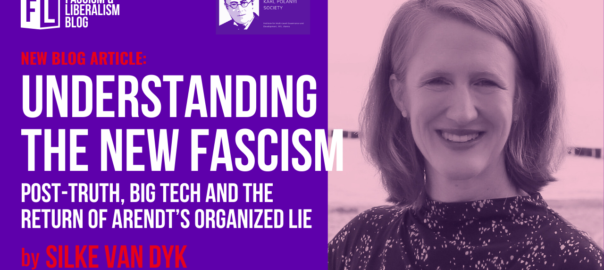
Understanding the New Fascism: Post-Truth, Big Tech and the Return of Arendt’s Organized Lie
by Silke van Dyk
12.03.2026
Trump II is far more than just a radical version of the first administration. Rather, we are confronting a deeper transformation of the political itself, writes Silke van Dyk. The flooding of public discourse with right-wing populist falsehoods that defined Trump’s first term has given way to a more far-reaching manipulation of public opinion. This is further reinforced by the rise of digital capitalism and its neo-feudal concentration of power and resources. As such, van Dyk argues we are seeing a return of Hannah Arendt’s “organized lie” – the ongoing and deliberate manipulation of opinion and knowledge – a defining feature of totalitarian regimes. But countering this new fascism will require more than fighting fake news. It means liberal democracies must also address their own inconsistencies
With the first and second election of Donald Trump, the Brexit referendum, the rise of right-wing parties across numerous countries, the influence of conspiracy narratives during the COVID-19 pandemic, and the momentum of climate change denial, a new political era has taken shape – one in which the right is increasingly challenging liberal hegemony. Alongside the resurgence of racist, nationalist, and chauvinist politics, public discourse itself has undergone a marked transformation. We are witnessing a proliferation of falsehoods, conspiracy theories, and half-truths, often coupled with hostility toward science and intellectuals. Political deception, of course, is nothing new. What is new, however, is its sheer volume, the speed of its dissemination, and the striking fact that exposure no longer appears to damage its authors. Whereas Richard Nixon was forced to resign in 1974 following the revelation of his lies in the Watergate scandal, Trump returned to the White House for a second term despite his countless false statements.
Traditional versus Organized Lies
The classic definition of the lie is that of an intentional act in which the perpetrator is quite capable of distinguishing between the true and the untrue and deliberately makes a false statement. The publication of the Pentagon Papers[i] prompted Hannah Arendt to re-evaluate this traditional lie, and to contrast it with what she termed the “organized lie”. According to Arendt, “the difference between the traditional lie and the modern (organized) lie will more often than not amount to the difference between hiding and destroying.”[ii] While the traditional lie revealed itself because the yardstick of truth remained intact, this no longer applies to the organzied lie, since it changes the overall context in such a way that the lie becomes a substitute for reality.
According to Arendt the organized lie destroys, our “sense by which we take our bearings in the real world”[iii]. The organized lie is a demanding practice: it requires the power to eliminate or refashion all contrary evidence – documents, testimonies, witnesses, even history books – so that reality itself is consigned to a form of orchestrated oblivion. Unsurprisingly, such practices are most characteristic of authoritarian and totalitarian regimes. As a central example, Hannah Arendt points to the Stalinist effort to erase all traces of Leon Trotsky from everyday life, education, and cultural memory.
If, according to Arendt, actors lack the power needed for the organized lie, with its inherent shift away from reality, they increasingly fall back on the mode of opinion, claiming the right to freedom of expression: “The blurring of the dividing line between factual truth and opinion belongs among the many forms that lying can assume.”[iv] To take just one example: it is one thing to conclude from the Fukushima nuclear disaster that Germany’s energy policy did not require revision – this would constitute a legitimate political opinion. It is quite another thing to deny the disaster itself in order to preserve nuclear energy – and to justify that denial in the name of free speech. The latter amounts to erasing the boundary between fact and opinion. To avoid any misunderstanding: Hannah Arendt consistently defended the value of opinion and warned that truth turns despotic when it supplants politics. At the same time, she made unequivocally clear that democratic contestation presupposes a shared sense of reality, which forms the indispensable basis of political struggle. Without it, public debate deteriorates into cynical relativism – a danger against which Hannah Arendt forcefully warned.
Trump I: The Populist Play With Truth
Echoing Friedrich Nietzsche’s dictum that truth is “the obligation to lie according to a fixed convention”[v], Trump & Co lied in open defiance of convention.[vi] The falsehoods were so frequent, so blatant, and so inconsistent that their inaccuracy were most often immediately apparent. Many of these statements were situational and contradictory, loosely connected rather than embedded in a coherent worldview. In Trump‘s first term, the surrounding context remained largely intact; indeed, the point was to flaunt the possibility of dismissing that context as the ‘deceptive reality’ constructed by allegedly left-liberal elites. In this configuration, being accused of lying poses no threat to the liar. On the contrary, it serves as proof of the critic’s elite status.
Deliberate fabrications or organized lies were less a threat to empirical realities than the elevation of mere opinion. When Trump once speculated that U.S. unemployment might be as high as 42% he did not challenge the official rate of 5.3% by criticizing statistical methods or narrow definitions of unemployment. Instead, he countered a verified figure with an opinion, citing unnamed sources and invoking the right to free speech. In its first phase, the Trump system thus sought to circumvent the established procedures of truth verification in liberal democracies. Yet the countless falsehoods of Trump I had another effect as well: they generated lasting confusion, thereby paving the way for authoritarianism. As Hannah Arendt observed: “The ideal subject of totalitarian rule is not the convinced Nazi or the dedicated Communist, but people for whom the distinction between fact and fiction (i.e. the reality of experience) and the distinction between true and false (i.e. the standards of thought) no longer exist.”[vii]
Trump II: The Fascist Return of the Organized Lie
From the outset of his second term, Trump and his circle made utterly clear that they would not simply replicate the first. Immediately after the inauguration on January 20, 2025, the new president signed numerous executive orders, including pardons for convicted Capitol rioters, withdrawal from the World Health Organization (WHO), and the elimination of birthright citizenship for U.S.–born children of non-citizen parents. Although the January 2025 inaugural address carried unmistakable populist overtones – Trump accused “a radical and corrupt establishment” of having “robbed our citizens of power and wealth” for years – the speech, and even more so the administration’s first-year policies, revealed distinctly fascist-like features.
This has resulted in the further radicalization of the extreme nationalist MAGA (Make America Great Again) project, paired with the construction of Trump as a Führer-like figure divinely chosen to end the “terrible betrayal” of international forces against the American people. Glorification of violence appears in the widespread imagery of deportations of alleged gang members, the repeated calls to expand the death penalty, and the brutal conduct of U.S. Immigration and Customs Enforcement (ICE), with its increasingly paramilitary characteristics. Migrant communities, queer people, and scientists are cast as enemies from whom the American people must be “saved.”
Concrete measures quickly followed: deportations, emergency legislation at the Mexican border, the elimination of the third-gender option on official documents, cuts to diversity programs, and sweeping restrictions on academic freedom. The manipulation of knowledge production and dissemination, the suppression of unwelcome research in climate, health, and diversity, and political interference in the governance and direction of cultural institutions all testify to a new form of control over education, culture, and science. School curricula, museums, and public libraries are seeing the increasing removal of references to the crimes of slavery and the history of racism. Government agencies are currently deleting photographs and documents that record the service of women and people of color in the military or critically examine U.S. military actions. In the terms of Hannah Arendt, this represents a renewed deployment of the organized lie with its characteristic power to derealize: inconvenient facts, evidence, and scientific knowledge are no longer merely challenged with opinion – they are actively manipulated, and the records themselves, destroyed.
Big Tech as Agents of Fascist Derealization
The newfound alliance between Silicon Valley tech giants and Trump & Co. has accelerated this trend, visible in every inauguration photograph, with the heads of Meta, Google, X, and Amazon seated in the front row. It proved highly convenient for the Trump administration that the fact-checking measures temporarily introduced on Facebook and Instagram to curb fake news and conspiracy theories vanished immediately after the inauguration. Likewise, Google promptly – and illegally – implemented Trump’s order to rename the Gulf of Mexico the “Gulf of America”, at least within the U.S. The fragmentation of the public sphere in the digital economy corresponds to the concentration of power in the hands of a handful of ultra-wealthy private entrepreneurs, who, as enablers of fascist–leaning governments, have become key agents of derealization. Artificial intelligence is increasingly deployed to reshape the state in anti-democratic ways: deepfakes can be used to discredit political opponents, while evidence of corruption and illegal government actions are likewise dismissed as false, fabricated by the liberal elite. The fascist–like return of the organized lie thus brings derealization into reality – something that even Hannah Arendt and George Orwell could hardly have imagined: a neofeudal, privately controlled capacity, enabled by new technologies, to artificially remake the very representation of the world.
The Liberal System Must Confront Its Own Inconsistencies
One obvious response to these developments would be to bring communication and information infrastructures under public ownership and democratic control – rather than subject to the priorities and profit motives of a handful of multi-billionaires. Yet to do so requires understanding why the “offer” of rightwing and fascist politicians appeal to so many. This means examining the functional deficits of liberal democracies. At a time when liberal elites often celebrate the primacy of truth, they frequently overlook their own problematic handling of facts. For decades, they have presented certain realities as immutable constraints, while promoting radical market and austerity policies as inevitable and beyond debate.
Hannah Arendt emphasized that political thinking operates between two risks, “the danger of taking [facts] as the results of some necessary development which men could not prevent and about which they can therefore do nothing, and the danger of denying them, of trying to manipulate them out of the world”[viii]. To understand the complex picture we face today, it is crucial to connect these two dangers and recognize that the liberal “postpolitics” of inevitability bears at least partial responsibility for the rise of rightwing forces that manipulate reality and advance their own anti-elite narratives. It is true, in other words, that “those at the top lie” when they claim there is no alternative. It becomes particularly dangerous when the necessary vigilance against the right blinds us to the functional deficits of liberal democracy and economy – the unfulfilled promises, technocratic tendencies, and socioeconomic failures that have brought us to the present moment. Even more perilous is the call to end debates among democrats in the face of the rightwing threat. Yet democratic public life depends on political contestation, including vigorous debate over what an anti-fascist social and economic policy should look like – a question that now, more than ever, must concern all democrats.

Silke van Dyk is a professor of Political Sociology at Friedrich Schiller University Jena. Her main research areas are the sociology of social inequality, the sociology of social policy and the welfare state, the sociology of aging and demography, and perspectives of social critique.
References
- i The Pentagon Papers are a formerly secret document produced by the US Department of Defense, whose serial publication by the New York Times in 1971 revealed the feeding of false information to the US public concerning the Vietnam War.
- ii Hannah Arendt (1969) Truth and Politics. In: Hannah Arendt, Between Past and Future: Eight Exercises in Political Thought, New York, p. 227-264 (here: 253).
- iii Ibid., p. 257.
- iv Ibid., p. 250.
- v Friedrich Nietzsche (1988) Kritische Studienausgabe, Vol. 1, Berlin/New York, p. 881 (own translation).
- vi For a detailed analysis, see Silke van Dyk (2022): „Post-Truth, the Future of Democracy and the Public Sphere”, in: Theory, Culture & Society, 39 (4), pp. 37-50.
- vii Hannah Arendt (1958) Origins of Totalitarianism, Cleveland/New York, S. 474.
- viii Hannah Arendt (1969) Truth and Politics, p. 259.