Property Damages
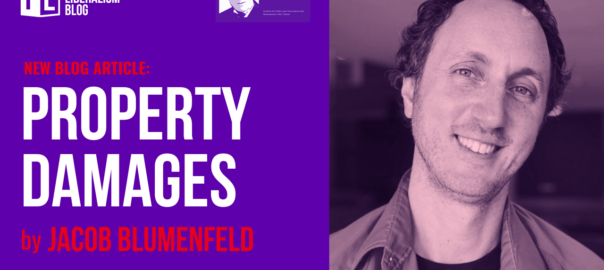
by Jacob Blumenfeld
13.02.2026
Does private property secure freedom, or train us for domination? In this article, philosopher Jacob Blumenfeld traces how liberal ownership rights shape social relations, trigger ecological conflict, and foment authoritarian desires. His claim is not that all forms of private ownership corrupt individuals. Rather, he argues that the specific legal form of liberal property rights – granting exclusive control over socially necessary resources – enables relations of power, resentment, and authority that prime authoritarian movements. In an age of climate crisis and deepening inequality, the future hinges on the question of how property relations are organized: for private ends – or for social needs.
In a speech on January 21st in Davos, Donald Trump asked, rhetorically, in relation to Greenland: “Who wants to defend something on a lease?” To defend something, he implied, one must first own it. The need for protection becomes the justification for possession. Trump’s remark expresses a familiar liberal conviction: authority appears legitimate when grounded in ownership, and ownership is only legitimate if you take on ‘responsibility’ and can defend it. Property rights, thus, do not only allocate resources, they allocate decision-making power. Whoever owns decides; others adapt. This article examines the ideological roots of such thinking and discusses the political consequences of that ordinary arrangement posing the question: does owning property make you more prone to fascism? Does acquiring a taste of sovereign authority over an external thing slowly translate into a desire to dominate people as well? If you treat the world fundamentally as property, characterized by the right to use and abuse things at will, then isn’t it only a matter of time before you overstep the boundary between thing and person?
Property is Power
If slavery is the origin of property rights, as David Graeber once argued, then being a property owner is an education in dominion, the authority to dispose over what is mine by commanding the wills of other people. The right to an external thing is a license to treat others in certain ways in relation to the thing at hand. My legally sanctioned authority over this land, these assets, and those machines gives me the legitimate power to determine how others may or may not use them, irrespective of the social consequences. Treating something as property flattens the salient normative distinctions between items of personal use, societal infrastructures, natural landscapes, and means of production, as if they could all be simply mine or yours, ours or theirs, without further thought. Property is power over people, masked as a relation of power over things. Whether a pair of shoes or a pair of companies, a piece of land or a piece of writing, I can develop or destroy what’s mine as I see fit. Whether the air is polluted, food wasted, tenants evicted, or ecosystems plundered, that is not my concern. Freedom trumps consequences.
Liberalism is founded on the right to private property, but private property is also what breaks liberalism. For what better way than owning property is there for learning how to be a dictator? If this is true, then the bedrock of liberal freedom is made from the same material as the authoritarian longings it is supposed to ward off. Or maybe we have it backwards. Does not owning property make you more prone to fascist tendencies? If you don’t have anything at all to call your own, does that make you jealous of those who do? Resentful, hateful, you see others as threats or competitors, as rivals scrambling for scarce jobs, limited resources, and even romantic companions. Dependent on bosses, managers, and landlords, you despise those not above you—you want to be them—but those beside you and below you. They are the ones taking your job, raising costs, committing crimes. Squeezed between employers and unemployed, between owners and beggars, you seek an outlet for affirming your unrecognized status, for exercising the power of possession over property you don’t have. A class of vulnerable people—women, migrants, minorities—fills the void of property and upon them you exert your dominion. But resentment does not remain a private feeling—it seeks a public form. It looks for a figure who can promise to restore what should be yours, someone who can bring back greatness, who can give you a share of domination as compensation for a share of ownership.
The Liberal Paradox of Private Property Rights
Damaged subjects, damaged objects, damaged society—property leaves wreckage in its wake, whether you have it or you don’t. But what is property after all? And isn’t this about private property, not property as such? The term property can refer to a thing that is owned, to rules of ownership, or to the right to control the use of something. Ownership usually entails rights of exclusion: the authority to legitimately exclude others from determining the use of something, including the right to possess, to control, to sell, to destroy, and so on. Private property—as opposed to public, common, open access, social and other forms of ownership—grants the authority to decide on the use of something to a single person, although “person” here is not a human being, but a juridical category. This right to exclude others from having a say in determining the use of goods is the anti-democratic core of liberal democracy, and it is morally permitted due to the alleged gains that private property contributes to securing individual freedom and fostering economic efficiency.
But private property is not a simple one-way relation between owner and owned. Rather, the relation extends in multiple directions out from the self: from self to others, from self to world, and from self to self. Property, in other words, is a social relation, a world relation and a self-relation. It shapes how we relate to each other, how we treat nature, and how we treat ourselves. Property organizes our ethical relations, our ecological conditions, and our subjective identities. It habituates us to a grammar of command and deference. While owning personal possessions need not be problematic, at the societal level, private control over infrastructure, housing, or productive assets magnifies the dominating, sovereign power of private property over social life. That is why it’s so important to prevent social property relations from being structured in ways that are beyond democratic control. Letting private persons with ownership rights determine the fate of the natural environment, visual media, medical developments, or technological investments, to name a few, can cause immense damage not only to social institutions and complex ecosystems, but also to the psychological well-being of individuals themselves.
The paradox is that liberal property rights, in their very atomism, bind human beings together on a planetary scale through our forced inclusion in global markets. We are individually empowered to exclude each other, yet collectively unable to escape one another. Therein lies the dual power of property rights: separating us in ways that foster regression and binding us in ways that elicit material transformation.
Critical Property Theory
There has been a renaissance of critical property theory in recent years. Eva von Redecker has shown how authoritarian tendencies emerge as a kind of reflexive phantom possession over amputated rights to dominate others. Daniel Loick argues that property rights themselves deform the subjects who exercise them, and thus demands a non-appropriative relation to the world. Brenna Bhandar has traced the colonial violence embedded in legal techniques of property such as title by registration, while Robert Nichols has demonstrated how states create property through acts of dispossession. Across these approaches, a common theme emerges: property is not a neutral legal tool but a central site of social conflict, whether over housing, data, land, finance, and the environment, or wherever we have a stake in determining the boundaries of mine and yours.
This insight has deep philosophical roots. Hegel described property as an “external sphere of freedom,” the domain in which the free will gives itself objective form in the world and can be recognized as such by others. For Hegel, property is a necessary but still one-sided realization of freedom. It must be taken up into richer ethical and political relations—family, civil society, and the state—if freedom is to acquire substance and direction. To treat nothing as property would block the will’s need to externalize itself. But to treat everything as property would be a scandal for ethical life, reducing all relations to the grammar of possession.
The political stakes of this ambiguity become stark in moments of crisis. In a 1934 essay on the relation between liberalism and fascism, Herbert Marcuse highlighted the property-centered definition of liberalism offered by Ludwig von Mises: liberalism, according to Mises, can be summed up in a single word—property, specifically private property in the means of production. From this premise follows both an unqualified defense of capitalism and a qualified tolerance for authoritarian rule, insofar as it is seen as a temporary bulwark against socialism. When property becomes the supreme value, the line between defending freedom and excusing domination grows perilously thin.
Max Horkheimer captured the view from below with brutal clarity: for those who live at the sharp end of economic power, liberal and authoritarian regimes often blur together. What changes is not the experience of hunger, police, or compulsion, but the language in which these realities are justified.
Liberal Property and Authoritarian Politics
A contemporary echo of this logic surfaced in Trump’s recent Davos speech, cited at the top. Ownership in Trump’s liberal-fascist rhetoric is bound explicitly to protection, and protection is bound to war—both legally and psychologically. What is not asked is what should be defended by whom in the first place. The fact that property must be defended is taken as retroactive justification for making it “mine.” Whether concerning oil, airspace, land, or minerals, the right to determine the use and abuse portions of the world as one’s property is the underlying premise of geopolitical struggle. Trump just made it explicit.
Also in Davos, Canadian prime minister Mark Carney defended what he calls the ‘liberal international order’ against Trump’s openly proprietarian language. Yet the contrast is less absolute than it appears: the liberal world order has long protected property claims through sovereignty, contracts, and international law, thereby limiting open territorial conflict while simultaneously enabling asymmetric control over resources, labor, and development across the global economy. Recognition and domination formed two sides of the same structure: internally pacified through rights, externally extended through markets, finance, and extraction.
Whether in Ukraine, Venezuela, or Gaza, it seems as if the recognition of formal property rights has suddenly ceased to play a role in geopolitics. But what is changing is not the respect for property as an international principle altogether, but the weakening of the discursive and juridical mediation around which property was previously organized. As the language of sovereignty loses its stabilizing force, conflicts increasingly appear in direct form as disputes over entitlement – who may dispose over shared conditions of life, and who must adapt. Those who have the power to take and defend property with force increasingly shape the future of the planet. Breaking the capacity of these claims to determine our collective fate for the gain of a few at the expense of the many is one of the defining political tasks of our time.
Under conditions of ecological crisis, these dynamics intensify further still. As material conditions deteriorate, struggles over access to energy, housing, water, and security sharpen. Claims of “mine” and “yours” harden, becoming less negotiable and more willing to enlist authoritarian means—which is what we are arguably witnessing in international politics already. Managing a declining economic order becomes a central political problem. If investment, infrastructure, and resource allocation remain governed primarily by markets and private rights, the burdens of transition will be distributed through mechanisms that amplify inequality, exclusion and violence. Demands for protection slide into demands for war.
Socialization or Regression
If authoritarian tendencies are rooted in the contradictions of liberal property rights, familiar liberal remedies, such as more rights, better juridical procedures and stronger institutions are unlikely to suffice. As long as the external sphere of freedom remains privately monopolized, the gap between formal equality and material power will continue to generate political and affective pressures that can be mobilized in illiberal directions. However, the alternative is not the abolition of property but its socialization, or rather, the abolition of one kind of property through its socialization: the democratization of the powers of use, control, and investment over the basic infrastructure of society so as to plan a better future together. Socialization means transforming property from a private claim backed by exclusive rights into a collective capacity oriented toward shared needs and democratic priorities. It asks who gets to decide what is built, extracted, funded, maintained, or allowed to decay. It seeks to expand the external sphere of freedom beyond the boundaries of private title – a necessary precondition for a more just and sustainable social order, particularly regarding the ownership of society’s central means of reproduction.
In this sense, socialization is a struggle for recognition at the level of material life. It aims to make democracy effective not only during the election cycle but in the everyday organization of production, reproduction, and ecological repair. It is an attempt to align formal equality with real capacities to shape one’s conditions of existence. When property relations fail to secure mutual recognition and the satisfaction of basic needs for large segments of society, they become politically damaging. The defense of private ownership transforms from a claim of freedom into a demand for domination.
Property is not simply something individuals have. It is a social relation through which freedom, dependence, and mutual obligation are organized. How that relation is structured will shape not only patterns of inequality but the very forms of politics that appear plausible, legitimate, or necessary in moments of crisis. Property damages, and damage demands compensation. In a world of climate breakdown and deepening precarity, the stakes of property are nothing less than the kinds of futures we make possible—or foreclose.

Jacob Blumenfeld is a philosopher and postdoctoral fellow at the Centre for Social Critique in Berlin. His work spans critical property theory, the normative foundations of socialization, climate change and subjectivity, Fichte’s critical theory, and the moral philosophy of Günther Anders.
References
- Angebauer, Niklas; Blumenfeld, Jacob; Wesche, Tilo (ed.) (2025): Umkämpftes Eigentum. Eine gesellschaftstheoretische Debatte. Suhrkamp.
- Bhandar, Brenna. 2018. Colonial Lives of Property. Duke University Press.
- Blumenfeld, Jacob. 2024. The Concept of Property in Kant, Fichte, and Hegel. Routledge.
- Graeber, David. 2011. Debt: The First 5000 Years. Melville House.
- Hegel, G.W.F. 1991 [1820]. Elements of the Philosophy of Right. Cambridge.
- Horkheimer, Max. 1973 [1940] . “The Authoritarian State” in Telos 15: 3-20.
- Loick, Daniel. 2023. The Abuse of Property. MIT Press
- Marcuse, Herbert. 2009 [1934]. “The Struggle against Liberalism in the Totalitarian View of the State.” in: Negations: Essays in Critical Theory. Mayfly.
- Mises, Ludwig von. 1985 [1927]. Liberalism. Liberty Fund/Cobden Press
- Nichols, Robert. 2019. Theft is Property! Duke University Press.
- Redecker, Eva von. 2020. “Ownership’s Shadow”. Critical Times 3 (1): 33–67.