
All posts by IKPS

F&L Blog – Four Learnings about the Interconnection of Fascism and Liberalism

Four Learnings About the Interconnection of Fascism and Liberalism: Yesterday and Today

Maie Klingenberg, Solveig Degen, and Andreas Novy

19.12.2025

Over the past months, a dozen articles on our newly founded blog have deepened our understanding of the entanglements between fascism and liberalism — both historically and today. As we look ahead to expanding our knowledge base with new authors and perspectives in the coming year, we want to use this final article of 2025 as a moment of reflection. Drawing on analyses and arguments that have been shared on our blog, we extract four learnings. Whether you are new to our blog or simply wish to revisit some of the central insights, this article is for you.

1.(Neo)liberal Austerity as an Attack on Democracy

Across several of the F&L blog articles, authors identify austerity politics as one of the central mechanisms that connect neoliberal and far-right agendas. But how does this connection actually play out? Here, we summarize two major insights.
The first is that we must begin to see the (neo)liberal call for “balanced budgets” as effectively withdrawing decisions about public spending from democratic control. As Colleen Schneider argued in her piece “Balanced Budgets, Broken Democracies”, the neoliberal orthodoxy treats government deficits as inherently problematic and insists that governments must adhere to strict fiscal limits. According to Schneider, the idea of balanced budgets, “has been used, consistently and across party lines, to justify austerity”. By this logic, governments have cut public services, rolled back welfare programs, and privatized state assets, thereby expanding the domain of markets into previously public spheres. Meanwhile, alternative understandings of the constraints on government spending have been sidelined.

As Pavlos Roufos argues in “Are We All Lisa Cook?”, the establishment of independent central banks as “non-majoritarian technocratic institutions” has served the same agenda of protecting capital accumulation against the interests of the majority. According to Roufos, independent central banks are commonly depicted as non-political institutions representing “the rational voice of the majority” and a pillar of democracy. In fact, public spending is being removed from democratic deliberation. After almost half a century of neoliberal hegemony, austerity is the new normal, legally codified in the EU’s Maastricht criteria and Germany’s debt brake.

The second major insight is that historically, such austerity measures weakened democratic forces and significantly helped the rise of 20th century fascism in Europe. After World War I and the collapsed Gold Standard, many countries underwent austerity programs to restore economic stability. According to Pavlos Roufos, it was a time of “outright hostility towards mass democracy” among liberals and conservatives, when leading liberal bankers lobbied to “insulat[e] monetary decisions from mass democracy” via central bank independence. In the case of Austria, the harsh enforcement of austerity measures mandated by the League of Nations was accompanied by an order to suppress any resistance by trade unions and political opponents, as Maria Markantonatou details in her article “Revisiting Polanyi’s warnings”, which describes how austerity politics enabled the rise of austrofascism. She cites Karl Polanyi in concluding that these measures “resulted in a decisive weakening of the democratic forces which might otherwise have averted the fascist catastrophe”. Strikingly, as Janek Wasserman points out in his article on “Functional Democracy” libertarian economist Ludwig van Mises “disparaged parliamentarianism and sided with conservatives and fascists in a quest for economic stability”. As Clara Mattei and Aditya Singh write in “Unmasking the Dehumanizing Logic of the Capital Order”, in Italy, the liberal establishment supported the rise of Benito Mussolini, as they “recognized that only an authoritarian state could defend the capital order”.

Drawing on these historical insights, it becomes apparent that liberalism and fascism are deeply entangled in their quest to minimize democratic control over public investments and monetary policy. Thus, fighting austerity measures and re-politicizing discourses around central banking and balanced budgets is of key importance for anti-fascist economics and politics in the 21st century.

2.A Shared Sinister View on Humanity as Self-fulfilling Prophecy

We draw a second key learning on the interconnection of liberalism and fascism from Natascha Strobl’s piece “A Perpetuum Mobile of Cynicism”. The article called our attention to the common psychological ground of fascism and neoliberalism: their shared negative conception of humanity where life is seen as a constant struggle for survival. Further, Strobl argues that “[o]ur experiences with neoliberalism confirm the fascist view that the world really is as bleak, ruthless and harsh as it has always been claimed to be”. Thus, it is instructive to think of fascists’ and neoliberals’ shared view of humanity as a sort of self-fulfilling prophecy.

According to Natascha Strobl, fascists as well as neoliberals — explicitly or implicitly — draw from Social Darwinism, seeing “survival of the fittest” as a desirable form of natural selection among humans. In this view, social welfare helps those who, in fact, do not deserve to make it. Here, an important parallel can be drawn to Nancy MacLean’s analysis of the historical genesis of the global libertarian and immensely influential think tank the Atlas Network. In her piece “Enchaining Democracy”, MacLean describes how the founders of the network were deeply influenced by the ideas of libertarian economist and Nobel laureate James M. Buchanan, who coined Public Choice Theory. According to this theory, politicians should be understood as self-interested actors whose actions are motivated by their own personal gain. He used this theory to explain why politicians would “overspend” in times of prosperity and not only in times of recession or crisis as Keynesians had argued before, thereby effectively “stealing” the money of wealthy taxpayers for their own political agenda. Buchanan’s view on taxes is far from a fringe view but gained immense popularity in conservative and liberal circles across the world – not least through the conscious efforts of libertarian think tanks, as we’ll return to later. In the view of Buchanan and the like, wealth is a sign of success in the civilizational struggle, leaving no reason to reward the losers of the game. On this ground, it is desirable to cut corporate and income taxes for the wealthy and to slash pensions, social benefits and investments in public infrastructure.

By applying their sinister logic to politics, neoliberals have created the conditions in which their outlook on society has become a reality for the majority: After half a century of austerity politics, life feels precarious and threatened for many, with fellow humans appearing as competitors in a zero-sum game over shrinking public services. Moreover, the promise to improve public services for everyone has lost credibility, as left-wing governments often fail to deliver due to international debt obligations or austerity written into constitutions. This loss of credibility, in turn, increases the appeal of centrist and far-right calls to exclude “undeserving outsiders” and “slackers” from access to public services.

3.The Rise of the Far Right as an Orchestrated Project from Above

While the rise of the far right might appear as an inevitable consequence of the socioeconomic grievances neoliberalism has created, many authors of our blog series reminded us that their ascent is not accidental, nor their victory a foregone conclusion.

As detailed by Nancy MacLean, the far right’s rise is the result of many years of groundwork by wealthy and powerful actors. Already in the 1970s, James Buchanan began building his market fundamentalist “counterintelligentsia” in order to push back on welfare policies. He won the billionaires Charles and David Koch to his cause, who began building the Koch Network of hundreds of like-minded, wealthy, conservative and libertarian donors, supporting right-wing organisations and education programs. A crucial part of this cosmos is the Atlas Network — the world’s largest think tank network, which provides enormous funds for libertarian research and has been shown to deliberately finance misinformation campaigns. Its entanglements — for example with the Mont Pelerin Society, the Friedrich Hayek Association in Germany, or the Austrian Economics Center — together with far-right parties such as AfD and FPÖ in Germany and Austria — exemplify the convergence of libertarian and far-right agendas.

Indeed, especially in times of crises, the capitalist class has something to win from an authoritarian state that protects business interests at all cost but is minimal in terms of public spending. This is also the reason why tech-oligarchs like Elon Musk and Peter Thiel have been trying to seize “the second Trump Administration as an opportunity to fundamentally reshape the federal government”, as Fred Block argues in his piece “Untangling Donald Trump”. In the interwar period, we can find similar, troubling alliances. As recounted by Clara Mattei and Aditya Singh , leading English banker Montagu Norman admitted to the equally influential American banker Jack Morgan Jr: “Fascism has surely brought order out of chaos over the last few years […]” and called Italian fascist leader Mussolini “the right man at a critical moment.”

What can we learn from this? While socioeconomic and psychological explanations for growing support for the far-right remain important, they are insufficient on their own. The far right’s current ascendancy must also be understood as the product of a sustained, decade-long effort by wealthy and powerful networks, especially those rooted in libertarian segments of conservatism.

However, while it is certainly true that fascist tendencies run deeply in our societies, Fred Block reminds us that the capitalist class is politically divided, with significant segments of the US business elite remaining firmly aligned with the Democratic Party. Far-right, libertarian projects, precisely because they depend on a group of extremely wealthy and powerful individuals, also tend to be incoherent and unstable. Block, for example, notes that Donald Trump’s erratic governance style — by “attacking so many different constituencies simultaneously” — could undermine the support of his voter base in the long run.

4.Ecological Crises as Accelerator of the Far Right

While it is obvious that far-right forces consisting of climate denialists and fossil rentiers will likely intensify ecological crises, we want to draw attention to the reverse: how escalating ecological crises accelerate the rise of the far right. Although the topic of ecological crises has not featured prominently on this blog so far, we want to highlight some of the major learnings we can draw from the contributions, firstly, because ecological crises form a critical condition setting today’s interplay of fascism and liberalism apart from past ones, and secondly, because we must resist the dangerous decline in attention paid to the climate crisis. Thus, we highlight two important causal mechanisms concerning the nexus between fascism, liberalism, and ecological crises.

First, the effect of austerity politics makes communities more receptive to far right narratives when experiencing ecological disasters. Simone Cremaschi presented this finding in his article “Profiting from Neoliberalism”, citing research that found that in Italian communities with lower levels of public services, far-right parties gained significantly after ecological shocks. The reason: communities that experience prolonged public service deprivation tend to develop narratives about abandonment by the government. They are not only ill-equipped to counter ecological shocks but quickly come to interpret such events as just another instance of state neglect. Thus, the initial assumption among progressives that communities would become supportive of climate politics once the effects of climate change were more tangible is called into question.

Second, as Julia Steinberger and Céline Keller highlight in their piece “Welcome to Cataclysm Capitalism”, “[m]ajor companies are no longer even bothering with greenwashing” and “have given up the slightest pretence of taking the climate and ecological crises seriously.” However, the point is not only about the shifting political climate in which big businesses are no longer held accountable for doing the tedious work that would be required to decarbonize entire industries. As Natascha Strobl argues, major industries such as the fossil industry are in fact the beneficiaries of antidemocratic agendas. As the practice of burning fossil fuels at the cost of present and coming generations would probably not stand a chance in truly democratic societies, fascism becomes declining industries’ best bet. Hence, we see the fossil industry “pumping money into the neoliberal-fascist ecosystem” according to Strobl.

Considering the major contestations around ecological policies led by liberal parties – as, for instance, experienced with the German “Heizungsgesetz” (heating law), the question remains how to make effective climate politics in the current political climate.

What will happen next?

Across a dozen blog articles , our authors have uncovered some of the profound tensions and contradictions between economic liberalism and democracy, an alliance once celebrated as the pinnacle of Enlightenment progress, even the “end of history.” The takeover of the far right we see today can, in many ways, be understood not as a rupture, but as a morphed continuity. As Daniela Caterina and her co-authors compellingly argue in their piece “From Berlusconi to Meloni”, “far-right forces are gaining ground across the world not by overcoming neoliberalism, but by reshaping it through further and deeper exclusionary, authoritarian, and nationalist politics”.

This reflection — though incomplete — has drawn together some of the key insights offered by our contributors. Our blog remains an evolving project, and we look forward to continuing this collective endeavor in the coming year.

Maie Klingenberg is a research assistant at the ISSET Institute at WU Vienna working on the democratization and deprivatization of provisioning systems.

Solveig Degen is a PhD student at the Centre for Social Critique in Berlin working on the socialisation of public services.

Andreas Novy

Andreas Novy is is associate professor and head of the ISSET Institute at WU Vienna and president of the International Karl Polanyi Society (IKPS).

References

  • Block, Fred. 2025. „Untangling Donald Trump: Between Liberalism and Fascism.“ Fascism & Liberalism Blog. International Karl Polanyi Society.
  • Caterina, Daniela, Adriano Cozzolino, Gemma Gasseau, und Davide Monaco. 2025. „From Berlusconi to Meloni: Right-wing Politics and the Making of Italy’s Neoliberal State.“ Fascism & Liberalism Blog. International Karl Polanyi Society.
  • Cremaschi, Simone. 2025. „Profiting from Neoliberalism: How the Radical Right Gains from Crumbling Public Services.“ Fascism & Liberalism Blog. International Karl Polanyi Society.
  • MacLean, Nancy. 2025. „Enchaining Democracy: The Koch Network’s Stealth Crusade for Free-Reign Capitalism.“ Fascism & Liberalism Blog. International Karl Polanyi Society.
  • Markantonatou, Maria. 2025. „Revisiting Polanyi’s Warnings: How Austerity Contributed to Fascism in Interwar Austria.“ Fascism & Liberalism Blog. International Karl Polanyi Society.
  • Mattei, Clara, und Aditya Singh. 2025. „Unmasking the Dehumanizing Logic of the Capital Order.“ Fascism & Liberalism Blog. International Karl Polanyi Society.
  • Roufos, Pavlos. 2025. „Are We All Lisa Cook? Central Bank Independence and the Politics of Depoliticization.“ Fascism & Liberalism Blog. International Karl Polanyi Society.
  • Schneider, Colleen. 2025. „Balanced Budgets, Broken Democracies: The Urgent Need to Democratize Money.“ Fascism & Liberalism Blog. International Karl Polanyi Society.
  • Steinberger, Julia, und Céline Keller. 2025. „Welcome to Cataclysm Capitalism: Confronting the Dangerous Merger of Neoliberalism and the Silicon Valley Far-Right.“ Fascism & Liberalism Blog. International Karl Polanyi Society.
  • Strobl, Natascha. 2025. „A Perpetuum Mobile of Cynicism: On the Symbiosis of Neoliberal and Fascist Views of Humanity.“ Fascism & Liberalism Blog. International Karl Polanyi Society.
  • Wasserman, Janek. 2025. „Functional Democracy: Polanyi’s Forgotten Antidote to Fascism and Neoliberalism.“ Fascism & Liberalism Blog. International Karl Polanyi Society.

Related Posts

Roufos Slider

F&L Blog – Are we all Lisa Cook?

Are we all Lisa Cook? Central Bank Independence and the Politics of Depoliticization

by Pavlos Roufos

04.12.2025

Recent authoritarian attacks on central bank independence have provoked a fierce defence of this institutional form not only as an anchor of economic stability, but as a foundation of democratic rule. Below, political economist Pavlos Roufos argues that such a depiction obscures its actual historical trajectory and reinforces the false belief that we must choose between technocratic insulation and authoritarian intervention. A closer look, he suggests, calls into question whether defending central bank independence makes sense at all.

The contemporary authoritarian shift observed across the globe – led most visibly by the Trump administration in the United States – has amplified state cruelty, undermined the rule of law, and eroded trust in the resilience of democratic checks and balances. More than anything else, ours appears as a transitional era, structured around relentless challenges against existing institutions and a widespread sense of uncertainty. Ours is also an era of profound confusion, exacerbated by algorithmically designed distraction. In the context of such a dizzying bundle of uncertainties, the desire to return to a nostalgically constructed past ‘normality’ acquires particular force.

Recent responses to authoritarian challenges on central bank independence represent an exemplary case of this dynamic. Central bank independence is not a democratic alternative to authoritarianism, but an institutional form historically grounded on the insulation of monetary policy from democratic structures. Maintaining a misleading conceptualization of CBI as concomitant with democratic rule can only result in the reproduction of a framework largely responsible for the present predicament.

Central Bank Independence (CBI) as Uncontested Good

Trump’s repeated jabs at the US Federal Reserve—undermining its chair Jerome Powell and attempting to fire Fed Board Member Lisa Cook—have provoked outrage across the global community of central bankers, economic analysts and liberal commentators. And we are cordially invited to share this outrage.

According to Bundesbank President Joachim Nagel, independence is part and parcel of the “DNA of central banks,” a critical anchor of stable markets whose erosion brings “global risks.” Investment researcher William M. Cunningham informed us in the magazine American Banker  that CBI has long been a cornerstone of price stability, an institutional guarantee of “long-term economic health,” and a crucial defence mechanism against “hyperinflation, currency devaluation and economic crises.” The Economist  lambasted “the insidious threats to central bank independence …by meddling politicians,” setting the stage for David Wessel, Director of the Hutchins Center for Fiscal and Monetary Policy, to describe Trump’s gestures as “undermining the foundations of our democracy,” adding that “history teaches that when central banks fall under political control, the consequences are severe”. American economist and Nobel laureate, Paul Krugman’s rallying cry, “We Are All Lisa Cook”, emerges as the appropriate cherry at the top of this wonderful cake.

The Anti-Democratic Interwar Roots of CBI

Since the end of the 1990s, CBI has been the dominant institutional set up of the lion’s share of central banks across the globe. Justifications for CBI drew overwhelmingly from literature which expanded dramatically after the 1970s energy crisis and resulting decade of ‘stagflation’ (high inflation coupled with high unemployment). This literature chastised political authorities’ tendency to undermine price stability due to their inherent prioritization of short-term electoral goals. CBI thus emerged as the optimal, safe and long-term solution.

Hidden behind this seemingly ‘common-sense’ narrative is the actual historical emergence and trajectory of CBI, which emerged during the interwar years as a response to the concurrent collapse of the global monetary order of the gold standard and, crucially, the advent of mass democracy.

"[...] CBI proponents joined the widespread chorus of fellow liberals and conservatives and openly decried the destabilizing forces of ‘excess democracy’ and the threats it posed for the world of capital and private property."

As Polanyi noted in The Great Transformation, the gold standard, one of the key pillars of the pre-1914 world, had become destructive for both labor and capital. Yet, the world of haute finance remained too entangled within this framework and its purported ‘political neutrality’ to abandon it without a fight. Faced with the incompatibility between mass democracy and maintaining the gold standard (as described by economists Eichengreen and Temin in 1997), officials within nation-states and international institutions began promoting CBI as a temporary institutional arrangement that could fulfil three simultaneous objectives: deprive democratic governments of discretionary powers over monetary policy; curtail rising demands for expansionary fiscal policies; and, lastly, provide an institutional return path for the eventual re-instatement of the gold standard.

‘Lords of Finance’ like Montagu Norman of the Bank of England and Benjamin Strong of the US Fed adapted their voices to the tune of international monetary conferences organized by the League of Nations – such as the Brussels and Genoa conferences of 1920 and 1922 – and vigorously promoted CBI as the optimal institutional setup for insulating monetary decisions from mass democracy and its so-called inherent inflationary bias. Though elements survive until today in more sophisticated forms, outright hostility towards mass democracy was, at the time, entirely explicit. Shocked by the forceful entrance of the ‘masses’ into the newly contested public space, CBI proponents joined the widespread chorus of fellow liberals and conservatives and openly decried the destabilizing forces of ‘excess democracy’ and the threats it posed for the world of capital and private property.

The 1970s Reframing of CBI as Democratic Foundation

Despite various interwar attempts, the turbulence caused by the Great Depression, shifts towards protectionism and the proliferation of visions of ‘planned economies’ undermined the potential for a wider adoption of CBI. Moreover, the aftermath of World War II saw both widespread support for liberal democracy (often presented as a counterexample to Soviet totalitarianism) and the proliferation of a macroeconomic framework of fiscal and monetary coordination that had no space for independent monetary bodies. With the potential exception of the German Bundesbank, no postwar central bank enjoyed ‘institutional loneliness’. Monetary decisions (primarily centred around credit policy) had to be embedded within wider fiscal, industrial and welfare targets.

A cursory examination of that period challenges the incredible (i.e. with little credibility) mantra which portrays CBI as an indispensable fortification against economic instability. Not only do such portrayals tend to focus on historically exceptional moments of monetary collapse (most notably, the interwar German hyperinflation of 1923), they glaringly ignore the impressive stability that took place in the two decades after the war—remarkable growth rates and noticeable inequality reduction—a period characterized by the complete absence of CBI.

It is not difficult to piece together the reasons why CBI-promoting publications proliferated towards the mid-1970s. Renewed interest in this institutional form was sparked by the return of a turbulent and socially explosive period, a generalized crisis that was also blamed on ‘excess democracy’ (something largely forgotten today). Having shed its anti-democratic, interwar origins, CBI came to be defined, as Wessel would claim 50 years later, as “a foundation of our democracy.” The re-conceptualization was, by all means, impressive. It was underpinned by a neoliberal framing of democracy that decomposes class relations in favor of the abstract individual endowed with standardized consumer rights. As a consequence, non-majoritarian technocratic institutions become the (rational) voice of the majority and, as the social scientist Philip Becher and his colleagues pointedly note, “anti-democratic tendencies are portrayed as genuinely democratic, whereas democratic advances are depicted as totalitarian threats.”

The Discursive Transformation: CBI as Democratization

"rather than promoting central bank independence as a safeguard against ‘excessive democracy’ (as in the interwar years), independent monetary policy now became a means of protecting democracy against abuses by corrupt and self-interested politicians"

The success of this transformation hinges on the key concept of ‘depoliticization’ and the underlying work it has performed in the time since. By superficially adopting expressions of discontent towards formal politics during the 1970s , proponents of CBI successfully portrayed the placing of limits and constraints on ‘political interference’ (i.e. democratic control) as tools of democratization. In this contextshort-sighted politicians (and, by definition, the equally unsuitable public) access to important decision making, insulated technical expertise should take charge. In this context, the previous conviction about the inherent inflationary bias of democratic society was also discursively reformulated: it is actually inflation, we are told today by ECB president Christine Lagarde, that “kills democracy”. This is why we are all suddenly Lisa Cook.

Progressive and left-wing commentators aware of this historical trajectory are, however, still faced with a dilemma: even while recognizing CBI as a bulwark of neoliberal depoliticization and a form of class politics, surely one cannot embrace authoritarian attempts of politicization?  “If central bank independence serves finance,” asked Ümit Akçay, “should the left side with the populists who want to end it?”. Along similar lines, economic historian Adam Tooze pointed out that while Krugman’s call to identify with Lisa Cook in defending “our democracy,” is “silly,” it is also “painfully true.”

Can Central Banks be Democratized?

"[Authoritarianism] does not politicize economic and monetary relations; instead, it (re)organizes politics as a mirror of the economic realm of domination, exclusion, and dehumanization."

A potential way out of this dilemma would be to question its construction. Describing authoritarian attacks on CBI as politicization betrays an inadvertent support for the concept of depoliticization. This is more than a discursive slip. There is no such thing as depoliticized monetary policy, but neither are authoritarians interested in exposing it to democratic or social pressure. CBI’s ‘depoliticization’ reflects the deeply political choice to insulate monetary policy from democratic meddling. But it also represents an institutional response to the potential existence of such meddling. Authoritarian or fascist regimes, on the other hand, have no interest in such institutional insulation.   Authoritarianism is associated with the suspension of legal procedures, repression, and the normalization of cruelty.

Responding to authoritarian developments by defending a historically anti-democratic institution makes little sense. At the same time, however, progressive calls to democratize money and central banks (Downey 2025; Monnet 2024) continue to uphold the need for (monetary) technical expertise as inevitable, forgetting that social and economic relations are a field of political and class contestation, not one of expertise. Reproducing such a disconnect between the political and the monetary fields inadvertently strengthens the neoliberal euphemism of depoliticization. At the same time, a nostalgic reconstruction of the postwar era of fiscal and monetary coordination can also be misleading as a democratisation alternative. Despite its divergence from CBI, there is nothing inherently democratic about this macroeconomic framework—it was as much adopted by authoritarian regimes (like postwar Greece) as it was by social-democratic ones.

If democratization is to have any substantial meaning, it can only be in opposition to the totality of capital’s rule—and that includes the artificial separation of the economic and the political.

author picture

Pavlos Roufos is a political economist working on the history of neo- and ordoliberalism, central banks, constitutional law and global governance.

References

  • Becher, Philip; Becker, Katrin; Rösch, Kevin & Seelig, Laura (2021) ’Ordoliberal White Democracy, Elitism, and the Demos: The Case of Wilhelm Röpke’, Democratic Theory, Vol. 8, Issue 2, Winter 2021, pp. 70-96
  • Downey, Leah (2025) Our Money: Monetary Policy as if Democracy Matters, Princeton University Press
  • Eichengreen, Barry J & Temin, P (1997) ‘The Gold Standard and the Great Depression’, Working Paper 6060, National Bureau of Economic Research, Massachusetts
  • Monnet, Eric (2024) Balance of Power: Central Banks and the Fate of Democracies, University of Chicago Press

Related Posts

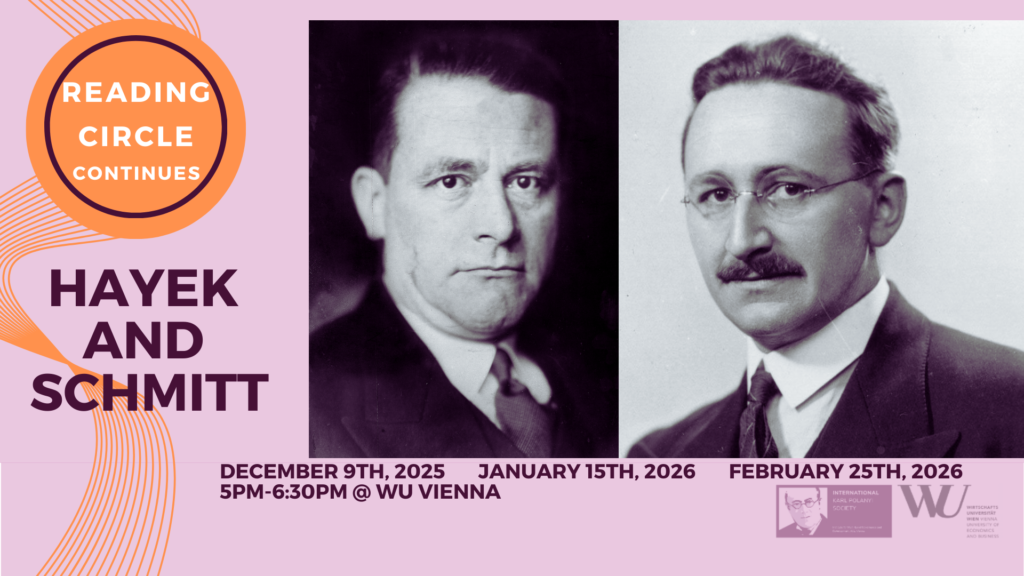
Reading Circle BACK IN SESSION: Friedrich Hayek and Carl Schmitt

December 1st, 2025

OUR READING CIRCLE IS BACK IN SESSION

Reading Circle on Friedrich Hayek and Carl Schmitt

We, the International Karl Polanyi Society (IKPS), the Institute for Spatial and Social-Ecological Transformations (ISSET) and the Institute for Law and Governance cordially invite you to join our reading circle on “Socioeconomics and Law.”

This reading circle will serve as a preparatory event for an upcoming international conference, titled “Socioeconomics and Law – The conditions of the authoritarian turn yesterday and today” that is set to take place in Vienna from May 24th to 26th 2027. At this conference and in the lead-up to this conference, we aim to engage in discussions about alternatives to the current radicalization of neoliberal thought, particularly its alignment with non-democratic and non-liberal political and legal ideologies.

After the first round of the reading circle that focused on Wendy Brown’s (2019) “In the Ruins of Neoliberalism”, the upcoming sessions will deal with texts by Friedrich Hayek and Carl Schmitt, diving into their understanding of freedom and democracy, of the state and markets and of fascism and liberalism.

The sessions will take place at Vienna University of Economics and Business (WU) on the following dates from 5pm – 6.30pm CEST:

  • Tue, December 09th, 2025, 5pm-6.30pm, WU, Building AD.0.090 (Sitzungssaal 6):
    The Road to Serfdom by Friedrich Hayek (Introduction, Chapter 1 and 2)
  • Thu, January 15th, 2026, 5pm-6.30pm, WU, Building D4.3.106:
    The Constitution of Liberty by Friedrich Hayek (Chapter 16)
  • Wed, February 25th, 2026, 5pm-6.30pm, WU, Building D4.3.106:
    Texts by and about Carl Schmitt (details will be shared soon)

To enable international participation there is also the possibility to participate in a hybrid mode. Please register via e-mail for a link to participate online.

We are looking forward to your participation and to an exciting exchange!

Andreas Novy, Verena Madner and Stefan Mayr

As additional introductory texts for the reading circle we recommend:

The new blog of the IKPS on Fascism and Liberalism: Yesterday and Today criticizes the deeply ingrained belief that economic liberalism is conducive to democracy.

Furthermore, Andreas Novy highlights – based on Wendy Brown – the role of markets and morals in Hayek’s work: Markets and Morals: The Reactionary Right’s Ideological Core.


Author Picture

F&L Blog – Revisiting Polanyi’s Warnings

Revisiting Polanyi’s warnings: How Austerity contributed to Fascism in Interwar Austria

by Maria Markantonatou

20.11.2025

The rise of authoritarianism in interwar Austria is often explained through economic collapse and social conflict. But could austerity measures themselves have played an independent role in destabilizing democracy? In this blog piece, Maria Markantonatou draws on Karl Polanyi’s writings to revisit the League of Nations’ “Financial Reconstruction of Austria,” a radical austerity program that imposed wage cuts, mass dismissals, and shrinking public services. As Polanyi argued at the time, liberal elites embraced “authoritarian interventionism” to protect the economic order, weakening democratic institutions and paving the way for Austrofascism. The dismantling of Red Vienna, the civil war of 1934, and the suppression of the Left were all intertwined with externally imposed austerity. The parallels with contemporary fiscal adjustment programs suggest that today, too, technocratic austerity threatens democratic resilience. The question now is whether governments will confront these risks or repeat the errors of the past.

"Polanyi shows how austerity contributed to social breakdown and authoritarianism, blocking democratic and socialist alternatives. He offers a starting point to critique today’s fiscal adjustment programs – their ideological pattern, historical roots, and devastating impact on democracy."

Austria is once again entering a debate over austerity. Under the EU’s fiscal governance framework, the Austrian government is required to implement consolidation measures in the coming years, including reductions in public spending and welfare services. These measures are presented as technical necessities, but historical experiences show how austerity can fracture societies and fuel political extremism. A glance back at interwar Austria – where externally mandated austerity played a decisive role in democratic collapse – offers critical insights into the risks embedded in today’s fiscal debates.

In the first F&L blog article, Clara Mattei and Aditya Singh argued that Mussolini’s rise in interwar Italy was enabled by a liberal establishment convinced that “only an authoritarian state could defend the capital order in a country like Italy – where revolutionary energy among workers and peasants had reached a boiling point”. The authors conclude that the Italian 1920s demonstrate “the deep structural affinities between liberal and fascist economic policies.” 

The 1920s “Financial Reconstruction of Austria”

A similar point can be made for interwar Austria. In 1922, the League of Nations (LoN), together with domestic liberal elites, launched the “Financial Reconstruction of Austria” program —the first peacetime experiment in technocratic international economic governance by a supranational actor. The program imposed harsh austerity measures, such as wage cuts and public sector retrenchments, which fueled deep political polarization and led to the rise of Austrofascism and civil war. Parallels with contemporary austerity programs show that, now as then, policies of imposed austerity undermine democratic institutions and empower authoritarian politics.

Polanyi, writing in Vienna for the financial journal Der Österreichische Volkswirt, observed these developments firsthand.  He argued that the liberal attempt to insulate the economy from politics produced an “antagonism” between capitalism and democracy—one that culminated in fascism. Central to this antagonism was what Mattei and Singh describe as “the most Polanyian of all insights”: that free markets were never natural, but politically constructed. In the case of the LoN program, this construction assumed the form of what Polanyi called “authoritarian interventionism”, of which the stubborn support by economic liberals “had resulted in a decisive weakening of the democratic forces which might otherwise have averted the fascist catastrophe” (Polanyi 2001: 242).

The LoN program introduced sweeping austerity and liberalization, leading to unemployment, weakened social services, and political tensions. It began with a request to the LoN by the Austrian Christian-social Chancellor Ignaz Seipel, a Catholic priest. Seipel (in LoN 1922: 19–20) presented Austria’s situation before the LoN Council and asked for financial assistance to address hyperinflation, fiscal crisis, and insolvent banks. In his speech, Seipel appealed to the LoN describing Austrians as people “who have endured such terrible suffering and who are perhaps even more crushed by fear for the uncertainty of their future than by the physical misfortunes of the present time [and]are menaced by actual decimation through hunger and cold”. For Seipel (in LoN 1922: 20), the crisis was “unique in the financial history of the world”, as high exchange rates blocked imports of essential goods such as corn, sugar, and coal, causing shortages. The LoN offered loans but demanded the creation of a commission of experts to control their use. Seipel (in LoN, 1922: 22) accepted that such a control would be “inevitable and natural,” but only if “sufficient credits were granted at the same time.” Ultimately, the LoN assumed control of Austria’s budget.

From Budget Control to Monetary Chaos

Historians Stephen Gross and Chase Gummer (2014) describe how Austria, reduced from a Habsburg Empire of 50 million to a small republic of seven million, struggled with a disintegrating currency and chaotic monetary fragmentation. The successor states stamped the old Habsburg krone notes to separate their currencies from the imperial krone, but such measures quickly created monetary chaos. Economic liberals deemed it urgent to stabilize the currency, reduce capital flight and war-related deficits, and stimulate growth.

The LoN appointed a Commissioner-General to supervise the program known as the Genfer Sanierung. His team oversaw the budget and the reforms in banking and public administration, approved loan tranches, and reintroduced the gold standard. To receive loans, social services and the public sector had to be cut.

The LoN blamed the “excessive number of [state] employees” as the main cause of Austria’s crisis. This led to a reduction of Federal Ministries and the dismissal of 100,000 officials within two years. A similar argument was used to justify cuts in the highly unionized railway sector. The LoN blamed the City of Vienna too, for having more state employees than when she was the capital of an empire.

[T]he LoN demanded the suppression of resisting social groups, trade unions, and political opponents, and the imposition of emergency legislation. The reforms required “a strong and fearless Government”, with the “duty not to hesitate to go forward with the necessary measures”

Ironically, the initial wave of dismissals raised public expenditure rather than lowering it, due to severance and pension obligations Covering these costs required another loan and, as a consequence, new austerity measures. Access to foreign capital markets re-opened, but the economy deteriorated again with the 1929-1930 global financial crisis. The collapse of the Creditanstalt bank in 1931 led to rapid capital flight and market panic, which necessitated another loan from external lenders, and further deepened Austria’s dependence on foreign debt assistance.

Notably, restriction of economic sovereignty did not imply a weak state. On the contrary, a strong state was considered necessary, as the LoN demanded the suppression of resisting social groups, trade unions, and political opponents, and the imposition of emergency legislation. The reforms required “a strong and fearless Government”, with the “duty not to hesitate to go forward with the necessary measures” , without “any political considerations” (LoN 1923: 10). Even after the assassination of Chancellor Dollfuss in 1934, loans continued to require further retrenchment, including new cuts to social services and pension rights.

Liberal Attacks on Red Vienna Paved the Way for Civil War

While Seipel negotiated the loan conditions with the LoN in Geneva, Red Vienna pursued a very different project: As the historian John Lewis recounts,“the Viennese authorities were developing a system of progressive taxation, which effectively shifted the bulk of the fiscal burden from the working classes (…) to the bourgeoisie”.

Red Vienna flourished in the 1920s, after the Social Democratic Workers’ Party’s victory in the 1919 local elections. Housing policies addressed poor working-class conditions: dwellings had typically consisted of a kitchen and a sleeping room, without gas and running water, while washing facilities were communal – conditions linked to tuberculosis and high mortality. From 1923 to 1927, the city council built over 25,000 small but modern units. These improved living standards but met resistance from landlords, who accused socialists of Steuersadismus (tax sadism) and of ruining the private housing market.

Conflicts between the Viennese authorities and the LoN’s supporters, who opposed the housing program, contributed to the Austrian civil war of 1934. This is why Polanyi (2001: 98) writes that Red Vienna “was bitterly attacked by economic liberals” and “succumbed under the attack of political forces powerfully sustained by the purely economic argument.” He criticized liberals who claimed that Vienna was merely an “‘allowance system’ which needed the iron broom of the classical economists”. When Red Vienna fell, “the Heimwehr victory in Austria formed part of a total catastrophe,” Polanyi notes regarding the civil war and the total crisis.

Polanyi writes that Red Vienna “was bitterly attacked by economic liberals” and “succumbed under the attack of political forces powerfully sustained by the purely economic argument.”

As social polarization deepened, Chancellor Dollfuss shut down Parliament in 1933. In 1934, a brief but devastating civil war erupted in Vienna, Linz, and Graz between state forces – supported by the paramilitary, rural-fascist Heimwehr – and the Social Democratic Party’s militia (Schutzbund). These events reflected efforts of domestic elites and the LoN to dismantle the Left and Red Vienna. As the British foreign correspondent Gedye (2009 [1939]: 12) put it, “the first thing was to get foreign money into the country, the second to persuade international finance (…) that its money would never be really safe until the power of the Left had been broken down.”

Polanyi agreed with this assessment that austerity was tied to anti-socialist politics: “[the Austrian government] never relaxed its pressure against the Left. The attack upon the position of the Left was carried several stages further. The Socialist press, the Social-Democratic Party, social services, rights of collective bargaining, the legal standing of public servants (…), the finance of the Municipality of Vienna, all had to suffer.” In his text, Austria and Germany, Polanyi follows the events after the 1933 German elections that paved the way to the Austrian Anschluss: pressure from Germany and Italy on Austria, the Austrian government’s Pronunciamento (banning public gatherings and imposing press censorship), far-right groups gaining power, and instability. The LoN’s interventions fueled polarization, empowered liberal economics, and repressed the labour resistance and socialist planning. While liberalism viewed markets as the only rational mechanism, Polanyi defended the socialist “overview” of production by communes, unions, and workers’ councils. In his seminal work The Great Transformation, Polanyi (2001: 265) argues that only their suppression paved the way for capitalist restoration and fascism:

“It was as a result of [the liberals’] efforts that big business was installed in several European countries and, incidentally, also various brands of fascism, as in Austria. Planning, regulation, and control (…), were then employed by the confessed enemies of freedom to abolish it altogether. Yet the victory of fascism was made practically unavoidable by the liberals’ obstruction of any reform involving planning”.

Interwar Austria as Forerunner to IMF and Eurozone-imposed Austerity

As the economic historian Charles Kindleberger (2006: 321) notes, “the LoN staff in Austria can be thought of as a forerunner of IMF stabilization advice to countries with balance-of-payments and stabilization problems after the World War II”. Following the war, the pattern of economic governance through “bailouts” was institutionalized: conditionality in the provision of loans to countries in need, with the poor paying the heavy price of austerity. The IMF intervened in a series of countries in Latin America (Argentina, Bolivia, Brazil, Chile, etc.), in Africa (Ghana, Morocco, Nigeria, etc.), in Asia (Bangladesh, Indonesia, Malaysia, Thailand, etc.), and elsewhere (Remmer 1986; Garuda 2000).

Similarly, during the Euro crisis in 2010, the “Troika” (EC, ECB, IMF) provided loans and imposed austerity measures on Greece, Portugal and Cyprus. With this austerity-led crisis management, especially in Greece, came attacks on democracy and suppression of social resistance while far-right forces and parties expanded their influence. Privatizations increased, heavily impacting working classes and the public sector, and further weakening a welfare state already diminished from decades of neoliberalization.

The Lessons for Today’s Fiscal Adjustment Programs

Polanyi shows how austerity contributed to social breakdown and authoritarianism, blocking democratic and socialist alternatives. He offers a starting point to critique today’s fiscal adjustment programs – their ideological pattern, historical roots, and devastating impact on democracy . The parallels of current austerity programs with interwar Austria suggest that authoritarianism and even fascism are not deviations from capitalism but recurring possibilities within it.

Maria Markantonatou is Associate Professor of Political Sociology at the University of the Aegean, Lesvos, Greece

References

  • Garuda, G. 2000. The Distributional Effects of IMF Programs. World Development, 28: 6
  • Gedye, G.E.R. 2009 [1939]. Fallen Bastions: The Central European Tragedy. London: Faber and Faber
  • Gross, S., Gummer, C. 2014. Ghosts of the Habsburg Empire: Collapsing Currency Unions and Lessons for the Eurozone. East European Politics and Societies and Cultures. 28: 1
  • Kindleberger, C. 2006. A Financial History of Western Europe. London: Routledge
  • League of Nations. 1922. The Restoration of Austria. Agreements. Geneva
  • League of Nations. 1923. Financial Reconstruction of Austria. First Report by the Commissioner-General of the LoN at Vienna. Extract no 11
  • Lewis, J. 1983. Red Vienna: Socialism in One City, 1918-27. European History Quarterly. 13
  • Mattei, C., Singh, A., Unmasking the dehumanizing logic of the capital order, International Karl Polanyi Society, 07.08.2025, Available Online: https://www.karlpolanyisociety.com/2025/08/07/fl-blog-mattei-singh-unmasking-the-dehumanizing-logic-of-the-capital-order/
  • Polanyi, K. 1933. Austria and Germany. International Affairs. 12: 5, Karl Polanyi Archive 18-2
  • Polanyi, K. 2001. The Great Transformation. Boston: Beacon Press
  • Remmer, K. 1986. The Politics of Economic Stabilization: IMF Standby Programs in Latin America, 1954- 1984. Comparative Politics, 19: 1

Related Posts

WebSlider

F&L Blog – Welcome to Cataclysm Capitalism

Welcome to Cataclysm Capitalism: Confronting the dangerous merger of neoliberalism and the Silicon Valley

far-right

by Julia Steinberger & Céline Keller

06.11.2025

According to Julia Steinberger, Professor of Societal Challenges of Climate Change at the University of Lausanne, and political graphic artist, expert in wealth-warped worldviews and climate activist Céline Keller, we have entered a new economic era: that of ‘cataclysm capitalism’—a merger of neoliberal and far-right ideology espoused by the ‘tech bros’ of Silicon Valley. Going even beyond previous neoliberal efforts to curb the capacity of democracies to enact pro-social and pro-environmental regulation, cataclysm capitalism dispenses with any illusion of ultimately serving the greater good. Entire categories of human beings are deemed dispensable, along with a livable planet. The authors argue our current politics and academia are ill-equipped to face the speed and scale of this new threat. To counter it, more people need to understand what we are up against, and organise around a positive alternative vision worth fighting for.

Note: This blog entry is an extended version of a recent Guardian column [i].

The ground is shifting beneath our feet so fast that it is dizzying: reading a newspaper or opening social media feels like embarking on a stomach-churning rollercoaster ride, except instead of drops, loops and twists, we plummet through genocide, planetary destruction, and the erosion of democracy and rule of law. Like in the first lines of Muriel Rukeyser’s poem I lived in the first century of world wars: “Most mornings I would be more or less insane.” [ii] (The whole poem is well worth reading.)

For anyone who wants to create a better, more equal, safer future, who wants to believe in the goodness of humanity, who wants to use their reason and emotions to make sense of the swirling evil chaos, and find some way forward, some meaning to life, these are crazy-making times. Domains we are taught from infancy to regard as separate—the economy, politics, war, environment, social relations, philosophy, science, culture, communication—all come swirling together, in ways that make the previous campaigns around socialism, labour rights, human rights or ecology, seem both quaint and obsolete, like Don Quixote tilting at windmills.

Here the warning words of Ngũgĩ wa Thiong’o in Decolonising The Mind [iii] ring loud: “Possibilities of triumph or victory are seen as remote, ridiculous dreams. The intended results are despair, despondency and a collective death-wish.” Keeping alive the “possibilities of triumph” is thus a vital act of resistance in itself. Indeed, later on, Ngũgĩ wa Thiong’o explains “Any blow against imperialism … is a victory for all anti-imperialist elements … The sum total of these blows not matter what their weight, size, scale, location in time and space makes the national heritage.” We would substitute “human dignity” for “national heritage”, but you get our point. [It is worth noting that Ngũgĩ wa Thiong’o’s argument on resistance is echoed in international law (both UN General Assembly Resolution 2625 and the Universal Declaration of Human Rights). Violence against civilians is in all cases prohibited by the Geneva Convention.]

If you are like us, you cling like a drowning person to anyone who can help make sense of even some facets of our times. The thinkers, mainly historians, who have already contributed to this “Fascism and Liberalism” blog are some of these beacons in the dark for us: the words of Nancy MacLean, Natascha Strobl, and Clara Mattei help us understand and navigate the perfect storm of our time.

Our goal in this piece is threefold: to illuminate the confluence of neoliberal and Silicon Valley far-right, and the existential dangers of this merged ideology; to cover how ill-equipped our current polities and academies are to face this new threat; and to present some ideas for fighting back. Ready for a different kind of roller-coaster? Let’s go. 

Trump’s Democracy-dismantling Alliance of Fossil Companies, Tech-Bros, and Billionaires

Everything is moving too fast. The Trump administration has torn through US government, universities and health organisations, firing tens of thousands of employees, jailing migrants and dissidents, eliminating billions in funding, destroying core science and health infrastructure, intimidating universities into silence and complicity. Israel, with full US support, is enacting genocide in Gaza, attacks on the West Bank, and bombing-territorial raids on Syria, Lebanon, Qatar and Yemen. Russia’s attacks on Ukraine are ramping up, with no end in sight. Major corporations and world governments have given up the slightest pretence of taking the climate and ecological crises seriously.

The EU block, led by the supposedly enlightened Ursula von der Leyen, is following all of these trends: steadfast in its support of Israel, attacking dissidents and progressive NGOs, and swinging hard to the neoliberal right, following Mario Draghi’s disastrous “Competitiveness Compass.” [iv] This report has been treated as a serious, grownup technocratic piece of policy guidance, but it is soaked through with neoliberal fervor for social and environmental deregulation, and enthusiasm for the same technologies as Trump-Musk: AI, space, automation, military build-up. Planning and regulation are shamelessly mobilised for technologies serving powerful elites, while the rest of the population is sacrificed on the deregulation altar of social austerity and accelerating ecological impacts.

The scope and speed of the attack is dizzying. It is almost impossible to keep up with the ongoing destruction, let alone to organise the resistance. None of this is accidental.

We need to understand the why and how of the Trump blitzkrieg to counter it in the US and recognise it fully in the EU. The dizzying pace of the attack can be traced to Trump’s long time strategist Steve Bannon, a self-described “accelerationist,” and aligns with his information warfare tactic to “flood the zone with shit,” to confuse, disengage and disorient. Whether on climate or Covid, rumours, lies and, conspiracy theories create a chaotic cacophony, leaving the public disoriented, fearful, and prey to oversimple Trumpist messages: blame the woke, the migrants, the trans, the Muslim, the doctors, the scientists. Now we can understand why Musk bought Twitter/X: to support Bannon’s shit-flooding agenda.

Within the accelerating chaos, there is a deliberate pattern, a plan. Last autumn, two major forces of Trump world came together during the “Reboot 2024” conference: the fossil-fuel funded Heritage Foundation, author of the “Project 2025” plan for Trump’s first year in office, and the billionaire tech magnates, like far-right Peter Thiel and his favoured theorist, Curtis Yarvin. Although we don’t know exactly who attended or what was said, the meeting clearly proved decisive. Subsequently, the tech magnates poured generously into Trump’s campaign, with Musk alone donating more than $250 million.

What we now see being implemented is a collaborative effort: the hostile government takeover described in Project 2025, merged with Yarvin and the tech bros dream to “reboot” a whole country, replacing the outmoded “democracy software” with something far less accountable and more business-friendly. Or, to be precise, more friendly to their business: regulatory positions eliminated, enabling  cryptocurrency to bypass democratic oversight, dismantling public agencies like NASA to favour Musk’s SpaceX, meanwhile replacing fired government employees with their own AI products. Musk’s chosen name for his Trumpland operation, Department Of Government Efficiency, is, of course, a corrupt advertisement for his own  cryptocurrency DOGE, but it is also a clear nod to Yarvin’s RAGE, Retire All Government Employees.

With the neoliberal Heritage Foundation and the tech billionaires setting the course, many industries are sensing the winds of change. Major companies are no longer even bothering with greenwashing or statements of green investments, they are dropping all pretence of responsibility for a liveable world. The climate and ecological implications of this shift are as disastrous as they are deliberate. We need an appropriate name for this new era of fossil companies’ and tech bros’ accelerating attack on democracy and the planet: perhaps cataclysm capitalism will do.

What is new about Cataclysm Capitalism?

Cataclysm capitalism is the worthy heir to neoliberalism and its disaster capitalism. As Naomi Klein described in her epoch-marking Shock Doctrine, neoliberal economic ideology took advantage of crises to deregulate economies, privatise public services, hobble trade unions and civil society, and generally create conditions that were ideal for private wealth accumulation and disastrous for equality, work and welfare. Cataclysm capitalism does all of this, but goes several steps further. The pace of change is accelerated, the dismantling of public institutions more complete, the attack on democracy more overt. Entire industries are captured, like social media, with the goal of forever dominating the information space and imposing pay-to-participate monopolies. Perhaps the most frightening aspect is that the industries laughing in the face of planetary and social destruction have made a clear calculus: they don’t need prosperous economies to profit. Neoliberalism at least claimed to be serving a form of greater good via rapacious market dominance. Cataclysm capitalism is dispensing even with even this illusion.

The fossil-fuel companies, the right-wing tech magnates, the financial companies hurrying in their wake, like the global giant BlackRock, have convinced themselves that they don’t need prosperous economies to prosper themselves. They have learned to profit from disruption, destruction and misery. They know from experience that immiserated populations still have human needs, and therefore will endure exploitative working conditions and go deep into debt to keep themselves and their families alive. And so what if multitudes fail and die, from lack of food, healthcare, climate disasters or some combination thereof? Many of the cataclysm capitalists are modern-day eugenicists. According to their belief system, those who will die from the hardships they are creating are by definition weak and undeserving of life. It doesn’t hurt that a major growth sector of cataclysm capitalism is security, public or private. After all, someone has to keep the hungry mobs away from the palaces of the elites. A key harsh lesson here is that those with the most wealth and power have already reconciled themselves to the sacrifice of the rest of us, ideologically and economically. The greater good is antithetical to their vision.

Paradoxically, the creation of vast economic insecurity secures right-wing and even far-right politics. As Karl Polanyi pointed out in his epic “Great Transformation,” this was already a major factor in the rise of Hitler in Germany. Voters in a constant state of fear and stress, without a clear understanding of the political system that is creating the hardships from which they are suffering, are an easy, indeed ideal, prey for far-right rhetoric blaming migrants, woke, trans and so on for all their ills. Sadly, since neoliberal ideology has devoured previously center-left factions (of the UK Labour party as of the US Democratic party), we are left with much less of an organised opposition, and much more of a pipeline to accelerating disaster. The EU as a block, following Draghi’s Competitiveness Compass, marches along in lockstep.

The picture we present is grim, but clear enough. We are faced with an organised plan of hostile takeover of democracy, coupled with a dismantling of the economy in favour of the sectors and industries most beneficial to the fossil-fuel and tech magnates, to our detriment and the detriment of all life on Earth. What can we do? What should we do? We propose a  three-pronged plan to start. This is by necessity short and schematic, but hopefully enough for you to get started.

Three Steps to Counter the Cataclysm Capitalists’ Attacks on Democracy

First, understanding is power. We need to learn more about the devourers of our world, from the fossil fuel think tanks of the Atlas Network to the far-right tech accelerationists. We need to explain to our fellow citizens who we are facing, and what their ultimate plan is. Replace helpless fear with knowledgeable anger.

Second, we need to organise, come together, in trade unions, in neighbourhood groups, in any and all collectives we can form. Since almost all of us, at this point, were raised in neoliberal cultures of individualism and isolation, organising sounds dauntingly foreign and difficult. It might be helpful to learn that our social ineptitude was created by design, not by accident, and is integral to the endeavour of disaster capitalism. In reality, human beings are among the most cooperative animals, with impressive innate capacity for dialogue and collective decision-making. Quite literally, organising is what we, as social animals, were born to do. At its most basic forms, organising consists in gathering people, raising awareness of the causes of our common problems, discussing possible avenues of action, putting them into operation. Rinse, repeat, make it part of your life’s hobbies and work. Because it is work, no doubt, but it is also social, and should include plenty of fun and more light-hearted moments and activities.

Third, we need to respond to the Trump-Musk project at the strategic level, not blow by blow. We know we can expect nothing but destruction and corruption from them: we have to put forward a positive vision, worth fighting for. We would describe it, from the perspective of research on well-being within planetary boundaries, as scientifically-informed democratic decision-making for the common good. This also means creating our own organisations for mutual aid and protection of the vulnerable. We have everything to lose if we don’t, and everything to gain if we do.

Author picture

Julia Steinberger is Professor of Societal Challenges of Climate Change at the University of Lausanne

Author picture

Céline Keller is a political graphic artist, expert in wealth-warped worldviews, and climate activist

References/Further Readings

  • [i] Steinberger, Julia. 2. April 2025. Trump and Musk have ushered in the era of cataclysm capitalism. But I have a plan to counter it. The Guardian. https://www.theguardian.com/commentisfree/2025/apr/02/donald-trump-elon-musk-capitalism-us-democracy
  • [ii] Rukeyser, Muriel. 1968. “Poem (I lived in the first century of world wars).” In: The Speed of Darkness.
  • [iii] Ngũgĩ wa Thiong’o. 1986. Decolonising the Mind: The Politics of Language in African Literature. London: James Currey / Boydell & Brewer, pages 2-3.
  • [iv] European Commission. 2025. The future of European competitiveness. Luxembourg: Publications Office of the European Union. https://commission.europa.eu/topics/eu-competitiveness/draghi-report_en

Related Posts

Simone Cremaschi Article F&L Blog

F&L Blog – Profiting from Neoliberalism

Profiting from Neoliberalism: How the Radical Right Gains From Crumbling Public Services

by Simone Cremaschi

23.10.2025

The rise of the far right is often linked to economic decline and depopulation of “left behind regions”. But could public service cuts, as part of broader neoliberal austerity policies, play an independent role? In this blog, Simone Cremaschi cites research he and his colleagues have conducted into otherwise similar municipalities in Italy, which, for varying reasons, underwent significantly different levels of public service cuts. They found evidence that regions with steeper retrenchments recorded higher shifts in support for the far-right. Using zero-sum logic, far-right parties have been able to frame shrinking services as a problem of demand, not supply. This suggests that restoring and rebuilding public services could halt the rise of the far-right. The question now is whether mainstream parties will re-build the credibility and support to do so.

Public services across Western Europe are under strain. Years of economic stagnation, financial crises, a pandemic, and rising energy prices have left governments with record debt and soaring interest payments. As a growing share of tax revenue is swallowed by debt service, less remains for hospitals, schools, and local infrastructure. These constraints leave little room to reverse a decade of neoliberal-imposed austerity, which closed or hollowed out key public services – from rural post offices and public transport links to police stations and GP practices in major cities.

One might expect these conditions to benefit parties on the left, traditionally associated with calls for higher public spending and stronger social support. Yet a series of empirical studies I have conducted with co-authors shows that reduced access to public services – what we call public service deprivation– often fuels support for radical-right parties instead.[i] This political backlash to service cuts helps explain why these parties have made such significant inroads into mainstream politics in the past years.

We began our research in Italy, where policy debates in recent years have devoted considerable attention to so-called “inner areas” – areas marked by economic stagnation, depopulation, and isolation from essential services such as schools, hospitals, and train stations. These territories struck us as the concrete embodiment of the “left-behind places” often invoked by journalists to explain the geographic concentration of support for radical-right leaders like Donald Trump, or the Brexit referendum. This led us to ask whether the availability – or withdrawal – of public services could be driving this geography of discontent.

How Public Service Deprivation Fuels Exclusionary Politics

"public services are the primary channel through which citizens interact with the state [...] their decline strikes at the heart of the social contract. These grievances translate into a demand for solutions at the ballot box, creating fertile ground for parties that promise to restore services by reallocating them toward “deserving” locals."

We began answering this question by studying a 2010 reform that required Italian municipalities below a fixed population threshold to deliver key public services – such as policing and waste collection – jointly with neighboring municipalities. Because of an arbitrary cut-off, it created a natural experiment: some municipalities were forced to amalgamate services while others of a similar size were not. This allowed us to compare municipalities in these two groups across time and isolate the effect of reducing public services on electoral outcomes. Our results, published in the American Journal of Political Science [ii], show that this reform ultimately reduced access to essential services and, in turn, boosted support for radical-right parties such as Salvini’s League among affected voters in the years that followed.

Our analysis suggests that public service deprivation fuels radical-right support by generating grievances that resonate with political rhetoric linking declining services to immigration. When communities accustomed to reliable public provision – as is common in Italy and Western Europe – experience sudden deterioration, they develop a sense of unfairness and neglect: a perception that “their” community is no longer receiving its fair share of resources and that political elites do not care. Because public services are the primary channel through which citizens interact with the state and observe how their taxes are spent, their decline strikes at the heart of the social contract. These grievances translate into a demand for solutions at the ballot box, creating fertile ground for parties that promise to restore services by reallocating them toward “deserving” locals.

Radical-right parties have proven particularly adept at meeting this demand. In our data, we show that they increasingly mobilized the issue of public services after the 2010 reform in Italy, framing service decline as a consequence of immigration and of a state that prioritizes “undeserving outsiders” over “deserving locals.” Even though immigrants are not the primary drivers of service retrenchment, this rhetoric resonates with zero-sum thinking triggered by service cutbacks, because public services are difficult to exclude users from. Consistent with this mechanism, we find that attitudes toward immigrants worsened in municipalities affected by the reform, helping to explain why voters in these areas shifted toward parties such as the League.

How Public Services Shape Political Reactions to Economic Shocks

Public services matter not only because their decline directly pushes voters toward the radical right, but also because they shape how communities respond to other crises. Economic shocks – from import competition to de-industrialization and technological change – are well-known triggers of discontent that radical-right leaders can mobilize. When communities have long felt neglected by the state, these shocks are more easily interpreted as yet another sign of abandonment, paving the way for a radical-right turn. We document this dynamic in a study recently published in the American Political Science Review [ii].

In this study, we turn to Xylella, a plant disease epidemic that exterminated olive trees in southern Puglia (the heel of Italy’s boot) between 2014 and 2016. As with the 2010 public service reform, this epidemic created a rare natural experiment. The bacterium arrived by chance on a boat from Costa Rica, landing in the port of Gallipoli, and spread northward, killing millions of trees before containment measures halted its advance roughly 200 kilometers away – leaving neighboring olive-producing regions largely untouched. This sharp boundary gave us a unique opportunity to compare affected and unaffected areas before and after the shock – something rarely possible since most economic shocks unfold gradually and across much larger regions. Our results show that this had similar electoral effects to other economic shocks observed across the United States and Western Europe, increasing support for radical-right parties – most notably Meloni’s Brothers of Italy – across affected areas.

"When communities experience prolonged public service deprivation, they develop a community narrative of abandonment by the state and political elites."

Our analysis explains why the plant disease epidemic led to a radical-right turn by highlighting the key role of public services. Combining statistical analysis with qualitative fieldwork in the most affected municipalities, we show that the epidemic not only disrupted a vital economic sector but also uprooted community life and identities that had been built over centuries around olive cultivation and oil production. The sudden extermination of olive trees generated deep concerns about the future of these communities, heightening the appeal of radical-right narratives that frame political elites as indifferent and promise to restore the status of neglected areas. Crucially, this effect was not uniform: we find that communities with a history of poorer access to public services were significantly more likely to shift their support toward radical-right parties.

Because public services are the primary channel through which citizens interact with the state, the level of service access available to a community shapes how residents see themselves and their relationship with public institutions. Over time, collective identities become embedded in the stories people tell each other about the place where they live. These stories, passed among neighbors and across generations, form a shared lens for interpreting new events. When communities experience prolonged public service deprivation, they develop a community narrative of abandonment by the state and political elites. In the case of Xylella in Italy, areas that had internalized this narrative interpreted the epidemic as yet another instance of state neglect. This interpretation resonated strongly with radical-right messaging, amplifying the turn toward radical-right parties in the wake of the shock.

How the Radical Right Gains Across Europe

"Finding credible and popular responses to public service decline remains a key political challenge in the years ahead, but one we surely must tackle if we are to halt the continued rise of the radical right."

Rising radical-right support in response to public service cuts is not just an Italian story. Across Europe, researchers have shown that when schools or hospitals close – as in parts of Germany and Denmark – trust in the state falls and radical-right parties gain ground [iii, iv]. Another study, recently published in the American Journal of Political Science [v], finds that austerity measures across Europe – often targeting public services – boosted radical-right voting in economically vulnerable regions.

England offers a particularly telling example. The National Health Service (NHS) is one of the largest publicly funded health care systems in the world, a clear symbol of the state’s duty to care for its people and one widely supported across the political spectrum. Yet public satisfaction with the NHS is sinking to its lowest level. A key source of frustration has been the steady disappearance of local doctors’ offices: since 2013, nearly 1,700 GP practices have shut down or merged – more than a quarter of England’s local clinics.

In a new study, we find that these closures have fuelled support for the radical right. Using data on every GP practice closure since 2013, we show that voters affected by closures report worse experiences with the health system and become more likely to support parties like UKIP and Reform UK. Examining political messaging, we find that these parties have effectively connected NHS pressures to immigration in their discourse. And, indeed, the shift toward the radical right is strongest in places with higher immigration, where the narrative of “outsiders overloading the system” resonates most.

This case shows that the dynamics we uncovered in Italy are not limited to extraordinary moments such as sudden reforms or economic shocks. The crisis of the NHS has been unfolding for decades and is likely to persist, driven by rising public debt and growing demand from an ageing population. These long-simmering grievances are once again being harnessed by political entrepreneurs who link them to immigration – a strategy that continues to fuel radical-right support.

Taken together, this body of research challenges the common expectation that declining public services should lead voters to demand more redistribution and flock to left-wing parties. Instead, we find that public service deprivation often fuels support for exclusionary – radical-right – parties. Their successes threaten the rights and protections of minority groups such as immigrants. And as growing evidence shows, they also contribute to the progressive erosion of democratic norms.

Several factors limit how mainstream parties can respond to radical-right gains over public service decline. Reversing service cuts usually implies higher taxes – a remedy that remains unpopular. Credibility is another hurdle: after decades of decline, promises to rebuild public services can ring hollow when they come from parties that previously oversaw the cuts. The radical right, by contrast, offers a deceptively simple solution: reduce demand by excluding “undeserving” outsiders, often immigrants. This rhetoric has proven both powerful and persuasive. Finding credible and popular responses to public service decline remains a key political challenge in the years ahead, but one we surely must tackle if we are to halt the continued rise of the radical right.

Headshot Cremaschi

Simone Cremaschi is a political scientists studying topics in comparative political economy, political behavior, and political sociology. He works as a postdoctoral researcher at Bocconi University and the Dondena Centre.

References/Further Readings

  • [i] Cremaschi, Simone, Paula Rettl, Marco Cappelluti, and Catherine E. De Vries (2024). “ Geographies of Discontent: Public Service Deprivation and the Rise of the Far Right in Italy.” American Journal of Political Science.
  • [ii] Cremaschi, Simone, Bariletto, Nicola, and Catherine E. De Vries (2025). “Without Roots: The Political Consequences of Collective Economic Shocks.” American Political Science Review.
  • [iii] Stroppe, Anne-Kathrin. 2023. “Left behind in a Public Services Wasteland? On the Accessibility of Public Services and Political Trust.” Political Geography 105: 102905.
  • [iv] Nyholt, Niels. 2024. “Left Behind: Voters’ Reactions to Local School and Hospital Closures.” European Journal of Political Research 63 (3): 884–905.
  • [v] Baccini, Leonardo, and Thomas Sattler. 2025. “ Austerity, Economic Vulnerability, and Populism.” American Journal of Political Science 69: 899–914.
  • [vi] Dickson, Zachary P., Sara B Hobolt, Catherine E de Vries and Simone Cremaschi (2025). Public Service Decline and Support for the Populist Right: Evidence from England’s National Health Service. Working Paper.

Related Posts

Polanyi in Graz

POLAYNYI-exhibition in graz

October 10th, 2025

invitation!

You are cordially invited to the finissage of our german Polanyi exhibition in Graz on November 4th where Brigitte Aulenbacher will present the “Life & Works of Karl Polanyi”!


This fall our German Karl Polanyi exhibition is shown in Graz, hosted by the Styrian Chamber of Labour.

The finissage will be held on November 6th at 4 PM at the Otto-Möbes-Academy in Stiftingtalerstraße 240 in Graz, Austria.

Our Vice-President Dr. Brigitte Aulenbacher from the Johannes Kepler University Linz will speak on the “Life and Works of Karl Polanyi” and share her insights on his biography and publications.

LOCATION:
Otto-Möbes-Academy, Stiftingtalerstraße 240; Graz, Austria.

Caterina et al

F&L Blog – From Berlusconi to Meloni

From Berlusconi to Meloni: Right-wing politics and the making of Italy's neoliberal state

Daniela Caterina, Adriano Cozzolino, Gemma Gasseau, and Davide Monaco

09.10.2025

How does neoliberalism enmesh with and help fuel the far right? Below, Daniela Caterina, Adriano Cozzolino, Gemma Gasseau and Davide Monaco offer Italy as an important case for understanding the contradictions of neoliberal projects and how these intersect with far-right politics. They argue that the Italian experience—from the rise of Berlusconi in the 1990s to today’s Meloni government—is not exceptional. Rather, it illustrates broader contemporary trends by showing how neoliberalism and far-right politics are not only compatible, but often mutually reinforcing. Berlusconi’s neoliberal project contributed to the mainstreaming of far-right parties, discourses and practices, and created the socio-political dislocations that were in turn exploited by the far right. Once in power, the far right left neoliberalism largely intact, while combining it with nationalist discourses and authoritarian practices. To counter the rise of the far right in Italy and elsewhere, the authors argue that we must understand neoliberalism not as a technocratic project—but a political one. This requires presenting not only alternative policies—but a comprehensive and compelling alternative political vision both to neoliberalism and far-right authoritarianism.

Neoliberalism as a political project​

For the better part of the last forty years, neoliberalism has reshaped economies, transformed societies and states, and redrawn the political imagination across the globe. Originally promoted as a pathway to economic prosperity and individual empowerment, neoliberalism has instead deepened inequality, eroded public goods, and hollowed out democracies. 

Today, we are witnessing its long-term political consequences. Broken social safety nets, the socio-economic marginalisation of entire regions as resources concentrated in ever-larger metropolitan hubs, the dislocation of working and middle classes, and growing distrust towards democratic institutions (and politics more generally) have together created a terrain ripe for the ascent of the far right in much of the Western world—and beyond. However, far-right forces are gaining ground across the world not by overcoming neoliberalism, but by reshaping it through further and deeper exclusionary, authoritarian, and nationalist politics. Understanding how this dynamic came to pass requires examining not just abstract trends, but the concrete political projects that have enabled neoliberal transformations. One of the most significant—yet often underappreciated —of these projects is Berlusconism. Through this   prism we can grasp not only the neoliberal transformation of the Italian state, but also the intertwined evolution of neoliberalism and right-wing politics. 

To fully unpack the significance of Berlusconism, it is essential to move beyond viewing neoliberalism simply as a technocratic and abstract doctrine of deregulation and austerity. It should instead be regarded as a political project that has evolved through time, forged through complex interactions between global pressures and national responses. It does not take the form of a fixed policy blueprint, but of a dynamic process marked by ruptures, rearrangements, and contradictions. Its success hinges on powerful political alliances capable of implementing its core logics across politics, institutions and culture. 

How Berlusconism created space for the far-right

In this context, Berlusconism provides an insightful lens into the ways neoliberalism adapts to national conditions and generates space for far-right politics. In the early 1990s, Italy was gripped by structural crisis fuelled by economic stagnation, the collapse of the post-war party system, and a loss of confidence in traditional elites. Into this vacuum stepped Silvio Berlusconi—not merely a media-savvy entrepreneur, but the architect of a new kind of political-economic order. 

Launched in 1994, Berlusconi’s political project was more than just an electoral springboard—it amounted to a wholesale reconfiguration of Italy’s political economy. Drawing on media power, anti-elite sentiment, and pro-market ideology, Berlusconism reshaped the right and restructured the Italian state along neoliberal lines. It normalized once-marginal radical right forces, integrated regionalist parties into national governance, and constructed a durable coalition capable of sustaining neoliberal reforms. Though the heterogeneous nature of Berlusconi’s first government—a coalition that brought together post-fascists (Alleanza Nazionale), northern separatists (Lega Nord), and free-marketeers (Forza Italia)—posed some constraints, Berlusconism successfully created a new right-wing political space that permanently altered the structure of Italian politics. 

This emergent bloc became the lynchpin for consolidating Berlusconi’s neoliberal project. While technocrats and center-left governments had also pursued pro-market reforms during the 1990s, their efforts were often hamstrung by weak political legitimacy—a gap filled by relying on the ‘external’ legitimation provided by adhering to supranational constraints, including the EU fiscal rules. By contrast, Berlusconism fused neoliberal governance with charismatic leadership, a tighter social alliance, and broader popular appeal—making it far more stable and ideologically coherent. 


Berlusconism’s emergence, consolidation, and crisis

"The case of Berlusconism shows that the Italian experience should not be seen as exceptional. Rather, it illustrates how neoliberalism and far-right politics are not only compatible, but often mutually reinforcing. Neoliberalism generates the social dislocation and political distrust that the far right exploits. Meanwhile, far-right narratives help neoliberal elites to deflect blame, reassert control, and maintain the market order under a new guise."

The trajectory of Berlusconism can be divided into three defining phases: its rapid emergence (1994–95), its firm consolidation (2001–06), and its eventual crisis (2008–11)

During the emergence phase, the first Berlusconi government only partially implemented neoliberal reforms, opting for selective tax amnesties and mild budget cuts rather than deep structural overhauls. However, the political success of uniting previously incompatible right-wing forces marked a foundational transformation. The far right—especially the post-fascist Alleanza Nazionale, the forerunner of Giorgia Meloni’s party Fratelli d’Italia—  was no longer outside the system: it had become a normalized partner in government. 

By the early 2000s, Berlusconism entered a phase of consolidation. The second and third Berlusconi governments pushed for more systematic neoliberal reforms, including widespread privatizations and labor market deregulation. These efforts occurred alongside intensified tensions—between North and South, within coalition partners, and between the government and EU institutions. Nevertheless, Berlusconism maintained its coherence by continuing to function as the gravitational center of right-wing politics in Italy, embedding its policies within a durable socio-political alliance. Berlusconism can be therefore seen as one of the political projects shaping the neoliberalisation of the Italian state. 

The 2007-08 global financial crisis sent this trajectory into freefall. The economic shocks and increasing demands for austerity from international and EU authorities exacerbated contradictions within Berlusconism itself. Caving to these pressures for fiscal discipline meant abandoning a significant part of its social base—more precarious working classes, particularly in the South—and narrowing its social bloc to unsustainable levels. This structural impasse—not just personal scandals or leadership fatigue—precipitated Berlusconi’s decline. 

The social dislocation left by neoliberalisation paved the way for the far-right to govern

In retrospect, Berlusconism held sway over Italy’s political life for almost two decades by rooting neoliberal reforms within a larger ideological and cultural framework. Its unique capacity to fuse symbolic narratives, media control, and a vision of national revival secured enduring consent for its brand of neoliberalism and cemented the foundations of its political project. Berlusconism offered a compelling political-economic agenda that resonated across class, regional, and ideological lines. By normalizing discourses and practices typically advanced by far-right forces—anti-immigration sentiment, judicial delegitimization, anti-intellectualism—it paved the way for today’s far-right actors to govern from within the mainstream. 

The case of Berlusconism shows that the Italian experience should not be seen as exceptional. Rather, it illustrates how neoliberalism and far-right politics are not only compatible, but often mutually reinforcing. Neoliberalism generates the social dislocation and political distrust that the far right exploits. Meanwhile, far-right narratives help neoliberal elites to deflect blame, reassert control, and maintain the market order under a new guise. 

Understanding Berlusconism is thus key to making sense of today’s far-right, including Giorgia Meloni’s ascendant movement and government. The political space and the social alliance carefully crafted by Berlusconi starting in the 1990s—a mix of small and medium business owners, petty bourgeoisie, and working classes frustrated with the status quo—is still the one Meloni thrives on decades later. The rise of Meloni is also inseparable from the long-running neoliberalisation of the Italian state, which created the political and economic terrain that allowed far-right support to grow. What’s more, despite its anti-establishment rhetoric, the Meloni government continues to uphold fiscal discipline and economic orthodoxy, leaving neoliberalisation largely intact while entangling it further with nationalist discourse and authoritarian practices.

Learning the lessons of Italy: the need to counter both neoliberalism and the far-right

Italy offers a key case for understanding how neoliberalism morphs amid tensions and contradictions, and how it intersects with the far right. It shows that neoliberalism is not simply a technocratic project, but a political process shaped by national alliances, crises, and ideological work. It also reveals that the far right does not emerge in opposition to neoliberalism, but often as its product and partner. 

Understanding Berlusconism as a political project—and not merely as a personal phenomenon—provides valuable insights into the molecular mechanisms through which neoliberalism reproduces itself. It allows us to see the rise of figures like Trump and Milei   not as a rupture, but as a continuation of a broader pattern already visible in places like Italy decades earlier. Finally, the Italian case offers a glimpse of the endgame behind conservative parties’ current strategies to normalize and mainstream far-right forces across Europe: a complete takeover by the radical right. 

If neoliberalism and the far right have evolved together, then they must be fought together.   This requires confronting not just policies, but the political architectures and cultural narratives that sustain them. It means creating new alliances, institutions, and alternative visions able to counter neoliberal hegemony on every front. 

Italy’s experience teaches us that political projects can be built—and unbuilt. The question now is whether we can learn from this history and construct an alternative capable of challenging the toxic convergence of neoliberalism and the far right—and all the societal threats that this entails.

Daniela Caterina

Daniela Caterina is an associate professor at the Huazhong University of Science and Technology in Wuhan, China

Adriano Cozzolino is an assistant professor of global politics at the University of Campania “Luigi Vanvitelli”, Italy

Gemma Gasseau is a postdoctoral researcher at the Scuola Normale Superiore, Italy

Davide Monaco is a research fellow on the Future of Work at the Centre for European Policy Studies in Brussels

Further Readings

  • Caterina D, Cozzolino A, Gasseau G and Monaco D (2025) A lasting legacy? A critical political economy perspective on Berlusconism and its afterlives. In: Bieler A and Maccarrone V (eds) Critical political economy of the European polycrisis. Cheltenham: Edward Elgar Publishing.   
  • Cozzolino A, Caterina D, Gasseau G and Monaco D (forthcoming) The International Political Economy of Berlusconism: Emergence, Consolidation and Crisis of a Neoliberalising Project. European Journal of International Relations.

Related Posts

F&L Blog – Balanced Budgets, Broken Democracies

Balanced budgets, Broken Democracies: the urgent need to democratize money

Colleen Schneider

25.09.2025

Colleen Schneider is a PhD researcher at the Vienna University of Economics and Business in the Institute for Ecological Economics. Her work focuses on the political economy of monetary and fiscal policy in a social-ecological transition. In this piece she explores how ideas about money greatly shape states’ capacity for governance, explaining how the neoliberal ideology of “balanced budgets” has been used consistently and across party lines to justify austerity. As Polanyi saw governments’ adherence to the Gold Standard during the 1930s as enabling the rise of fascism, today’s attachment to arbitrary fiscal rules risks emboldening the far-right while worsening social and ecological crises. To counter this, Schneider calls for a “deficit owl” approach to budgeting focused on the effects of fiscal spending, supported by a politicization and democratization of money.

“The government should create, issue and circulate all the currency and credit needed to satisfy the spending power of the government and the buying power of consumers. The privilege of creating and issuing money is not only the supreme prerogative of government, but it is the government’s greatest creative opportunity. Money will cease to be master and will then become servant of humanity.”
Abraham Lincoln, 1985
“Well, we’re out of money now.”
Barak Obama, 2009

How ideas about money shape the capacity to govern ​

For the last 5,000 years money has served as a tool of governance. Through the Middle Ages Monarchs regularly reminted coins to increase the money supply, often to fund war. This was possible because the value of coinage was set by political decree and reinforced by trust in the governing authority. Today, we operate in a fiat money system, meaning that money is created through the spending of currency-issuing governments. Governments’ ability to create money is limited by ideas about the desirability of fiscal spending and the role of government debt.

Ideas about money shape the potential and structure of governance. The idea of “balanced budgets” has delimited the political imaginary of the last several decades. The shift to understanding balanced budgets as a good in-and-of themselves, and to the institutionalization of this idea, is a core tenet of the neoliberal era. It has been used, consistently and across party lines, to justify austerity. This includes cuts to social welfare programs as well as spending cuts on necessary public infrastructure, health, and education.  

To illustrate the importance of these ideas and how they shape the capacity for governance, we can define three distinct positions. The first two are orthodox positions of “deficit hawks” and “deficit doves.” Hawks insist government deficits are always problematic. Their thinking goes that when governments spend more than they receive in taxes, they “crowd out” private sector spending, ultimately leading to lower growth and risking default. In contrast, doves acknowledge running government deficits can be useful and necessary in the short term, such as during recession. Like hawks, they hold with the position that balanced budgets should be prioritized in the longer term. Both hawks and doves present this constraint not as a political rule, but as economic law.

The third position is that of “deficit owls.” Owls see the constraints on spending by sovereign currency-issuing governments as access to real resources, their ability to maintain price stability, and political will. Owls place the focus on the results of fiscal spending. For governments (or supra-national regions, like the Eurozone) that issue their own currency, hard limits come into play if there is a need to access foreign currency for, say, import purchases or paying foreign-denominated debts. Utilizing domestic resources, however, is constrained by the availability of those resources and the effects on the macroeconomy—namely, inflation. Owls point out that public sector deficits are nothing more than private sector surpluses. Running public surpluses, thereby driving the private sector to take on more debt, has consistently preceded recessions.   

In short, politically imposed limits on debt and deficits are the result of certain ideas about money, and of political decisions taken in specific historical and ideological contexts. In our present case, the hegemonic status of neoliberal ideology has provided the container for institutionalizing fiscal limits.

The neoliberal de-democratization of the monetary system stripped money as a tool of governance

The post-WWII Keynesian era of fiscal dominance relied upon democratic coordination for macroeconomic stability. In contrast, the 1980s were marked by a distinct shift in how the monetary system was understood and operationalized as a governance tool. Under neoliberalism, politically-embedded management of the monetary system was replaced with technocratic management and a reverential deference to bond markets. This construction of monetary scarcity can be understood through the apparent “naturalization” and “depoliticization” of money that is central to the neoliberal project. This logic found academic justification in the neoclassical treatment of money as a neutral veil over market exchange.

This naturalization of money makes the management of the monetary system a matter of technocratic efficiency best left to economists at “apolitical” and “independent” central banks. Through the shift in central banking and the deference of elected governments to the need for balanced budgets, money as a mode of governance was effectively removed from the democratic political sphere while being simultaneously stripped of morality and subjectivity. Depoliticization went hand-in-hand with de-democratization. 

Balanced budgets paved the way for austerity in the United States and Europe

Following the rhetoric of American Presidents vis-a-vis the fiscal situation of the United States provides an enlightening perspective on the shift toward deference of balanced budgets and its effects. While Lincoln, and those that came after him for the next century, discussed the fiscal budget in reference to its effects in the economy – such as employment and social provision – the 1970s mark a break from this functional understanding of monetary governance.  

In the 1980s Ronald Reagan relied heavily on the rhetorical trope of balanced budgets to impose austerity, pledging to “discipline the federal Government to live within its means”. He signed deficit reduction into law while lowering taxes and cutting spending on housing, education, and agriculture (before going on to enact massive increases in military spending in his second term). George Bush Senior went so far as to attempt to write balanced budgets into the constitution. James Buchanan supported this effort, arguing that it would be an effective and permanent barrier against democratic demands for social spending. This was democracy, insulated from too much democracy—a marker of neoliberal politics.

Buchanan’s effort was not successful, and, in place of constitutional amendment, Bush Senior institutionalized a pay-as-you-go (PAYGO) spending rule, intended to limit fiscal capacity and “solve the problem of budget deficits.”  Clinton, too, oversaw vast cuts and, in some cases, complete withdrawal of social welfare programs in the name of deficit reduction. G.W. Bush then used the“left over” money from Clinton’s budget surplus then to justify tax cuts. Obama focused on the need for fiscal discipline and restored the PAYGO rule.

Both the Democratic and Republican parties have consistently taken the positions of fiscal doves or hawks, treating public goods as liabilities and economic growth as the highest good. The consistent result has been the gutting of social protections.  

The fiscal limits of the European Union—enshrined in the Maastricht Criteria and enacted through the Stability and Growth Pact (SGP)—are emblematic of the de-democratization of monetary governance. Several European states have also enshrined balanced budgets into their constitutions. Switzerland amended their constitution in 2001, and Germany constitutionalized the debt brake in 2009, among others. These limits are not based on any sound empirical relationship between debt, deficits, and growth, while institutionally embedding an incapacity to effectively deal with unemployment, the climate crisis, and myriad other crises.

The COVID pandemic revealed the fragile state of public services in the EU after years of austerity, and the activation of the SGP’s escape clause during the pandemic made clear the extent to which the debt and deficit rules inhibit effective social (and ecological) spending. In 2024 the SGP was revised and reinstated by the European Council with only minor changes, and now imposes an estimated €100 billion in cuts for EU governments, which will hit low-income households hardest.  

From neoliberal balanced budgets to far-right extremism

Just as Karl Polanyi referred to faith in the gold standard as an ideology shared by whole nations in the 19th century, balanced budgets play this role in the neoliberal era. The result is governments that have been heavily constrained in their capacity to address social ills, driving skyrocketing inequality, and escalating ecological crises. A line can be drawn from the disenfranchisement driven by years of neoliberal austerity to recent fascistic counter-movements. Consider the rise of the Golden Dawn party in the midst of the Greek government debt crisis driven by the Troika. Or the rise of Alt-Right groups in the United States in the last two decades.

In The Great Transformation Polanyi blamed the “stubbornness” of economic liberals in prioritizing the maintenance of the gold standard system in the late 19th and early 20th century for the “decisive weakening of the democratic forces that might otherwise have averted the fascist catastrophe”. Polanyi contended that the United States, in leaving the Gold Standard in 1933, showed themselves to be “masters not servants of the currency” and utilized their newfound fiscal capacity to fund the New Deal program. Two converging factors enabled this to happen: a claiming of the fiscal capacity of the government, and a government that was held accountable to the needs of the working class. The New Deal demonstrated how democratic politics and social protection can go hand-in-hand to mitigate the effects of increasing marketization and to forestall shifts toward fascism. Politicization and democratization of the monetary system are essential in this.

With this in mind, we can question where cracks in the ideology of balanced budgets exist today, and toward what ends they are directed.

Deficits for war, not peace?

For decades now neoliberal dominance has delimited the political imaginary. Attempts to question the validity of fiscal rules and to explore alternatives have been dismissed as “unrealistic” or “irresponsible.”  But government responses to the financial crisis of 2007-08 and to the pandemic created cracks in the veneer of “there is no alternative”. Recently, the European Council has granted the activation of national escape clauses specifically for defense spending and, as of July 2025, 15 nations have signed on to this option. This means, simply, that spending on defense is not counted toward debt and deficit limits. A political choice made manifest, while holding on to the rhetorical insistence that the limits are necessary. Following the pause on the SGP during the pandemic, a coalition of EU nations called for social and ecological spending to be permanently exempted from debt and deficit limits, but a stronger coalition pushing “fiscal responsibility” effectively opposed this.  

Donald Trump has stated that he wants to scrap the U.S. debt limit entirely. While he has not managed to do this, the One Big Beautiful Bill Act passed in July 2025 raises the debt ceiling by $5 trillion, and will add an estimated $3.4 trillion to the national debt over the next decade. Most of the economic benefits will go to the rich. The middle class will see little, if any benefit, and poorer households will lose. In doing so, Trump can frame himself as breaking with the (much maligned) status quo, while simultaneously serving corporatist and wealthy financial interests. This is money as a tool of plutocratic governance.  

To confront our crises we must politicize and democratize money

To effectively address the multiple social and ecological crisis of the present day, we must make explicit the political nature of money, and thus the capacity for money as a mode of governance. However—as Polanyi witnessed in Europe in the 1930s and the US is witnessing today—a politicized monetary system can serve as a tool of fascism just as easily as one of socialism. Given this, it is essential that politicization takes place alongside strengthening and expanding democracy, including monetary and economic forms of democracy.

In focusing on the effects of public spending, not arbitrary budget rules, the approach of deficit owls creates a coherent alternative to neoliberal rhetoric, a counter to austerity logic, and offers the capacity to build out robust forms of social protection and effective responses to ecological crises.

Colleen Schneider is a PhD researcher at the Vienna University of Economics and Business in the Institute for Ecological Economics.

Related Posts

F&L Blog – Functional Democracy

Functional Democracy: Polanyi's Forgotten Antidote to Fascism and neoliberalism

Janek Wasserman

11.09.2025

As Professor of History at the University of Alabama, Janek Wasserman specializes in modern Central European history and the development of economic thought, in particular, Austrian economic thought. In this short essay he traces the formation of Karl Polanyi’s ideas during his Vienna years (1919-1933), especially his theories relating to democracy, liberalism, and fascism. Prof. Wasserman puts forward that Polanyi’s pragmatic and humane proposal for a Functional Democracy – emphasizing the need for transparency and participation in economic and political decision-making – carries important lessons for today, and offers a powerful basis for rethinking economic, political, and social relations in the twenty-first century. 

Polanyi’s quest for a new, non-Marxist socialism ​

"The intervention of fascism...means the practical salvation of capitalism. It is not a return to liberal ‘laissez-faire’ but a planned economy that is led not by an anti-entrepreneurial democratic state but by ‘titans-of-industry’ capitalists themselves.”
Karl Polanyi

When Karl Polanyi emigrated from Hungary to Austria in 1919, he threw himself into the intellectual debates roiling Central Europe, infusing a distinctive blend of Christian spirituality, philosophical idealism, and liberal socialism.  He was disaffected by Communism after the failed Hungarian Revolution—and debates with his friend, the Marxist György Lukács—yet unconvinced about the efficiency or merits of free market capitalism. He argued instead for a system that honored the dignity of the individual.  

His first public Viennese intervention came during the Socialist Calculation debate of 1922. He had no interest in reigniting the dispute between free market liberals (such as Ludwig von Mises), Communists (the Bolsheviks), and the various socialists (Otto Neurath, Karl Kautsky). He agreed with liberals that a centralized bureaucracy could not solve the accounting and pricing problems of a modern economy. However, he disagreed that a capitalist economy was the only – or best – answer. A “practical” third way, pioneered by Otto Bauer, G.D.H. Cole, and Vladimir Lenin, suggested a better solution.  Building on this, Polanyi advocated for a “functional, guild-socialist-organized” form of socialism that opened space for democratic governance within the economy. This approach required democratic participation and transparency in all decisions as part of an “oversight” (Übersicht) apparatus. This functionalism necessitated a new, non-Marxist socialism.  

Morality as the common missing link between collectivist and capitalist approaches ​

Polanyi believed liberals, conservatives, and Marxists had failed to theorize an efficient and moral economy. Both liberals and collectivists were myopically focused on accounting as the basis of a functioning economy. While the former emphasized market prices and profits for decision-making; the latter stressed state statistics and production quotas. As he wrote in his essay “Sozialistische Rechnungslehre” (Socialist Accounting Theory), neither could justify their decisions based on social or moral principles: “Whether these goals are ‘theoretically’ right or wrong, possible or impossible, moral or immoral, contradictory or logical, accounting must remain indifferent (gleichgültig).” 

In Polanyi’s view, this moral agnosticism doomed both approaches as the foundation for a humane economy. A humane system must marry productive efficiency and social justice. Collectivism had failed to maximize technical output and achieve positive social outcomes, as the Bolshevik regime had already revealed. In the Capitalist model, too, technical production lagged because zero-sum competition hindered the efficient allocation and utilization of productive resources in various sectors, while the boom-and-bust nature of finance capitalism led to production gridlocks and bottlenecks. These technical failures left the common interest (Gemeinnützigkeit) by the wayside. 

The capitalist system had no means for understanding (or calculating) the social relations between people that—as opposed to prices— undergirded all economic production. Channeling the earlier Viennese reformer Josef Popper, Polanyi argued that this condition, “…contradicted the right to live that every member of society possesses.”

Centering democratic and transparent decision-making in a functional democracy ​

Polanyi’s termed his alternative the ‘functionally organized society’ (or ‘functional democracy’). Such a system would place democratic representation and transparent decision-making at the center of production and consumption decisions. Associations for producers and industries would co-exist alongside consumer societies. The political nature of these open negotiations ensured their effectiveness and ethics: “The commune is not only a political organ but the actual carrier of the higher goal of the common good.” Ongoing negotiations would assure just wages and prices, a reasonable distribution of goods and profits, an equitable allocation of productive resources, and acceptable levels of capital reinvestment. They would also engage people as active participants in economic and political processes. 

While liberals such as Ludwig von Mises objected that “functional socialism” lacked a clear executive power and remained “nebulous and vague” for Polanyi, the lack of a single basis of power was precisely the point. Functional socialism (or functional democracy) was not about naked power relations (Machtverhältnisse) but relationships of mutual recognition (Anerkennungsverhältnisse).

A need for empathy in economics ​

Polanyi saw oversight as the pathway to a transformed human order. Oversight concerned moral questions as much as material ones. Grappling with such disparate sources required empathy. As he wrote in “New Reflections Concerning Our Theory and Practice”: “Means of production are visible, tangible aspects of the external world, which are countable, measurable and externally ascertainable. The needs and hardships of another person, by contrast, we can only envision in some fashion, through mentally putting ourselves in his situation, through an empathetic experience of his needs and hardships, through entering into them within ourselves.” Only through interpersonal interactions could human beings understand one another’s needs. Administrative bodies and unions could assist with external (material) oversight, but inner (intersubjective) oversight required democratic self-organization.

How neoliberalism’s 'cruel rationality' paved the way for fascism ​

“Never and nowhere did Hitler promise to his followers the abolition of the capitalist system. Rather, the essential thrust of his program consisted in a belief in the healthy functioning of the capitalist system within the nationalist state.”
Karl Polanyi

Polanyi would later link the failures of liberal economics with the rise of fascism—the twin causes of the crises of the 1930s. His critiques of contemporaries such as Mises, Friedrich Hayek, and Walter Lippmann, not to mention classical British political economists, formed the core of his analysis of early neoliberalism, which culminated in his 1944 The Great Transformation

He utilized the young Marx’s ideas of alienation to critique liberal categories of goods, labor, land, and capital. In “Community and Society,” Polanyi lamented the cruelty that passed as rationality in liberal society: “Grotesque perversions of common sense take on the semblance of rationality under the way of what is supposed to be an economic law.” Labor became, “a commodity to be bought and sold, like cucumbers. That to this commodity a human being is attached is treated as an accidental feature of no substantial relevance.” The use of money exacerbated alienation, obscuring the reality of human relations behind the seemingly objective notion of value. The fetish of capital was, “the most disastrous to the emancipation of mankind,” because it effaced the accumulated human labor in capital goods.

In their quest for stability, neoliberals embraced illiberalism ​

The specter of fascism increasingly haunted Polanyi’s thoughts. He saw it as an atavistic reaction against the failed promises of liberalism, even as it entrenched capitalist relations. Polanyi associated fascism with the growing rift between liberal economics and democracy. Contemporary liberals such as Mises disparaged parliamentarianism and sided with conservatives and fascists in a quest for economic stability, thus destroying the very freedoms they claimed to support. Fascists responded to the spiritual needs that liberalism had betrayed. Politically, fascism was anti-democratic and illiberal; it supported authoritarianism and dictatorship. Economically, it opposed democratic socialism and capitalism, preferring a corporatist economy. Its “anti-capitalism” focused on finance capital (with an antisemitic stamp) rather than economic inequality or property relations. Ideologically, it emphasized ideas of race, blood, myth, and empire against reason, humanity, law, and democracy.

For Polanyi, fascism failed as a solution because it destroyed individual freedom and re-entrenched capitalism. This was his major contribution to fascist theory and an important note on modern capitalism: “The intervention of fascism in this sense means the practical salvation of capitalism, and indeed with the help of revolutionary transformations of the entire state and social system. It is not a return to liberal ‘laissez-faire’ but a planned economy that is led not by an anti-entrepreneurial democratic state but by ‘titans-of-industry’ capitalists themselves.” Polanyi saw fascism’s total subordination of the state and society to the economy as the culmination of liberal economistic fantasies. Fascism and the market fundamentalism of neoliberalism had much in common. 

Polanyi saw national socialism as capitalism rooted in a nationalist state ​

By the time Polanyi left Vienna in 1933 he had developed powerful critiques of fascism, liberalism and capitalism. Polanyi’s analysis of Othmar Spann’s universalism, the Austro-Fascist Constitution of May 1934, and National Socialism laid bare their claims of “true democracy” and anti-capitalism. For Polanyi, Spann was an intellectual pioneer whose system anticipated the Fascists and Nazis. But Spann’s corporatist system left economic control in the hands of the elites.  In  “Spanns faschistische Utopie,” Polanyi concluded, “His utopia confirms that the essence of fascism guarantees the control of property owners and managers of the means of production over the economic chamber, establishing the power of that chamber over society as a whole.” 

Polanyi made the same point about Austro-Fascism, whose leaders paid lip service to Catholic social theory yet rooted their power in capitalist economics. Polanyi disparaged the May Constitution as, “an embodiment of religious and racist fundamentalism,” and, “the arrival of theocracy.” The corporate bodies in the Austrian state had no democratic representation; everyone was appointed.  

National Socialism failed Polanyi’s test even more egregiously. Within months of gaining power, Hitler abjured attacks on the wealthy and promised an end to economic experimentation. Polanyi declared acidly in “Hitler und die Wirtschaft,” “Never and nowhere did Hitler promise to his followers the abolition of the capitalist system. Rather, the essential thrust of his program consisted in a belief in the healthy functioning of the capitalist system within the nationalist state.” Nazi leadership clearly had no interest in the “S” in the NSDAP. 

No alternative? Revisiting Polanyi's powerful call for a functional democracy ​

“[Social freedom] is based on the real relation of men to men… Being free therefore no longer means, as in the typical ideology of the bourgeois, to be free of duty and responsibility but rather to be free through duty and responsibility.”
Karl Polanyi

Recasting Marx’s thought in a humanist vein allowed Polanyi to imagine a popular front against fascist capitalism. It opened the door to a “sphere of the personal.” In “On Freedom” Polanyi conceptualized a new theory of social freedom: “[It] is based on the real relation of men to men… Being free therefore no longer means, as in the typical ideology of the bourgeois, to be free of duty and responsibility but rather to be free through duty and responsibility.” Our reimagined communities would not be the realm of individual freedom imagined by liberals, nor the völkisch dystopias of the fascists. They would rest on mutual dependence, empathy and social freedom.

Ninety years later, Polanyi’s lessons endure. Fascism and far-right populism pose renewed threats to the world order. Capitalist individuals and corporations once again accommodate illiberal politicians in the name of shareholder value and profit. Meanwhile, participatory democratic proposals and democratic socialism are dismissed as utopian: there is no alternative to capitalism.  

Yet as centrist political parties struggle to mobilize their eroding bases—thanks to failed neoliberal policies which offer little to most citizens—we would be wise to revisit Polanyi’s critiques, and ideas. His positive program for functional democracy is a powerful alternative to both the sclerosis of neoliberal centrism and an emboldened far-right populism.

Janek Wasserman is Professor of History at the University of Alabama.

Further Reading

  • Dale, Gareth. Karl Polanyi: A Life on the Left. New York: Columbia University Press, 2016. 
  • Polanyi, Karl. Chronik der großen Transformation. Artikel und Aufsätze (1920-1945). Edited by Michele Cangiani and Claus Thomasberger. 3 vols. Marburg: Metropolis, 2003. 
  • Polanyi, Karl. Economy and Society: Selected Writings. Edited by Michele Cangiani and Claus Thomasberger. Cambridge, UK: Polity, 2018. 

Related Posts